

C=C Bond Formation
2.6
353
3.3 4,5-Unsaturated Monosaccharides
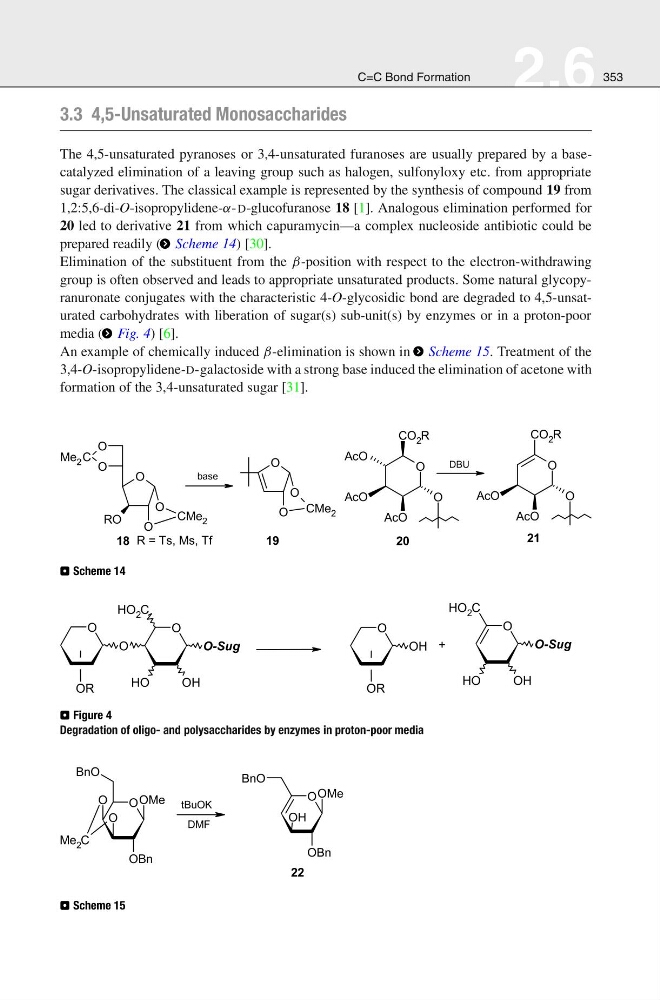
The 4,5-unsaturated pyranoses or 3,4-unsaturated furanoses are usually prepared by a basecatalyzed elimination of a leaving group such as halogen, sulfonyloxy etc. from appropriate
sugar derivatives. The classical example is represented by the synthesis of compound 19 from
1,2:5,6-di-O-isopropylidene-α-D-glucofuranose 18 [1]. Analogous elimination performed for
20 led to derivative 21 from which capuramycin—a complex nucleoside antibiotic could be
prepared readily ( > Scheme 14) [30].
Elimination of the substituent from the β-position with respect to the electron-withdrawing
group is often observed and leads to appropriate unsaturated products. Some natural glycopyranuronate conjugates with the characteristic 4-O-glycosidic bond are degraded to 4,5-unsaturated carbohydrates with liberation of sugar(s) sub-unit(s) by enzymes or in a proton-poor
media ( > Fig. 4) [6].
An example of chemically induced β-elimination is shown in > Scheme 15. Treatment of the
3,4-O-isopropylidene-D-galactoside with a strong base induced the elimination of acetone with
formation of the 3,4-unsaturated sugar [31].
⊡ Scheme 14
⊡ Figure 4
Degradation of oligo- and polysaccharides by enzymes in proton-poor media
⊡ Scheme 15
2.6
353
3.3 4,5-Unsaturated Monosaccharides
The 4,5-unsaturated pyranoses or 3,4-unsaturated furanoses are usually prepared by a basecatalyzed elimination of a leaving group such as halogen, sulfonyloxy etc. from appropriate
sugar derivatives. The classical example is represented by the synthesis of compound 19 from
1,2:5,6-di-O-isopropylidene-α-D-glucofuranose 18 [1]. Analogous elimination performed for
20 led to derivative 21 from which capuramycin—a complex nucleoside antibiotic could be
prepared readily ( > Scheme 14) [30].
Elimination of the substituent from the β-position with respect to the electron-withdrawing
group is often observed and leads to appropriate unsaturated products. Some natural glycopyranuronate conjugates with the characteristic 4-O-glycosidic bond are degraded to 4,5-unsaturated carbohydrates with liberation of sugar(s) sub-unit(s) by enzymes or in a proton-poor
media ( > Fig. 4) [6].
An example of chemically induced β-elimination is shown in > Scheme 15. Treatment of the
3,4-O-isopropylidene-D-galactoside with a strong base induced the elimination of acetone with
formation of the 3,4-unsaturated sugar [31].
⊡ Scheme 14
⊡ Figure 4
Degradation of oligo- and polysaccharides by enzymes in proton-poor media
⊡ Scheme 15