

352
2
General Synthetic Methods
3.2 3,4-Unsaturated Monosaccharides
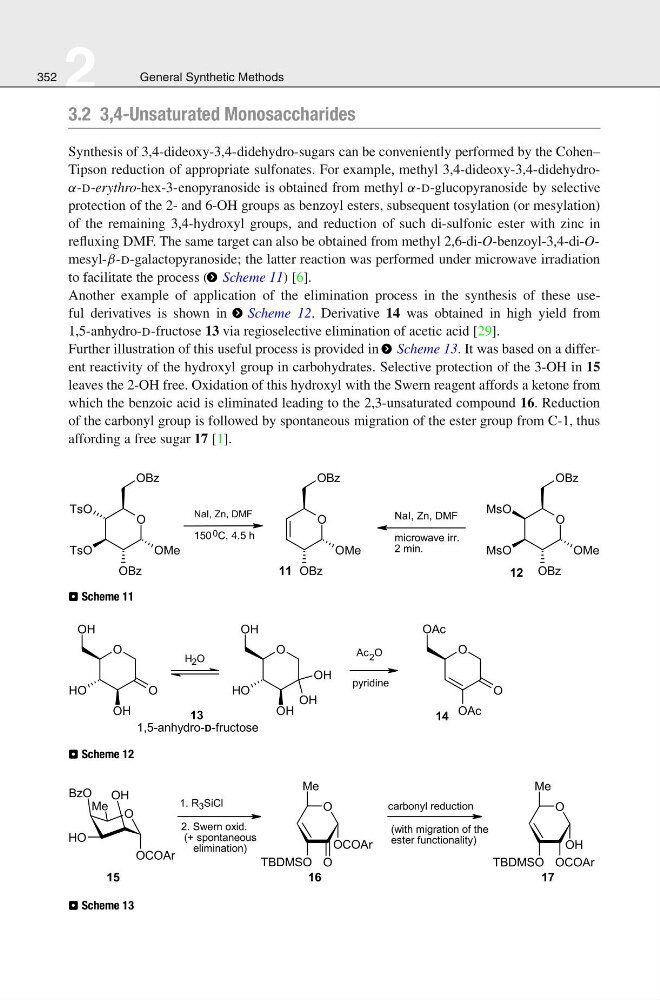
Synthesis of 3,4-dideoxy-3,4-didehydro-sugars can be conveniently performed by the Cohen–
Tipson reduction of appropriate sulfonates. For example, methyl 3,4-dideoxy-3,4-didehydroα-D-erythro-hex-3-enopyranoside is obtained from methyl α-D-glucopyranoside by selective
protection of the 2- and 6-OH groups as benzoyl esters, subsequent tosylation (or mesylation)
of the remaining 3,4-hydroxyl groups, and reduction of such di-sulfonic ester with zinc in
refluxing DMF. The same target can also be obtained from methyl 2,6-di-O-benzoyl-3,4-di-Omesyl-β-D-galactopyranoside; the latter reaction was performed under microwave irradiation
to facilitate the process ( > Scheme 11) [6].
Another example of application of the elimination process in the synthesis of these useful derivatives is shown in > Scheme 12. Derivative 14 was obtained in high yield from
1,5-anhydro-D-fructose 13 via regioselective elimination of acetic acid [29].
Further illustration of this useful process is provided in > Scheme 13. It was based on a different reactivity of the hydroxyl group in carbohydrates. Selective protection of the 3-OH in 15
leaves the 2-OH free. Oxidation of this hydroxyl with the Swern reagent affords a ketone from
which the benzoic acid is eliminated leading to the 2,3-unsaturated compound 16. Reduction
of the carbonyl group is followed by spontaneous migration of the ester group from C-1, thus
affording a free sugar 17 [1].
⊡ Scheme 11
⊡ Scheme 12
⊡ Scheme 13
2
General Synthetic Methods
3.2 3,4-Unsaturated Monosaccharides
Synthesis of 3,4-dideoxy-3,4-didehydro-sugars can be conveniently performed by the Cohen–
Tipson reduction of appropriate sulfonates. For example, methyl 3,4-dideoxy-3,4-didehydroα-D-erythro-hex-3-enopyranoside is obtained from methyl α-D-glucopyranoside by selective
protection of the 2- and 6-OH groups as benzoyl esters, subsequent tosylation (or mesylation)
of the remaining 3,4-hydroxyl groups, and reduction of such di-sulfonic ester with zinc in
refluxing DMF. The same target can also be obtained from methyl 2,6-di-O-benzoyl-3,4-di-Omesyl-β-D-galactopyranoside; the latter reaction was performed under microwave irradiation
to facilitate the process ( > Scheme 11) [6].
Another example of application of the elimination process in the synthesis of these useful derivatives is shown in > Scheme 12. Derivative 14 was obtained in high yield from
1,5-anhydro-D-fructose 13 via regioselective elimination of acetic acid [29].
Further illustration of this useful process is provided in > Scheme 13. It was based on a different reactivity of the hydroxyl group in carbohydrates. Selective protection of the 3-OH in 15
leaves the 2-OH free. Oxidation of this hydroxyl with the Swern reagent affords a ketone from
which the benzoic acid is eliminated leading to the 2,3-unsaturated compound 16. Reduction
of the carbonyl group is followed by spontaneous migration of the ester group from C-1, thus
affording a free sugar 17 [1].
⊡ Scheme 11
⊡ Scheme 12
⊡ Scheme 13