

C=C Bond Formation
2.6
351
⊡ Scheme 8
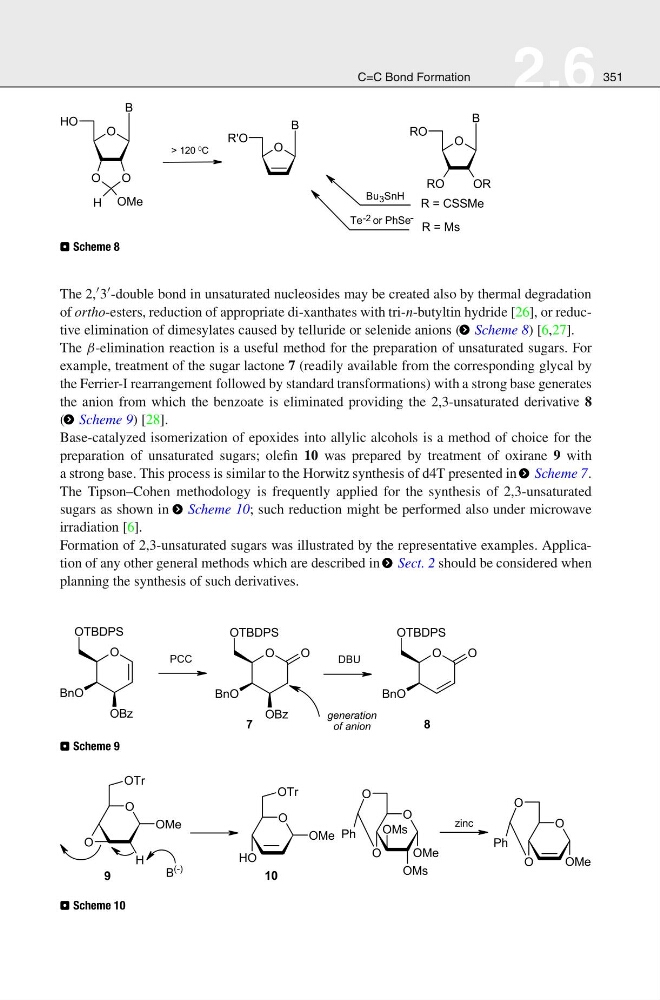
The 2, 3 -double bond in unsaturated nucleosides may be created also by thermal degradation
of ortho-esters, reduction of appropriate di-xanthates with tri-n-butyltin hydride [26], or reductive elimination of dimesylates caused by telluride or selenide anions ( > Scheme 8) [6,27].
The β-elimination reaction is a useful method for the preparation of unsaturated sugars. For
example, treatment of the sugar lactone 7 (readily available from the corresponding glycal by
the Ferrier-I rearrangement followed by standard transformations) with a strong base generates
the anion from which the benzoate is eliminated providing the 2,3-unsaturated derivative 8
( > Scheme 9) [28].
Base-catalyzed isomerization of epoxides into allylic alcohols is a method of choice for the
preparation of unsaturated sugars; olefin 10 was prepared by treatment of oxirane 9 with
a strong base. This process is similar to the Horwitz synthesis of d4T presented in > Scheme 7.
The Tipson–Cohen methodology is frequently applied for the synthesis of 2,3-unsaturated
sugars as shown in > Scheme 10; such reduction might be performed also under microwave
irradiation [6].
Formation of 2,3-unsaturated sugars was illustrated by the representative examples. Application of any other general methods which are described in > Sect. 2 should be considered when
planning the synthesis of such derivatives.
⊡ Scheme 9
⊡ Scheme 10
2.6
351
⊡ Scheme 8
The 2, 3 -double bond in unsaturated nucleosides may be created also by thermal degradation
of ortho-esters, reduction of appropriate di-xanthates with tri-n-butyltin hydride [26], or reductive elimination of dimesylates caused by telluride or selenide anions ( > Scheme 8) [6,27].
The β-elimination reaction is a useful method for the preparation of unsaturated sugars. For
example, treatment of the sugar lactone 7 (readily available from the corresponding glycal by
the Ferrier-I rearrangement followed by standard transformations) with a strong base generates
the anion from which the benzoate is eliminated providing the 2,3-unsaturated derivative 8
( > Scheme 9) [28].
Base-catalyzed isomerization of epoxides into allylic alcohols is a method of choice for the
preparation of unsaturated sugars; olefin 10 was prepared by treatment of oxirane 9 with
a strong base. This process is similar to the Horwitz synthesis of d4T presented in > Scheme 7.
The Tipson–Cohen methodology is frequently applied for the synthesis of 2,3-unsaturated
sugars as shown in > Scheme 10; such reduction might be performed also under microwave
irradiation [6].
Formation of 2,3-unsaturated sugars was illustrated by the representative examples. Application of any other general methods which are described in > Sect. 2 should be considered when
planning the synthesis of such derivatives.
⊡ Scheme 9
⊡ Scheme 10