

350
2
General Synthetic Methods
3 Monosaccharides with the Endocyclic Double Bond
In this section the selected and most representative examples (including also several older
ones) of the preparation of unsaturated monosaccharides with the double bond present in the
sugar ring will be described. The material will be divided into three main classes: 2,3-, 3,4-,
and 4,5-unsaturated sugars in both pyranose and furanose form.
3.1 2,3-Unsaturated Monosaccharides
One of the most convenient methods for the synthesis of 2,3-unsaturated sugars is the socalled Ferrier-I rearrangement of glycals ( > Scheme 6). This reaction allows one to obtain the
unsaturated targets via the process in which the double bond migrates from the C1–C2 to the
C2–C3 position [1,2,4,5,11].
⊡ Scheme 6
It is not concerned, therefore, with the formation of the double bond and this process will be
described in more detail in > Sect. 3.4 (rearrangement).
In this section only the direct synthesis of 2,3-unsaturated sugars, in which the double bond
is created will be presented. Numerous syntheses of these valuable compounds have been
described in the literature. One of the most important classes of such derivatives are 2, 3 -
dideoxy-2, 3 -didehydronucleosides which possess a broad spectrum of biological activity.
Two different approaches to 2, 3 -dideoxy-2, 3 -didehydro-thymidine (d4T) illustrate the general methodology of their preparation.
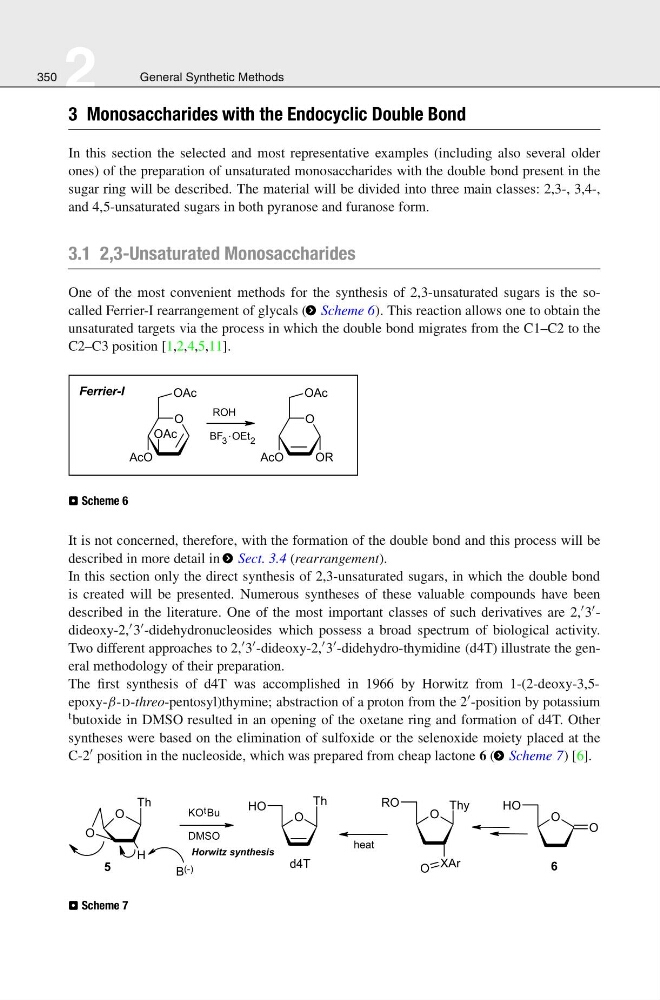
The first synthesis of d4T was accomplished in 1966 by Horwitz from 1-(2-deoxy-3,5epoxy-β-D-threo-pentosyl)thymine; abstraction of a proton from the 2 -position by potassium
t butoxide in DMSO resulted in an opening of the oxetane ring and formation of d4T. Other
syntheses were based on the elimination of sulfoxide or the selenoxide moiety placed at the
C-2 position in the nucleoside, which was prepared from cheap lactone 6 ( > Scheme 7) [6].
⊡ Scheme 7
2
General Synthetic Methods
3 Monosaccharides with the Endocyclic Double Bond
In this section the selected and most representative examples (including also several older
ones) of the preparation of unsaturated monosaccharides with the double bond present in the
sugar ring will be described. The material will be divided into three main classes: 2,3-, 3,4-,
and 4,5-unsaturated sugars in both pyranose and furanose form.
3.1 2,3-Unsaturated Monosaccharides
One of the most convenient methods for the synthesis of 2,3-unsaturated sugars is the socalled Ferrier-I rearrangement of glycals ( > Scheme 6). This reaction allows one to obtain the
unsaturated targets via the process in which the double bond migrates from the C1–C2 to the
C2–C3 position [1,2,4,5,11].
⊡ Scheme 6
It is not concerned, therefore, with the formation of the double bond and this process will be
described in more detail in > Sect. 3.4 (rearrangement).
In this section only the direct synthesis of 2,3-unsaturated sugars, in which the double bond
is created will be presented. Numerous syntheses of these valuable compounds have been
described in the literature. One of the most important classes of such derivatives are 2, 3 -
dideoxy-2, 3 -didehydronucleosides which possess a broad spectrum of biological activity.
Two different approaches to 2, 3 -dideoxy-2, 3 -didehydro-thymidine (d4T) illustrate the general methodology of their preparation.
The first synthesis of d4T was accomplished in 1966 by Horwitz from 1-(2-deoxy-3,5epoxy-β-D-threo-pentosyl)thymine; abstraction of a proton from the 2 -position by potassium
t butoxide in DMSO resulted in an opening of the oxetane ring and formation of d4T. Other
syntheses were based on the elimination of sulfoxide or the selenoxide moiety placed at the
C-2 position in the nucleoside, which was prepared from cheap lactone 6 ( > Scheme 7) [6].
⊡ Scheme 7