

C=C Bond Formation
2.6
349
⊡ Scheme 4
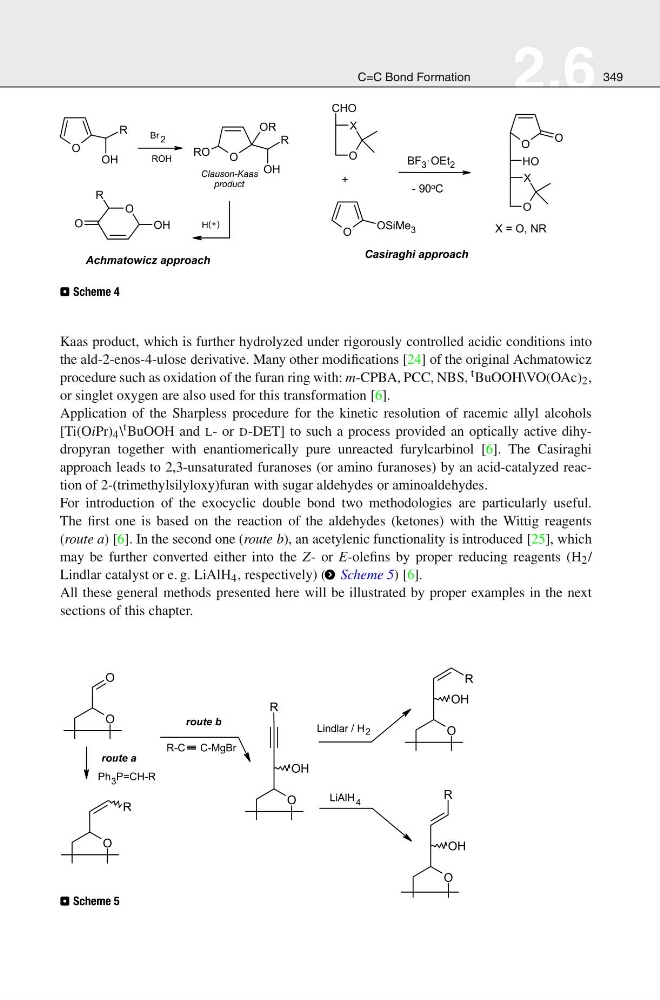
Kaas product, which is further hydrolyzed under rigorously controlled acidic conditions into
the ald-2-enos-4-ulose derivative. Many other modifications [24] of the original Achmatowicz
procedure such as oxidation of the furan ring with: m-CPBA, PCC, NBS, t BuOOH\VO(OAc) 2 ,
or singlet oxygen are also used for this transformation [6].
Application of the Sharpless procedure for the kinetic resolution of racemic allyl alcohols
[Ti(OiPr) 4 \ t BuOOH and L- or D-DET] to such a process provided an optically active dihydropyran together with enantiomerically pure unreacted furylcarbinol [6]. The Casiraghi
approach leads to 2,3-unsaturated furanoses (or amino furanoses) by an acid-catalyzed reaction of 2-(trimethylsilyloxy)furan with sugar aldehydes or aminoaldehydes.
For introduction of the exocyclic double bond two methodologies are particularly useful.
The first one is based on the reaction of the aldehydes (ketones) with the Wittig reagents
(route a) [6]. In the second one (route b), an acetylenic functionality is introduced [25], which
may be further converted either into the Z- or E-olefins by proper reducing reagents (H 2 /
Lindlar catalyst or e. g. LiAlH 4 , respectively) ( > Scheme 5) [6].
All these general methods presented here will be illustrated by proper examples in the next
sections of this chapter.
⊡ Scheme 5
2.6
349
⊡ Scheme 4
Kaas product, which is further hydrolyzed under rigorously controlled acidic conditions into
the ald-2-enos-4-ulose derivative. Many other modifications [24] of the original Achmatowicz
procedure such as oxidation of the furan ring with: m-CPBA, PCC, NBS, t BuOOH\VO(OAc) 2 ,
or singlet oxygen are also used for this transformation [6].
Application of the Sharpless procedure for the kinetic resolution of racemic allyl alcohols
[Ti(OiPr) 4 \ t BuOOH and L- or D-DET] to such a process provided an optically active dihydropyran together with enantiomerically pure unreacted furylcarbinol [6]. The Casiraghi
approach leads to 2,3-unsaturated furanoses (or amino furanoses) by an acid-catalyzed reaction of 2-(trimethylsilyloxy)furan with sugar aldehydes or aminoaldehydes.
For introduction of the exocyclic double bond two methodologies are particularly useful.
The first one is based on the reaction of the aldehydes (ketones) with the Wittig reagents
(route a) [6]. In the second one (route b), an acetylenic functionality is introduced [25], which
may be further converted either into the Z- or E-olefins by proper reducing reagents (H 2 /
Lindlar catalyst or e. g. LiAlH 4 , respectively) ( > Scheme 5) [6].
All these general methods presented here will be illustrated by proper examples in the next
sections of this chapter.
⊡ Scheme 5