

356
2
General Synthetic Methods
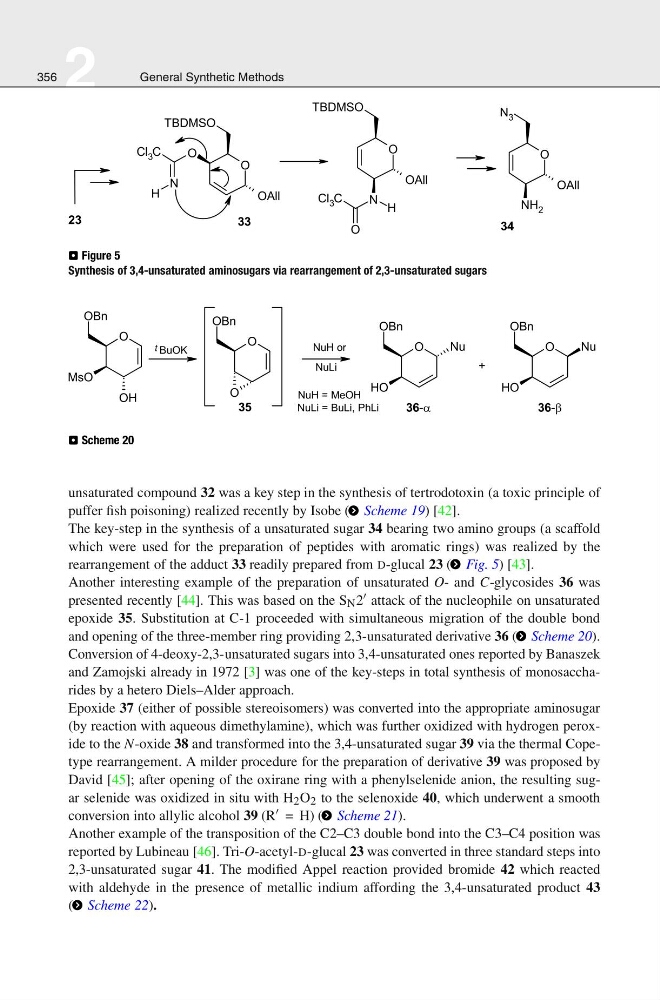
⊡ Figure 5
Synthesis of 3,4-unsaturated aminosugars via rearrangement of 2,3-unsaturated sugars
⊡ Scheme 20
unsaturated compound 32 was a key step in the synthesis of tertrodotoxin (a toxic principle of
puffer fish poisoning) realized recently by Isobe ( > Scheme 19) [42].
The key-step in the synthesis of a unsaturated sugar 34 bearing two amino groups (a scaffold
which were used for the preparation of peptides with aromatic rings) was realized by the
rearrangement of the adduct 33 readily prepared from D-glucal 23 ( > Fig. 5) [43].
Another interesting example of the preparation of unsaturated O- and C-glycosides 36 was
presented recently [44]. This was based on the S N 2 attack of the nucleophile on unsaturated
epoxide 35. Substitution at C-1 proceeded with simultaneous migration of the double bond
and opening of the three-member ring providing 2,3-unsaturated derivative 36 ( > Scheme 20).
Conversion of 4-deoxy-2,3-unsaturated sugars into 3,4-unsaturated ones reported by Banaszek
and Zamojski already in 1972 [3] was one of the key-steps in total synthesis of monosaccharides by a hetero Diels–Alder approach.
Epoxide 37 (either of possible stereoisomers) was converted into the appropriate aminosugar
(by reaction with aqueous dimethylamine), which was further oxidized with hydrogen peroxide to the N-oxide 38 and transformed into the 3,4-unsaturated sugar 39 via the thermal Copetype rearrangement. A milder procedure for the preparation of derivative 39 was proposed by
David [45]; after opening of the oxirane ring with a phenylselenide anion, the resulting sugar selenide was oxidized in situ with H 2 O 2 to the selenoxide 40, which underwent a smooth
conversion into allylic alcohol 39 (R = H) ( > Scheme 21).
Another example of the transposition of the C2–C3 double bond into the C3–C4 position was
reported by Lubineau [46]. Tri-O-acetyl-D-glucal 23 was converted in three standard steps into
2,3-unsaturated sugar 41. The modified Appel reaction provided bromide 42 which reacted
with aldehyde in the presence of metallic indium affording the 3,4-unsaturated product 43
( > Scheme 22).
2
General Synthetic Methods
⊡ Figure 5
Synthesis of 3,4-unsaturated aminosugars via rearrangement of 2,3-unsaturated sugars
⊡ Scheme 20
unsaturated compound 32 was a key step in the synthesis of tertrodotoxin (a toxic principle of
puffer fish poisoning) realized recently by Isobe ( > Scheme 19) [42].
The key-step in the synthesis of a unsaturated sugar 34 bearing two amino groups (a scaffold
which were used for the preparation of peptides with aromatic rings) was realized by the
rearrangement of the adduct 33 readily prepared from D-glucal 23 ( > Fig. 5) [43].
Another interesting example of the preparation of unsaturated O- and C-glycosides 36 was
presented recently [44]. This was based on the S N 2 attack of the nucleophile on unsaturated
epoxide 35. Substitution at C-1 proceeded with simultaneous migration of the double bond
and opening of the three-member ring providing 2,3-unsaturated derivative 36 ( > Scheme 20).
Conversion of 4-deoxy-2,3-unsaturated sugars into 3,4-unsaturated ones reported by Banaszek
and Zamojski already in 1972 [3] was one of the key-steps in total synthesis of monosaccharides by a hetero Diels–Alder approach.
Epoxide 37 (either of possible stereoisomers) was converted into the appropriate aminosugar
(by reaction with aqueous dimethylamine), which was further oxidized with hydrogen peroxide to the N-oxide 38 and transformed into the 3,4-unsaturated sugar 39 via the thermal Copetype rearrangement. A milder procedure for the preparation of derivative 39 was proposed by
David [45]; after opening of the oxirane ring with a phenylselenide anion, the resulting sugar selenide was oxidized in situ with H 2 O 2 to the selenoxide 40, which underwent a smooth
conversion into allylic alcohol 39 (R = H) ( > Scheme 21).
Another example of the transposition of the C2–C3 double bond into the C3–C4 position was
reported by Lubineau [46]. Tri-O-acetyl-D-glucal 23 was converted in three standard steps into
2,3-unsaturated sugar 41. The modified Appel reaction provided bromide 42 which reacted
with aldehyde in the presence of metallic indium affording the 3,4-unsaturated product 43
( > Scheme 22).