

338
2
General Synthetic Methods
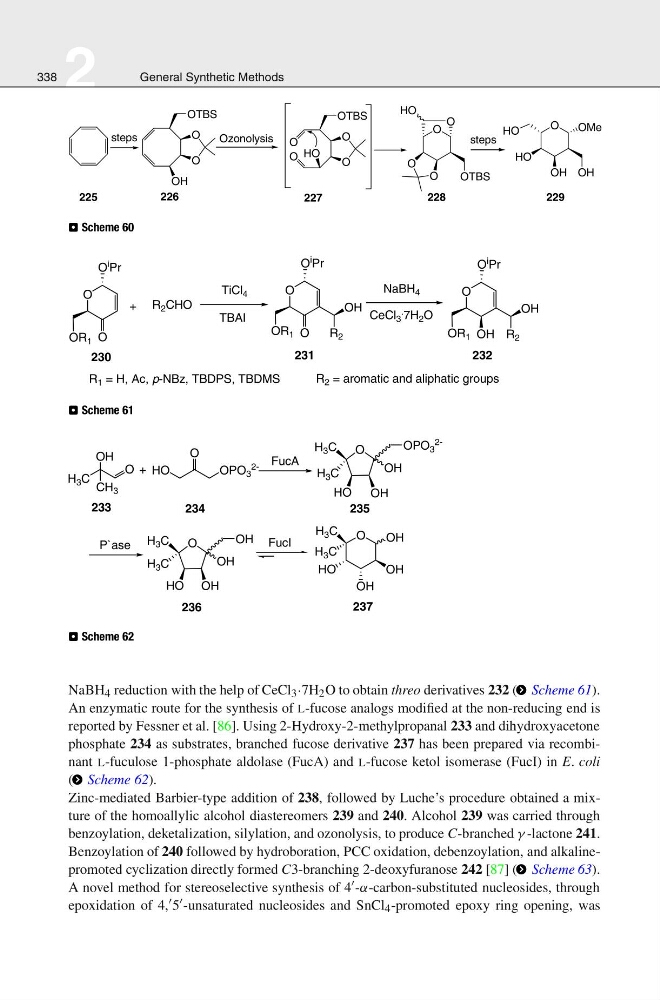
⊡ Scheme 60
⊡ Scheme 61
⊡ Scheme 62
NaBH 4 reduction with the help of CeCl 3 ·7H 2 O to obtain threo derivatives 232 ( > Scheme 61).
An enzymatic route for the synthesis of L-fucose analogs modified at the non-reducing end is
reported by Fessner et al. [86]. Using 2-Hydroxy-2-methylpropanal 233 and dihydroxyacetone
phosphate 234 as substrates, branched fucose derivative 237 has been prepared via recombinant L-fuculose 1-phosphate aldolase (FucA) and L-fucose ketol isomerase (FucI) in E. coli
( > Scheme 62).
Zinc-mediated Barbier-type addition of 238, followed by Luche’s procedure obtained a mixture of the homoallylic alcohol diastereomers 239 and 240. Alcohol 239 was carried through
benzoylation, deketalization, silylation, and ozonolysis, to produce C-branched γ -lactone 241.
Benzoylation of 240 followed by hydroboration, PCC oxidation, debenzoylation, and alkalinepromoted cyclization directly formed C3-branching 2-deoxyfuranose 242 [87] ( > Scheme 63).
A novel method for stereoselective synthesis of 4 -α-carbon-substituted nucleosides, through
epoxidation of 4, 5 -unsaturated nucleosides and SnCl 4 -promoted epoxy ring opening, was
2
General Synthetic Methods
⊡ Scheme 60
⊡ Scheme 61
⊡ Scheme 62
NaBH 4 reduction with the help of CeCl 3 ·7H 2 O to obtain threo derivatives 232 ( > Scheme 61).
An enzymatic route for the synthesis of L-fucose analogs modified at the non-reducing end is
reported by Fessner et al. [86]. Using 2-Hydroxy-2-methylpropanal 233 and dihydroxyacetone
phosphate 234 as substrates, branched fucose derivative 237 has been prepared via recombinant L-fuculose 1-phosphate aldolase (FucA) and L-fucose ketol isomerase (FucI) in E. coli
( > Scheme 62).
Zinc-mediated Barbier-type addition of 238, followed by Luche’s procedure obtained a mixture of the homoallylic alcohol diastereomers 239 and 240. Alcohol 239 was carried through
benzoylation, deketalization, silylation, and ozonolysis, to produce C-branched γ -lactone 241.
Benzoylation of 240 followed by hydroboration, PCC oxidation, debenzoylation, and alkalinepromoted cyclization directly formed C3-branching 2-deoxyfuranose 242 [87] ( > Scheme 63).
A novel method for stereoselective synthesis of 4 -α-carbon-substituted nucleosides, through
epoxidation of 4, 5 -unsaturated nucleosides and SnCl 4 -promoted epoxy ring opening, was