

C–C Bond Formation
2.5
339
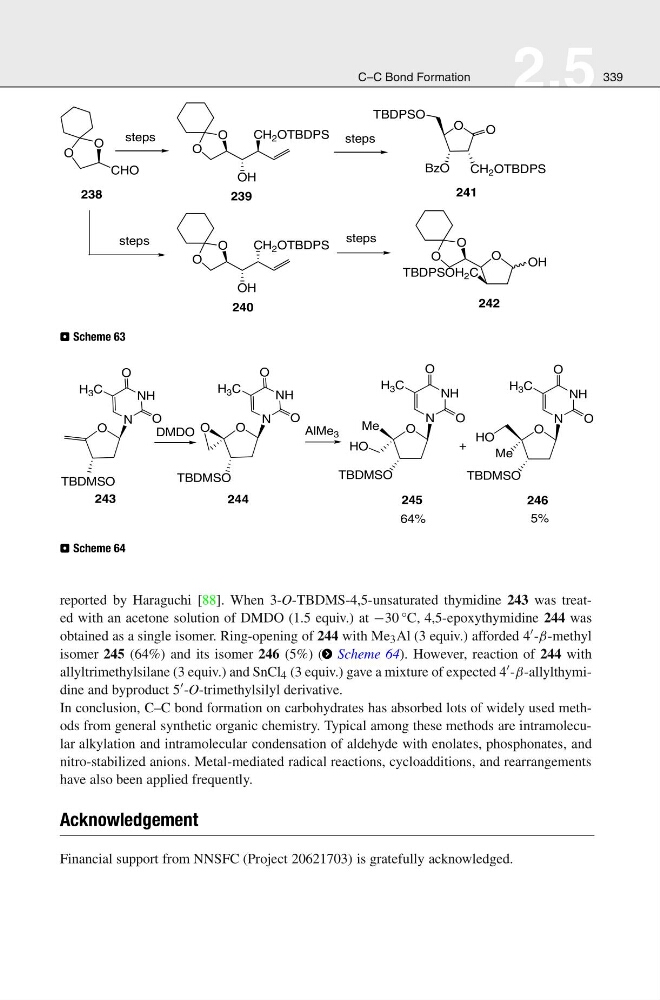
⊡ Scheme 63
⊡ Scheme 64
reported by Haraguchi [88]. When 3-O-TBDMS-4,5-unsaturated thymidine 243 was treated with an acetone solution of DMDO (1.5 equiv.) at −30 °C, 4,5-epoxythymidine 244 was
obtained as a single isomer. Ring-opening of 244 with Me 3 Al (3 equiv.) afforded 4 -β-methyl
isomer 245 (64%) and its isomer 246 (5%) ( > Scheme 64). However, reaction of 244 with
allyltrimethylsilane (3 equiv.) and SnCl 4 (3 equiv.) gave a mixture of expected 4 -β-allylthymidine and byproduct 5 -O-trimethylsilyl derivative.
In conclusion, C–C bond formation on carbohydrates has absorbed lots of widely used methods from general synthetic organic chemistry. Typical among these methods are intramolecular alkylation and intramolecular condensation of aldehyde with enolates, phosphonates, and
nitro-stabilized anions. Metal-mediated radical reactions, cycloadditions, and rearrangements
have also been applied frequently.
Acknowledgement
Financial support from NNSFC (Project 20621703) is gratefully acknowledged.
2.5
339
⊡ Scheme 63
⊡ Scheme 64
reported by Haraguchi [88]. When 3-O-TBDMS-4,5-unsaturated thymidine 243 was treated with an acetone solution of DMDO (1.5 equiv.) at −30 °C, 4,5-epoxythymidine 244 was
obtained as a single isomer. Ring-opening of 244 with Me 3 Al (3 equiv.) afforded 4 -β-methyl
isomer 245 (64%) and its isomer 246 (5%) ( > Scheme 64). However, reaction of 244 with
allyltrimethylsilane (3 equiv.) and SnCl 4 (3 equiv.) gave a mixture of expected 4 -β-allylthymidine and byproduct 5 -O-trimethylsilyl derivative.
In conclusion, C–C bond formation on carbohydrates has absorbed lots of widely used methods from general synthetic organic chemistry. Typical among these methods are intramolecular alkylation and intramolecular condensation of aldehyde with enolates, phosphonates, and
nitro-stabilized anions. Metal-mediated radical reactions, cycloadditions, and rearrangements
have also been applied frequently.
Acknowledgement
Financial support from NNSFC (Project 20621703) is gratefully acknowledged.