

C–C Bond Formation
2.5
337
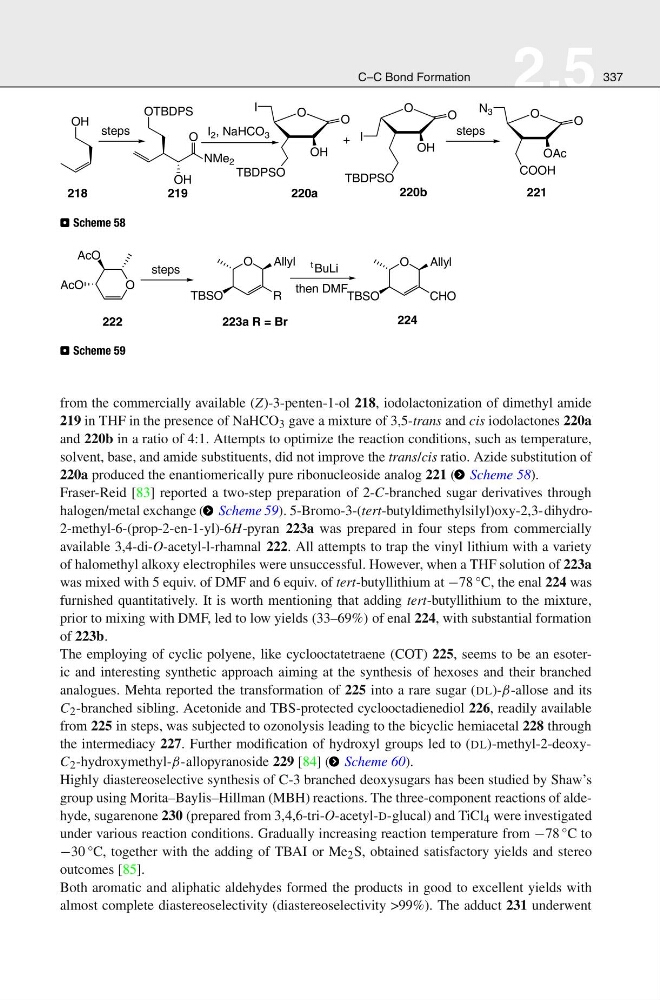
⊡ Scheme 58
⊡ Scheme 59
from the commercially available (Z)-3-penten-1-ol 218, iodolactonization of dimethyl amide
219 in THF in the presence of NaHCO 3 gave a mixture of 3,5-trans and cis iodolactones 220a
and 220b in a ratio of 4:1. Attempts to optimize the reaction conditions, such as temperature,
solvent, base, and amide substituents, did not improve the trans/cis ratio. Azide substitution of
220a produced the enantiomerically pure ribonucleoside analog 221 ( > Scheme 58).
Fraser-Reid [83] reported a two-step preparation of 2-C-branched sugar derivatives through
halogen/metal exchange ( > Scheme 59). 5-Bromo-3-(tert-butyldimethylsilyl)oxy-2,3-dihydro2-methyl-6-(prop-2-en-1-yl)-6H-pyran 223a was prepared in four steps from commercially
available 3,4-di-O-acetyl-l-rhamnal 222. All attempts to trap the vinyl lithium with a variety
of halomethyl alkoxy electrophiles were unsuccessful. However, when a THF solution of 223a
was mixed with 5 equiv. of DMF and 6 equiv. of tert-butyllithium at −78 °C, the enal 224 was
furnished quantitatively. It is worth mentioning that adding tert-butyllithium to the mixture,
prior to mixing with DMF, led to low yields (33–69%) of enal 224, with substantial formation
of 223b.
The employing of cyclic polyene, like cyclooctatetraene (COT) 225, seems to be an esoteric and interesting synthetic approach aiming at the synthesis of hexoses and their branched
analogues. Mehta reported the transformation of 225 into a rare sugar (DL)-β-allose and its
C 2 -branched sibling. Acetonide and TBS-protected cyclooctadienediol 226, readily available
from 225 in steps, was subjected to ozonolysis leading to the bicyclic hemiacetal 228 through
the intermediacy 227. Further modification of hydroxyl groups led to (DL)-methyl-2-deoxyC 2 -hydroxymethyl-β-allopyranoside 229 [84] ( > Scheme 60).
Highly diastereoselective synthesis of C-3 branched deoxysugars has been studied by Shaw’s
group using Morita–Baylis–Hillman (MBH) reactions. The three-component reactions of aldehyde, sugarenone 230 (prepared from 3,4,6-tri-O-acetyl-D-glucal) and TiCl 4 were investigated
under various reaction conditions. Gradually increasing reaction temperature from −78 °C to
−30 °C, together with the adding of TBAI or Me 2 S, obtained satisfactory yields and stereo
outcomes [85].
Both aromatic and aliphatic aldehydes formed the products in good to excellent yields with
almost complete diastereoselectivity (diastereoselectivity >99%). The adduct 231 underwent
2.5
337
⊡ Scheme 58
⊡ Scheme 59
from the commercially available (Z)-3-penten-1-ol 218, iodolactonization of dimethyl amide
219 in THF in the presence of NaHCO 3 gave a mixture of 3,5-trans and cis iodolactones 220a
and 220b in a ratio of 4:1. Attempts to optimize the reaction conditions, such as temperature,
solvent, base, and amide substituents, did not improve the trans/cis ratio. Azide substitution of
220a produced the enantiomerically pure ribonucleoside analog 221 ( > Scheme 58).
Fraser-Reid [83] reported a two-step preparation of 2-C-branched sugar derivatives through
halogen/metal exchange ( > Scheme 59). 5-Bromo-3-(tert-butyldimethylsilyl)oxy-2,3-dihydro2-methyl-6-(prop-2-en-1-yl)-6H-pyran 223a was prepared in four steps from commercially
available 3,4-di-O-acetyl-l-rhamnal 222. All attempts to trap the vinyl lithium with a variety
of halomethyl alkoxy electrophiles were unsuccessful. However, when a THF solution of 223a
was mixed with 5 equiv. of DMF and 6 equiv. of tert-butyllithium at −78 °C, the enal 224 was
furnished quantitatively. It is worth mentioning that adding tert-butyllithium to the mixture,
prior to mixing with DMF, led to low yields (33–69%) of enal 224, with substantial formation
of 223b.
The employing of cyclic polyene, like cyclooctatetraene (COT) 225, seems to be an esoteric and interesting synthetic approach aiming at the synthesis of hexoses and their branched
analogues. Mehta reported the transformation of 225 into a rare sugar (DL)-β-allose and its
C 2 -branched sibling. Acetonide and TBS-protected cyclooctadienediol 226, readily available
from 225 in steps, was subjected to ozonolysis leading to the bicyclic hemiacetal 228 through
the intermediacy 227. Further modification of hydroxyl groups led to (DL)-methyl-2-deoxyC 2 -hydroxymethyl-β-allopyranoside 229 [84] ( > Scheme 60).
Highly diastereoselective synthesis of C-3 branched deoxysugars has been studied by Shaw’s
group using Morita–Baylis–Hillman (MBH) reactions. The three-component reactions of aldehyde, sugarenone 230 (prepared from 3,4,6-tri-O-acetyl-D-glucal) and TiCl 4 were investigated
under various reaction conditions. Gradually increasing reaction temperature from −78 °C to
−30 °C, together with the adding of TBAI or Me 2 S, obtained satisfactory yields and stereo
outcomes [85].
Both aromatic and aliphatic aldehydes formed the products in good to excellent yields with
almost complete diastereoselectivity (diastereoselectivity >99%). The adduct 231 underwent