

336
2
General Synthetic Methods
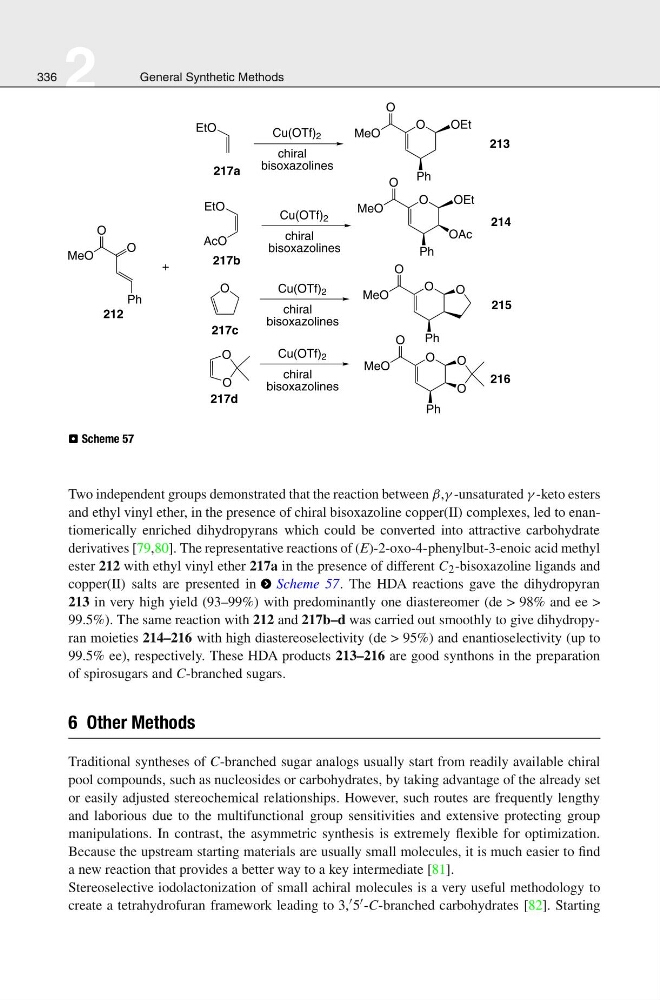
⊡ Scheme 57
Two independent groups demonstrated that the reaction between β,γ -unsaturated γ -keto esters
and ethyl vinyl ether, in the presence of chiral bisoxazoline copper(II) complexes, led to enantiomerically enriched dihydropyrans which could be converted into attractive carbohydrate
derivatives [79,80]. The representative reactions of (E)-2-oxo-4-phenylbut-3-enoic acid methyl
ester 212 with ethyl vinyl ether 217a in the presence of different C 2 -bisoxazoline ligands and
copper(II) salts are presented in > Scheme 57. The HDA reactions gave the dihydropyran
213 in very high yield (93–99%) with predominantly one diastereomer (de > 98% and ee >
99.5%). The same reaction with 212 and 217b–d was carried out smoothly to give dihydropyran moieties 214–216 with high diastereoselectivity (de > 95%) and enantioselectivity (up to
99.5% ee), respectively. These HDA products 213–216 are good synthons in the preparation
of spirosugars and C-branched sugars.
6 Other Methods
Traditional syntheses of C-branched sugar analogs usually start from readily available chiral
pool compounds, such as nucleosides or carbohydrates, by taking advantage of the already set
or easily adjusted stereochemical relationships. However, such routes are frequently lengthy
and laborious due to the multifunctional group sensitivities and extensive protecting group
manipulations. In contrast, the asymmetric synthesis is extremely flexible for optimization.
Because the upstream starting materials are usually small molecules, it is much easier to find
a new reaction that provides a better way to a key intermediate [81].
Stereoselective iodolactonization of small achiral molecules is a very useful methodology to
create a tetrahydrofuran framework leading to 3, 5 -C-branched carbohydrates [82]. Starting
2
General Synthetic Methods
⊡ Scheme 57
Two independent groups demonstrated that the reaction between β,γ -unsaturated γ -keto esters
and ethyl vinyl ether, in the presence of chiral bisoxazoline copper(II) complexes, led to enantiomerically enriched dihydropyrans which could be converted into attractive carbohydrate
derivatives [79,80]. The representative reactions of (E)-2-oxo-4-phenylbut-3-enoic acid methyl
ester 212 with ethyl vinyl ether 217a in the presence of different C 2 -bisoxazoline ligands and
copper(II) salts are presented in > Scheme 57. The HDA reactions gave the dihydropyran
213 in very high yield (93–99%) with predominantly one diastereomer (de > 98% and ee >
99.5%). The same reaction with 212 and 217b–d was carried out smoothly to give dihydropyran moieties 214–216 with high diastereoselectivity (de > 95%) and enantioselectivity (up to
99.5% ee), respectively. These HDA products 213–216 are good synthons in the preparation
of spirosugars and C-branched sugars.
6 Other Methods
Traditional syntheses of C-branched sugar analogs usually start from readily available chiral
pool compounds, such as nucleosides or carbohydrates, by taking advantage of the already set
or easily adjusted stereochemical relationships. However, such routes are frequently lengthy
and laborious due to the multifunctional group sensitivities and extensive protecting group
manipulations. In contrast, the asymmetric synthesis is extremely flexible for optimization.
Because the upstream starting materials are usually small molecules, it is much easier to find
a new reaction that provides a better way to a key intermediate [81].
Stereoselective iodolactonization of small achiral molecules is a very useful methodology to
create a tetrahydrofuran framework leading to 3, 5 -C-branched carbohydrates [82]. Starting