

C–C Bond Formation
2.5
335
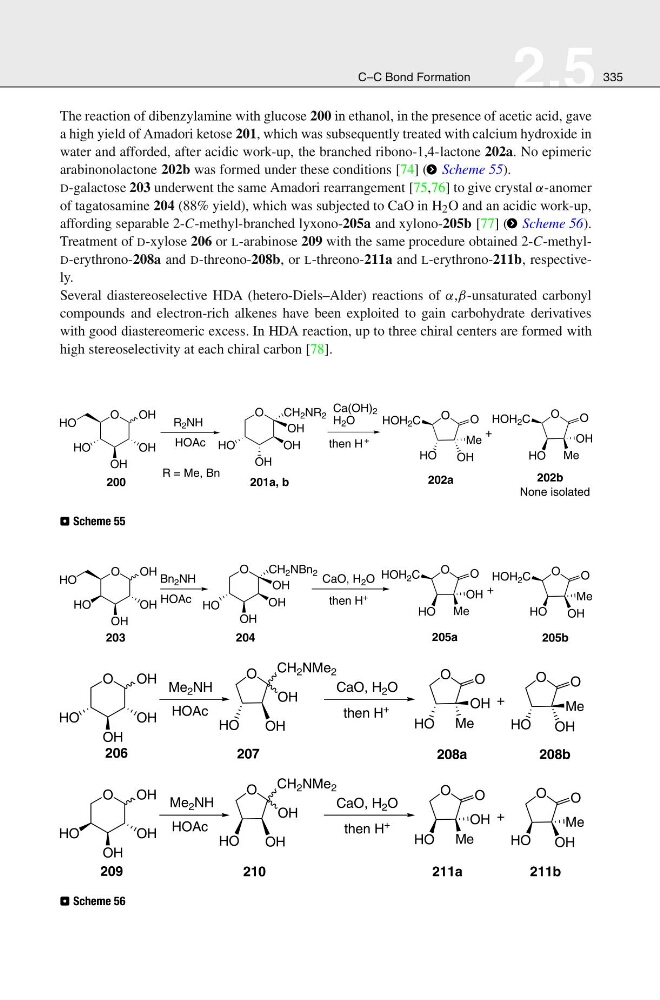
The reaction of dibenzylamine with glucose 200 in ethanol, in the presence of acetic acid, gave
a high yield of Amadori ketose 201, which was subsequently treated with calcium hydroxide in
water and afforded, after acidic work-up, the branched ribono-1,4-lactone 202a. No epimeric
arabinonolactone 202b was formed under these conditions [74] ( > Scheme 55).
D-galactose 203 underwent the same Amadori rearrangement [75,76] to give crystal α-anomer
of tagatosamine 204 (88% yield), which was subjected to CaO in H 2 O and an acidic work-up,
affording separable 2-C-methyl-branched lyxono-205a and xylono-205b [77] ( > Scheme 56).
Treatment of D-xylose 206 or L-arabinose 209 with the same procedure obtained 2-C-methylD-erythrono-208a and D-threono-208b, or L-threono-211a and L-erythrono-211b, respectively.
Several diastereoselective HDA (hetero-Diels–Alder) reactions of α,β-unsaturated carbonyl
compounds and electron-rich alkenes have been exploited to gain carbohydrate derivatives
with good diastereomeric excess. In HDA reaction, up to three chiral centers are formed with
high stereoselectivity at each chiral carbon [78].
⊡ Scheme 55
⊡ Scheme 56
2.5
335
The reaction of dibenzylamine with glucose 200 in ethanol, in the presence of acetic acid, gave
a high yield of Amadori ketose 201, which was subsequently treated with calcium hydroxide in
water and afforded, after acidic work-up, the branched ribono-1,4-lactone 202a. No epimeric
arabinonolactone 202b was formed under these conditions [74] ( > Scheme 55).
D-galactose 203 underwent the same Amadori rearrangement [75,76] to give crystal α-anomer
of tagatosamine 204 (88% yield), which was subjected to CaO in H 2 O and an acidic work-up,
affording separable 2-C-methyl-branched lyxono-205a and xylono-205b [77] ( > Scheme 56).
Treatment of D-xylose 206 or L-arabinose 209 with the same procedure obtained 2-C-methylD-erythrono-208a and D-threono-208b, or L-threono-211a and L-erythrono-211b, respectively.
Several diastereoselective HDA (hetero-Diels–Alder) reactions of α,β-unsaturated carbonyl
compounds and electron-rich alkenes have been exploited to gain carbohydrate derivatives
with good diastereomeric excess. In HDA reaction, up to three chiral centers are formed with
high stereoselectivity at each chiral carbon [78].
⊡ Scheme 55
⊡ Scheme 56