

C–C Bond Formation
2.5
329
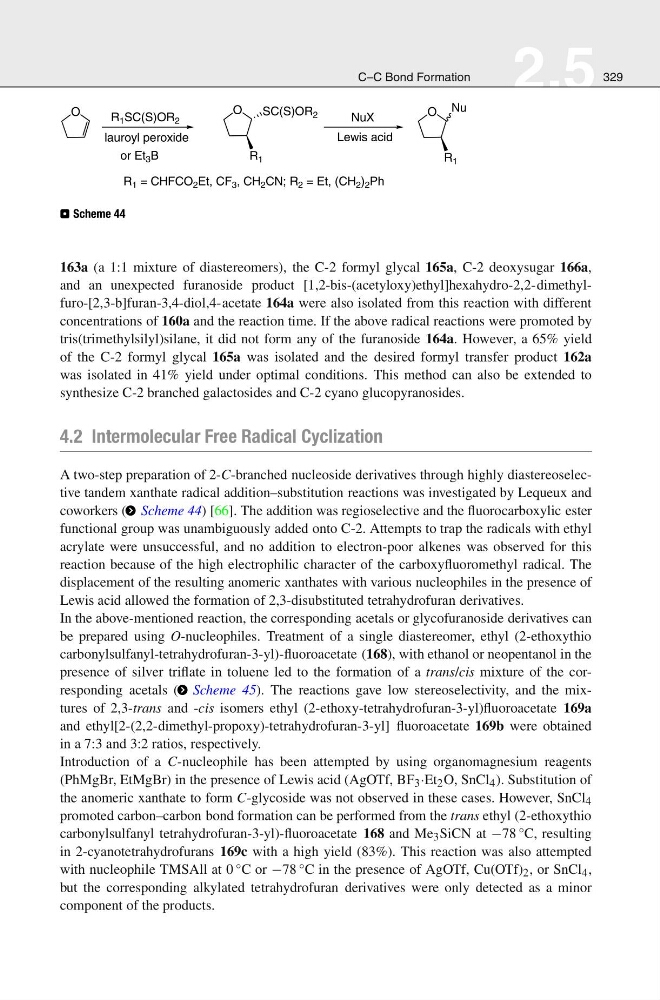
⊡ Scheme 44
163a (a 1:1 mixture of diastereomers), the C-2 formyl glycal 165a, C-2 deoxysugar 166a,
and an unexpected furanoside product [1,2-bis-(acetyloxy)ethyl]hexahydro-2,2-dimethylfuro-[2,3-b]furan-3,4-diol,4-acetate 164a were also isolated from this reaction with different
concentrations of 160a and the reaction time. If the above radical reactions were promoted by
tris(trimethylsilyl)silane, it did not form any of the furanoside 164a. However, a 65% yield
of the C-2 formyl glycal 165a was isolated and the desired formyl transfer product 162a
was isolated in 41% yield under optimal conditions. This method can also be extended to
synthesize C-2 branched galactosides and C-2 cyano glucopyranosides.
4.2 Intermolecular Free Radical Cyclization
A two-step preparation of 2-C-branched nucleoside derivatives through highly diastereoselective tandem xanthate radical addition–substitution reactions was investigated by Lequeux and
coworkers ( > Scheme 44) [66]. The addition was regioselective and the fluorocarboxylic ester
functional group was unambiguously added onto C-2. Attempts to trap the radicals with ethyl
acrylate were unsuccessful, and no addition to electron-poor alkenes was observed for this
reaction because of the high electrophilic character of the carboxyfluoromethyl radical. The
displacement of the resulting anomeric xanthates with various nucleophiles in the presence of
Lewis acid allowed the formation of 2,3-disubstituted tetrahydrofuran derivatives.
In the above-mentioned reaction, the corresponding acetals or glycofuranoside derivatives can
be prepared using O-nucleophiles. Treatment of a single diastereomer, ethyl (2-ethoxythio
carbonylsulfanyl-tetrahydrofuran-3-yl)-fluoroacetate (168), with ethanol or neopentanol in the
presence of silver triflate in toluene led to the formation of a trans/cis mixture of the corresponding acetals ( > Scheme 45). The reactions gave low stereoselectivity, and the mixtures of 2,3-trans and -cis isomers ethyl (2-ethoxy-tetrahydrofuran-3-yl)fluoroacetate 169a
and ethyl[2-(2,2-dimethyl-propoxy)-tetrahydrofuran-3-yl] fluoroacetate 169b were obtained
in a 7:3 and 3:2 ratios, respectively.
Introduction of a C-nucleophile has been attempted by using organomagnesium reagents
(PhMgBr, EtMgBr) in the presence of Lewis acid (AgOTf, BF 3 ·Et 2 O, SnCl 4 ). Substitution of
the anomeric xanthate to form C-glycoside was not observed in these cases. However, SnCl 4
promoted carbon–carbon bond formation can be performed from the trans ethyl (2-ethoxythio
carbonylsulfanyl tetrahydrofuran-3-yl)-fluoroacetate 168 and Me 3 SiCN at −78 °C, resulting
in 2-cyanotetrahydrofurans 169c with a high yield (83%). This reaction was also attempted
with nucleophile TMSAll at 0 °C or −78 °C in the presence of AgOTf, Cu(OTf) 2 , or SnCl 4 ,
but the corresponding alkylated tetrahydrofuran derivatives were only detected as a minor
component of the products.
2.5
329
⊡ Scheme 44
163a (a 1:1 mixture of diastereomers), the C-2 formyl glycal 165a, C-2 deoxysugar 166a,
and an unexpected furanoside product [1,2-bis-(acetyloxy)ethyl]hexahydro-2,2-dimethylfuro-[2,3-b]furan-3,4-diol,4-acetate 164a were also isolated from this reaction with different
concentrations of 160a and the reaction time. If the above radical reactions were promoted by
tris(trimethylsilyl)silane, it did not form any of the furanoside 164a. However, a 65% yield
of the C-2 formyl glycal 165a was isolated and the desired formyl transfer product 162a
was isolated in 41% yield under optimal conditions. This method can also be extended to
synthesize C-2 branched galactosides and C-2 cyano glucopyranosides.
4.2 Intermolecular Free Radical Cyclization
A two-step preparation of 2-C-branched nucleoside derivatives through highly diastereoselective tandem xanthate radical addition–substitution reactions was investigated by Lequeux and
coworkers ( > Scheme 44) [66]. The addition was regioselective and the fluorocarboxylic ester
functional group was unambiguously added onto C-2. Attempts to trap the radicals with ethyl
acrylate were unsuccessful, and no addition to electron-poor alkenes was observed for this
reaction because of the high electrophilic character of the carboxyfluoromethyl radical. The
displacement of the resulting anomeric xanthates with various nucleophiles in the presence of
Lewis acid allowed the formation of 2,3-disubstituted tetrahydrofuran derivatives.
In the above-mentioned reaction, the corresponding acetals or glycofuranoside derivatives can
be prepared using O-nucleophiles. Treatment of a single diastereomer, ethyl (2-ethoxythio
carbonylsulfanyl-tetrahydrofuran-3-yl)-fluoroacetate (168), with ethanol or neopentanol in the
presence of silver triflate in toluene led to the formation of a trans/cis mixture of the corresponding acetals ( > Scheme 45). The reactions gave low stereoselectivity, and the mixtures of 2,3-trans and -cis isomers ethyl (2-ethoxy-tetrahydrofuran-3-yl)fluoroacetate 169a
and ethyl[2-(2,2-dimethyl-propoxy)-tetrahydrofuran-3-yl] fluoroacetate 169b were obtained
in a 7:3 and 3:2 ratios, respectively.
Introduction of a C-nucleophile has been attempted by using organomagnesium reagents
(PhMgBr, EtMgBr) in the presence of Lewis acid (AgOTf, BF 3 ·Et 2 O, SnCl 4 ). Substitution of
the anomeric xanthate to form C-glycoside was not observed in these cases. However, SnCl 4
promoted carbon–carbon bond formation can be performed from the trans ethyl (2-ethoxythio
carbonylsulfanyl tetrahydrofuran-3-yl)-fluoroacetate 168 and Me 3 SiCN at −78 °C, resulting
in 2-cyanotetrahydrofurans 169c with a high yield (83%). This reaction was also attempted
with nucleophile TMSAll at 0 °C or −78 °C in the presence of AgOTf, Cu(OTf) 2 , or SnCl 4 ,
but the corresponding alkylated tetrahydrofuran derivatives were only detected as a minor
component of the products.