

330
2
General Synthetic Methods
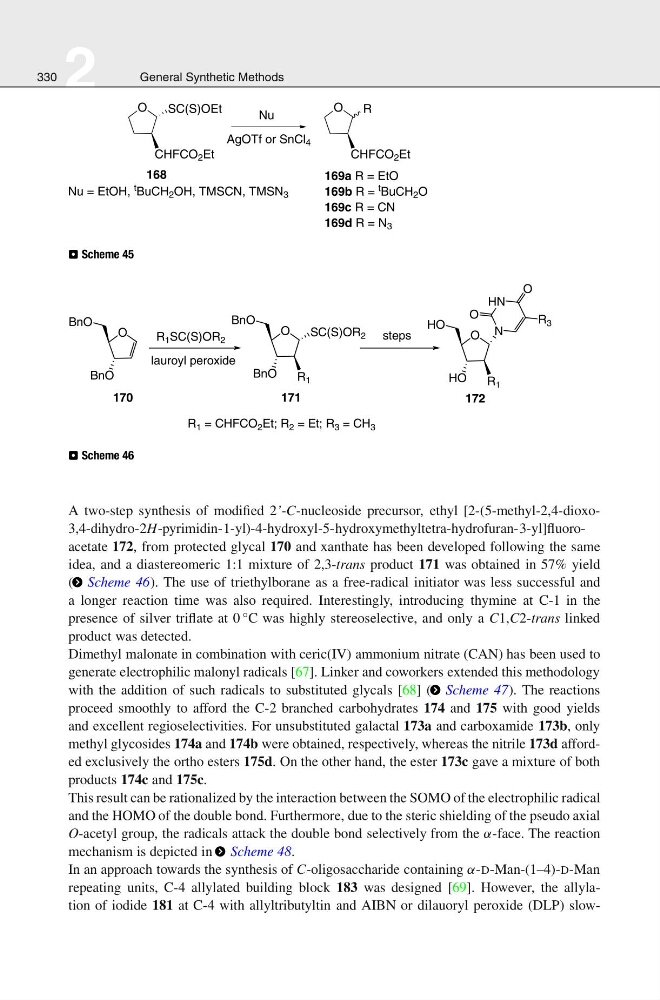
⊡ Scheme 45
⊡ Scheme 46
3,4-dihydro-2H-pyrimidin-1-yl)-4-hydroxyl-5-hydroxymethyltetra-hydrofuran-3-yl]fluoroacetate 172, from protected glycal 170 and xanthate has been developed following the same
idea, and a diastereomeric 1:1 mixture of 2,3-trans product 171 was obtained in 57% yield
( > Scheme 46). The use of triethylborane as a free-radical initiator was less successful and
a longer reaction time was also required. Interestingly, introducing thymine at C-1 in the
presence of silver triflate at 0 °C was highly stereoselective, and only a C1,C2-trans linked
product was detected.
Dimethyl malonate in combination with ceric(IV) ammonium nitrate (CAN) has been used to
generate electrophilic malonyl radicals [67]. Linker and coworkers extended this methodology
with the addition of such radicals to substituted glycals [68] ( > Scheme 47). The reactions
proceed smoothly to afford the C-2 branched carbohydrates 174 and 175 with good yields
and excellent regioselectivities. For unsubstituted galactal 173a and carboxamide 173b, only
methyl glycosides 174a and 174b were obtained, respectively, whereas the nitrile 173d afforded exclusively the ortho esters 175d. On the other hand, the ester 173c gave a mixture of both
products 174c and 175c.
This result can be rationalized by the interaction between the SOMO of the electrophilic radical
and the HOMO of the double bond. Furthermore, due to the steric shielding of the pseudo axial
O-acetyl group, the radicals attack the double bond selectively from the α-face. The reaction
mechanism is depicted in > Scheme 48.
In an approach towards the synthesis of C-oligosaccharide containing α-D-Man-(1–4)-D-Man
repeating units, C-4 allylated building block 183 was designed [69]. However, the allylation of iodide 181 at C-4 with allyltributyltin and AIBN or dilauoryl peroxide (DLP) slow-
2
General Synthetic Methods
⊡ Scheme 45
⊡ Scheme 46
3,4-dihydro-2H-pyrimidin-1-yl)-4-hydroxyl-5-hydroxymethyltetra-hydrofuran-3-yl]fluoroacetate 172, from protected glycal 170 and xanthate has been developed following the same
idea, and a diastereomeric 1:1 mixture of 2,3-trans product 171 was obtained in 57% yield
( > Scheme 46). The use of triethylborane as a free-radical initiator was less successful and
a longer reaction time was also required. Interestingly, introducing thymine at C-1 in the
presence of silver triflate at 0 °C was highly stereoselective, and only a C1,C2-trans linked
product was detected.
Dimethyl malonate in combination with ceric(IV) ammonium nitrate (CAN) has been used to
generate electrophilic malonyl radicals [67]. Linker and coworkers extended this methodology
with the addition of such radicals to substituted glycals [68] ( > Scheme 47). The reactions
proceed smoothly to afford the C-2 branched carbohydrates 174 and 175 with good yields
and excellent regioselectivities. For unsubstituted galactal 173a and carboxamide 173b, only
methyl glycosides 174a and 174b were obtained, respectively, whereas the nitrile 173d afforded exclusively the ortho esters 175d. On the other hand, the ester 173c gave a mixture of both
products 174c and 175c.
This result can be rationalized by the interaction between the SOMO of the electrophilic radical
and the HOMO of the double bond. Furthermore, due to the steric shielding of the pseudo axial
O-acetyl group, the radicals attack the double bond selectively from the α-face. The reaction
mechanism is depicted in > Scheme 48.
In an approach towards the synthesis of C-oligosaccharide containing α-D-Man-(1–4)-D-Man
repeating units, C-4 allylated building block 183 was designed [69]. However, the allylation of iodide 181 at C-4 with allyltributyltin and AIBN or dilauoryl peroxide (DLP) slow-