

328
2
General Synthetic Methods
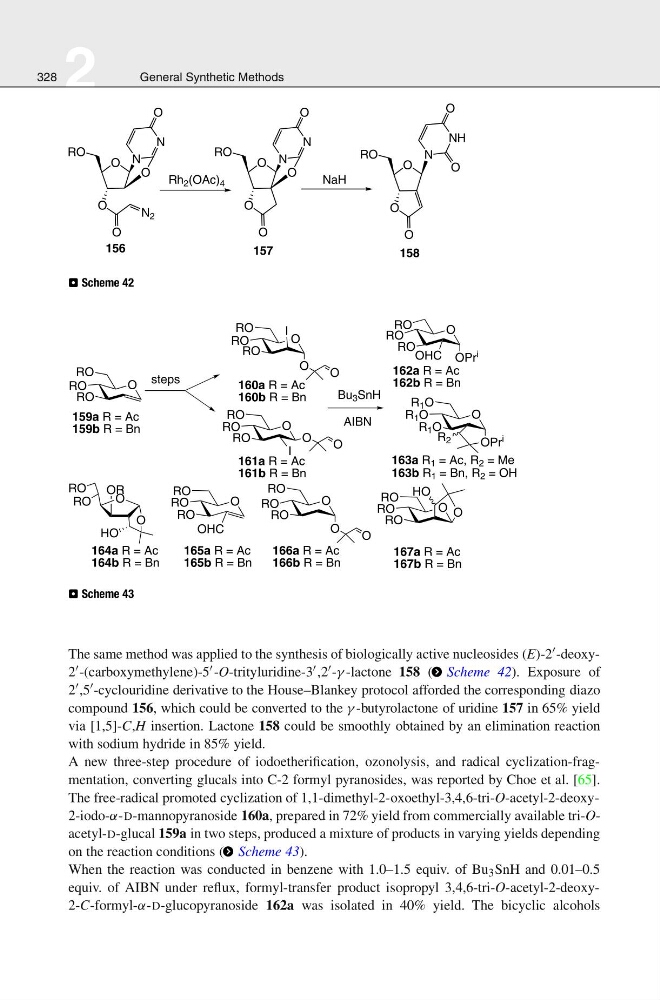
⊡ Scheme 42
⊡ Scheme 43
The same method was applied to the synthesis of biologically active nucleosides (E)-2 -deoxy2 -(carboxymethylene)-5 -O-trityluridine-3 ,2 -γ -lactone 158 ( > Scheme 42). Exposure of
2 ,5 -cyclouridine derivative to the House–Blankey protocol afforded the corresponding diazo
compound 156, which could be converted to the γ -butyrolactone of uridine 157 in 65% yield
via [1,5]-C,H insertion. Lactone 158 could be smoothly obtained by an elimination reaction
with sodium hydride in 85% yield.
A new three-step procedure of iodoetherification, ozonolysis, and radical cyclization-fragmentation, converting glucals into C-2 formyl pyranosides, was reported by Choe et al. [65].
The free-radical promoted cyclization of 1,1-dimethyl-2-oxoethyl-3,4,6-tri-O-acetyl-2-deoxy2-iodo-α-D-mannopyranoside 160a, prepared in 72% yield from commercially available tri-Oacetyl-D-glucal 159a in two steps, produced a mixture of products in varying yields depending
on the reaction conditions ( > Scheme 43).
When the reaction was conducted in benzene with 1.0–1.5 equiv. of Bu 3 SnH and 0.01–0.5
equiv. of AIBN under reflux, formyl-transfer product isopropyl 3,4,6-tri-O-acetyl-2-deoxy2-C-formyl-α-D-glucopyranoside 162a was isolated in 40% yield. The bicyclic alcohols
2
General Synthetic Methods
⊡ Scheme 42
⊡ Scheme 43
The same method was applied to the synthesis of biologically active nucleosides (E)-2 -deoxy2 -(carboxymethylene)-5 -O-trityluridine-3 ,2 -γ -lactone 158 ( > Scheme 42). Exposure of
2 ,5 -cyclouridine derivative to the House–Blankey protocol afforded the corresponding diazo
compound 156, which could be converted to the γ -butyrolactone of uridine 157 in 65% yield
via [1,5]-C,H insertion. Lactone 158 could be smoothly obtained by an elimination reaction
with sodium hydride in 85% yield.
A new three-step procedure of iodoetherification, ozonolysis, and radical cyclization-fragmentation, converting glucals into C-2 formyl pyranosides, was reported by Choe et al. [65].
The free-radical promoted cyclization of 1,1-dimethyl-2-oxoethyl-3,4,6-tri-O-acetyl-2-deoxy2-iodo-α-D-mannopyranoside 160a, prepared in 72% yield from commercially available tri-Oacetyl-D-glucal 159a in two steps, produced a mixture of products in varying yields depending
on the reaction conditions ( > Scheme 43).
When the reaction was conducted in benzene with 1.0–1.5 equiv. of Bu 3 SnH and 0.01–0.5
equiv. of AIBN under reflux, formyl-transfer product isopropyl 3,4,6-tri-O-acetyl-2-deoxy2-C-formyl-α-D-glucopyranoside 162a was isolated in 40% yield. The bicyclic alcohols