

322
2
General Synthetic Methods
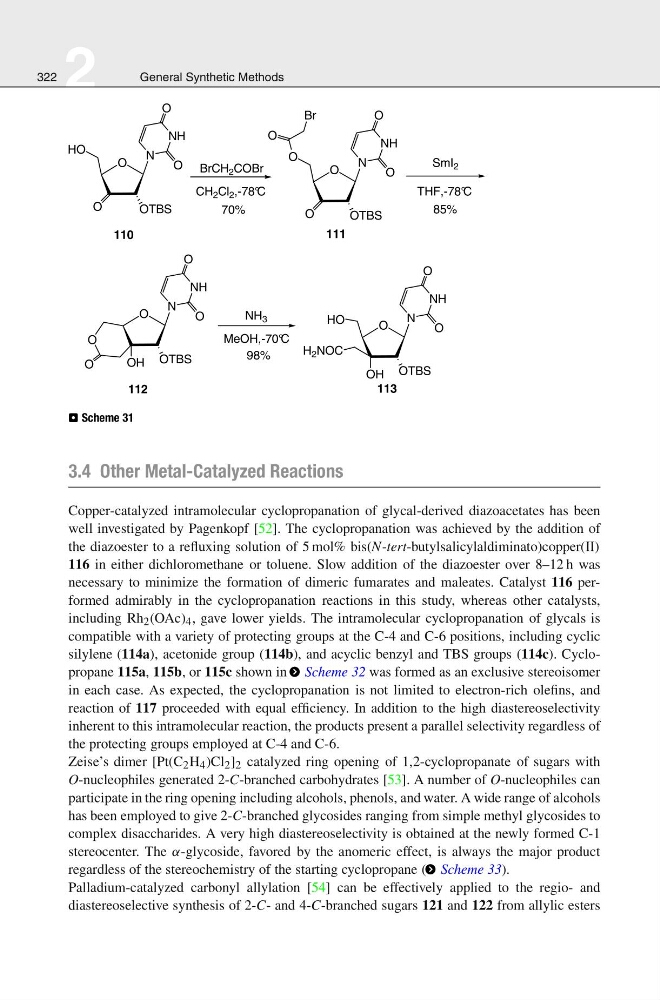
⊡ Scheme 31
3.4 Other Metal-Catalyzed Reactions
Copper-catalyzed intramolecular cyclopropanation of glycal-derived diazoacetates has been
well investigated by Pagenkopf [52]. The cyclopropanation was achieved by the addition of
the diazoester to a refluxing solution of 5 mol% bis(N-tert-butylsalicylaldiminato)copper(II)
116 in either dichloromethane or toluene. Slow addition of the diazoester over 8–12 h was
necessary to minimize the formation of dimeric fumarates and maleates. Catalyst 116 performed admirably in the cyclopropanation reactions in this study, whereas other catalysts,
including Rh 2 (OAc) 4 , gave lower yields. The intramolecular cyclopropanation of glycals is
compatible with a variety of protecting groups at the C-4 and C-6 positions, including cyclic
silylene (114a), acetonide group (114b), and acyclic benzyl and TBS groups (114c). Cyclopropane 115a, 115b, or 115c shown in > Scheme 32 was formed as an exclusive stereoisomer
in each case. As expected, the cyclopropanation is not limited to electron-rich olefins, and
reaction of 117 proceeded with equal efficiency. In addition to the high diastereoselectivity
inherent to this intramolecular reaction, the products present a parallel selectivity regardless of
the protecting groups employed at C-4 and C-6.
Zeise’s dimer [Pt(C 2 H 4 )Cl 2 ] 2 catalyzed ring opening of 1,2-cyclopropanate of sugars with
O-nucleophiles generated 2-C-branched carbohydrates [53]. A number of O-nucleophiles can
participate in the ring opening including alcohols, phenols, and water. A wide range of alcohols
has been employed to give 2-C-branched glycosides ranging from simple methyl glycosides to
complex disaccharides. A very high diastereoselectivity is obtained at the newly formed C-1
stereocenter. The α-glycoside, favored by the anomeric effect, is always the major product
regardless of the stereochemistry of the starting cyclopropane ( > Scheme 33).
Palladium-catalyzed carbonyl allylation [54] can be effectively applied to the regio- and
diastereoselective synthesis of 2-C- and 4-C-branched sugars 121 and 122 from allylic esters
2
General Synthetic Methods
⊡ Scheme 31
3.4 Other Metal-Catalyzed Reactions
Copper-catalyzed intramolecular cyclopropanation of glycal-derived diazoacetates has been
well investigated by Pagenkopf [52]. The cyclopropanation was achieved by the addition of
the diazoester to a refluxing solution of 5 mol% bis(N-tert-butylsalicylaldiminato)copper(II)
116 in either dichloromethane or toluene. Slow addition of the diazoester over 8–12 h was
necessary to minimize the formation of dimeric fumarates and maleates. Catalyst 116 performed admirably in the cyclopropanation reactions in this study, whereas other catalysts,
including Rh 2 (OAc) 4 , gave lower yields. The intramolecular cyclopropanation of glycals is
compatible with a variety of protecting groups at the C-4 and C-6 positions, including cyclic
silylene (114a), acetonide group (114b), and acyclic benzyl and TBS groups (114c). Cyclopropane 115a, 115b, or 115c shown in > Scheme 32 was formed as an exclusive stereoisomer
in each case. As expected, the cyclopropanation is not limited to electron-rich olefins, and
reaction of 117 proceeded with equal efficiency. In addition to the high diastereoselectivity
inherent to this intramolecular reaction, the products present a parallel selectivity regardless of
the protecting groups employed at C-4 and C-6.
Zeise’s dimer [Pt(C 2 H 4 )Cl 2 ] 2 catalyzed ring opening of 1,2-cyclopropanate of sugars with
O-nucleophiles generated 2-C-branched carbohydrates [53]. A number of O-nucleophiles can
participate in the ring opening including alcohols, phenols, and water. A wide range of alcohols
has been employed to give 2-C-branched glycosides ranging from simple methyl glycosides to
complex disaccharides. A very high diastereoselectivity is obtained at the newly formed C-1
stereocenter. The α-glycoside, favored by the anomeric effect, is always the major product
regardless of the stereochemistry of the starting cyclopropane ( > Scheme 33).
Palladium-catalyzed carbonyl allylation [54] can be effectively applied to the regio- and
diastereoselective synthesis of 2-C- and 4-C-branched sugars 121 and 122 from allylic esters