

C–C Bond Formation
2.5
323
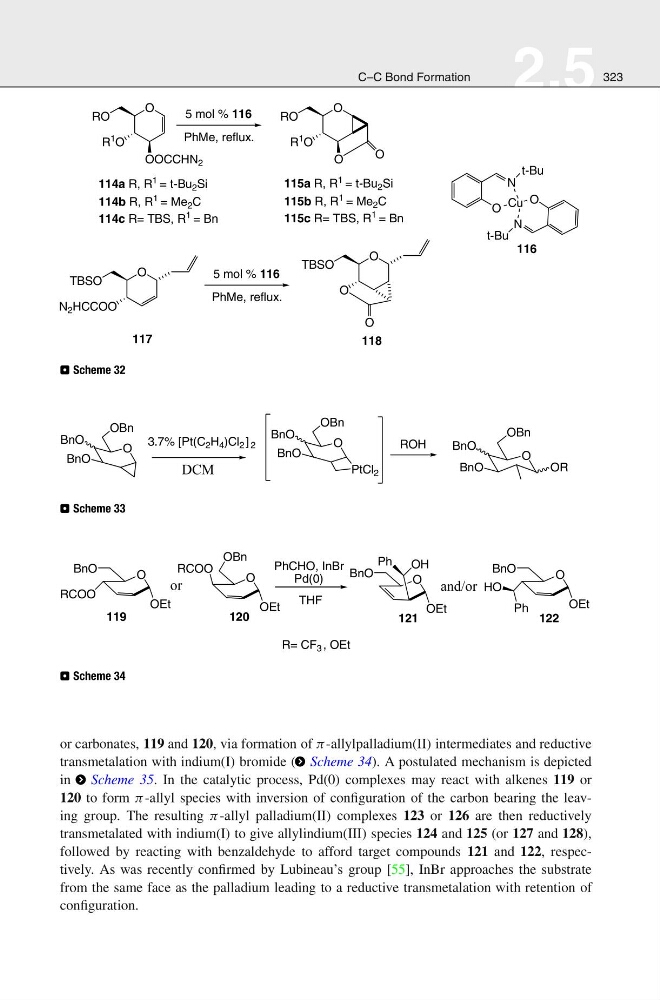
⊡ Scheme 32
⊡ Scheme 33
⊡ Scheme 34
or carbonates, 119 and 120, via formation of π-allylpalladium(II) intermediates and reductive
transmetalation with indium(I) bromide ( > Scheme 34). A postulated mechanism is depicted
in > Scheme 35. In the catalytic process, Pd(0) complexes may react with alkenes 119 or
120 to form π-allyl species with inversion of configuration of the carbon bearing the leaving group. The resulting π-allyl palladium(II) complexes 123 or 126 are then reductively
transmetalated with indium(I) to give allylindium(III) species 124 and 125 (or 127 and 128),
followed by reacting with benzaldehyde to afford target compounds 121 and 122, respectively. As was recently confirmed by Lubineau’s group [55], InBr approaches the substrate
from the same face as the palladium leading to a reductive transmetalation with retention of
configuration.
2.5
323
⊡ Scheme 32
⊡ Scheme 33
⊡ Scheme 34
or carbonates, 119 and 120, via formation of π-allylpalladium(II) intermediates and reductive
transmetalation with indium(I) bromide ( > Scheme 34). A postulated mechanism is depicted
in > Scheme 35. In the catalytic process, Pd(0) complexes may react with alkenes 119 or
120 to form π-allyl species with inversion of configuration of the carbon bearing the leaving group. The resulting π-allyl palladium(II) complexes 123 or 126 are then reductively
transmetalated with indium(I) to give allylindium(III) species 124 and 125 (or 127 and 128),
followed by reacting with benzaldehyde to afford target compounds 121 and 122, respectively. As was recently confirmed by Lubineau’s group [55], InBr approaches the substrate
from the same face as the palladium leading to a reductive transmetalation with retention of
configuration.