

C–C Bond Formation
2.5
321
water, in the absence of the phosphate buffer, the 4-C-adduct 104 is slowly transformed (30%
after 1.5 h) into an α,β mixture of 105. In fact, 105 α, β can also be formed from the acid
hydrolysis of the labile enol ether derivative 104 ( > Scheme 29). After electrophilic addition
of water, followed by pyran ring opening and elimination of the anomeric methoxy group, the
cyclization of the C-7 hydroxyl group with the aldehyde led to the keto-derivatives 105 α, β.
In order to confirm these results, compound 104 was treated with 0.1 M aq HCl affording 105
as a mixture of anomers (α/β, 1:3) in 90% yield.
3.3 Diiodosamarium-Mediated Reactions
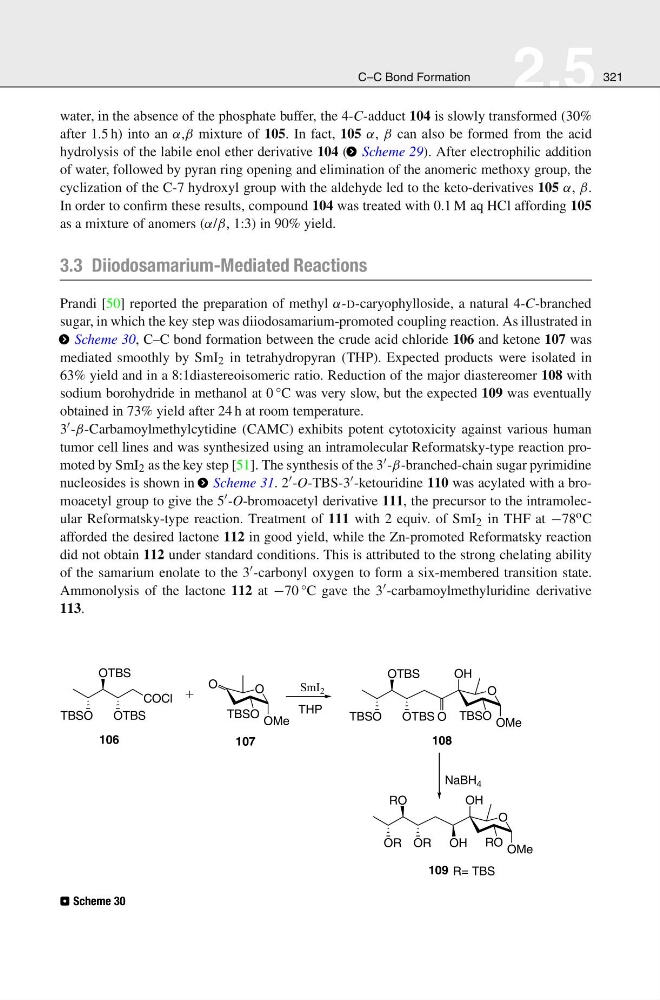
Prandi [50] reported the preparation of methyl α-D-caryophylloside, a natural 4-C-branched
sugar, in which the key step was diiodosamarium-promoted coupling reaction. As illustrated in
> Scheme 30, C–C bond formation between the crude acid chloride 106 and ketone 107 was
mediated smoothly by SmI 2 in tetrahydropyran (THP). Expected products were isolated in
63% yield and in a 8:1diastereoisomeric ratio. Reduction of the major diastereomer 108 with
sodium borohydride in methanol at 0 °C was very slow, but the expected 109 was eventually
obtained in 73% yield after 24 h at room temperature.
3 -β-Carbamoylmethylcytidine (CAMC) exhibits potent cytotoxicity against various human
tumor cell lines and was synthesized using an intramolecular Reformatsky-type reaction promoted by SmI 2 as the key step [51]. The synthesis of the 3 -β-branched-chain sugar pyrimidine
nucleosides is shown in > Scheme 31. 2 -O-TBS-3 -ketouridine 110 was acylated with a bromoacetyl group to give the 5 -O-bromoacetyl derivative 111, the precursor to the intramolecular Reformatsky-type reaction. Treatment of 111 with 2 equiv. of SmI 2 in THF at −78 o C
afforded the desired lactone 112 in good yield, while the Zn-promoted Reformatsky reaction
did not obtain 112 under standard conditions. This is attributed to the strong chelating ability
of the samarium enolate to the 3 -carbonyl oxygen to form a six-membered transition state.
Ammonolysis of the lactone 112 at −70 °C gave the 3 -carbamoylmethyluridine derivative
113.
⊡ Scheme 30
2.5
321
water, in the absence of the phosphate buffer, the 4-C-adduct 104 is slowly transformed (30%
after 1.5 h) into an α,β mixture of 105. In fact, 105 α, β can also be formed from the acid
hydrolysis of the labile enol ether derivative 104 ( > Scheme 29). After electrophilic addition
of water, followed by pyran ring opening and elimination of the anomeric methoxy group, the
cyclization of the C-7 hydroxyl group with the aldehyde led to the keto-derivatives 105 α, β.
In order to confirm these results, compound 104 was treated with 0.1 M aq HCl affording 105
as a mixture of anomers (α/β, 1:3) in 90% yield.
3.3 Diiodosamarium-Mediated Reactions
Prandi [50] reported the preparation of methyl α-D-caryophylloside, a natural 4-C-branched
sugar, in which the key step was diiodosamarium-promoted coupling reaction. As illustrated in
> Scheme 30, C–C bond formation between the crude acid chloride 106 and ketone 107 was
mediated smoothly by SmI 2 in tetrahydropyran (THP). Expected products were isolated in
63% yield and in a 8:1diastereoisomeric ratio. Reduction of the major diastereomer 108 with
sodium borohydride in methanol at 0 °C was very slow, but the expected 109 was eventually
obtained in 73% yield after 24 h at room temperature.
3 -β-Carbamoylmethylcytidine (CAMC) exhibits potent cytotoxicity against various human
tumor cell lines and was synthesized using an intramolecular Reformatsky-type reaction promoted by SmI 2 as the key step [51]. The synthesis of the 3 -β-branched-chain sugar pyrimidine
nucleosides is shown in > Scheme 31. 2 -O-TBS-3 -ketouridine 110 was acylated with a bromoacetyl group to give the 5 -O-bromoacetyl derivative 111, the precursor to the intramolecular Reformatsky-type reaction. Treatment of 111 with 2 equiv. of SmI 2 in THF at −78 o C
afforded the desired lactone 112 in good yield, while the Zn-promoted Reformatsky reaction
did not obtain 112 under standard conditions. This is attributed to the strong chelating ability
of the samarium enolate to the 3 -carbonyl oxygen to form a six-membered transition state.
Ammonolysis of the lactone 112 at −70 °C gave the 3 -carbamoylmethyluridine derivative
113.
⊡ Scheme 30