

320
2
General Synthetic Methods
a mechanistic point of view, the stereochemistry at C-7 can be explained by the formation
of a six-membered cyclic transition state between the carbonyl and the allyl-indium complex
moiety in which the phenyl group is in the axial position as depicted in > Scheme 25. Indeed,
molecular modeling showed clearly an unfavorable steric interaction between the equatorial
phenyl substituent and the β-ethoxy group. When 2-bromo-4-enopyranoside 99 was employed
in this reaction, a mixture of the C-2 axial product 100, the C-2 equatorial adduct 101, and the
known aldehyde 102 was obtained in a 6/6/1 ratio ( > Scheme 26), which could be rationalized
by the mechanism given in > Scheme 27. Firstly, an allylindium(I) species 99a is formed
which may undergo a ring opening through β-elimination. Secondly, indium(I) bromide
formed in the reaction may act as a Lewis acid and cause the cyclization of the enol ether
derivative 99b to give 99c, which will take a more favorable state 99d via a stereospecific
1,3-allylindium migration. In the same manner, the species 99a exists in equilibrium with its
regioisomer 99e in the presence of InBr. The desired products 100–102 were derived from
these intermediates, respectively.
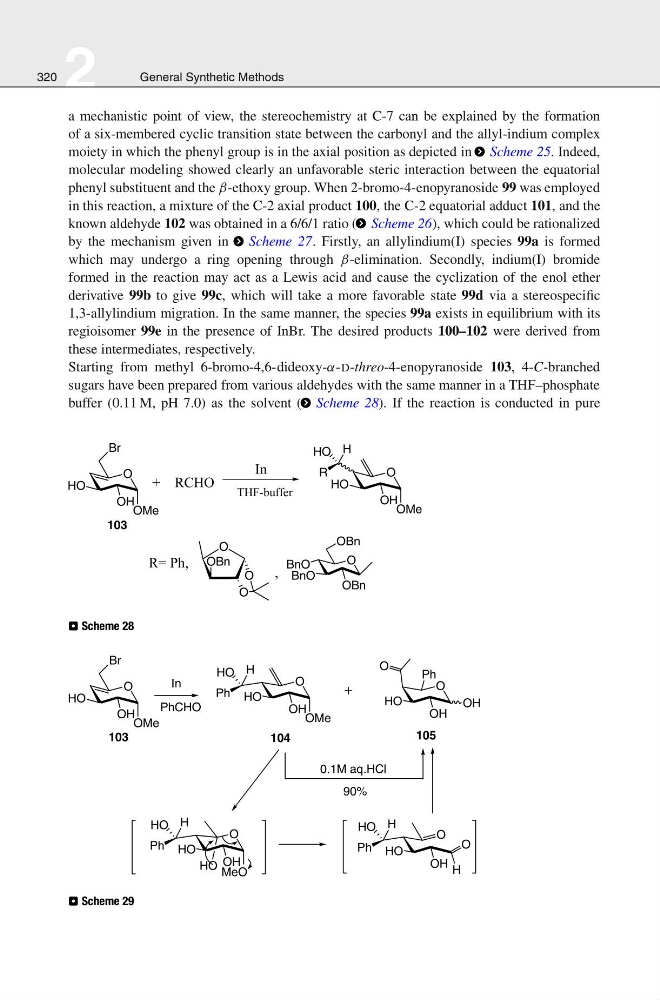
Starting from methyl 6-bromo-4,6-dideoxy-α-D-threo-4-enopyranoside 103, 4-C-branched
sugars have been prepared from various aldehydes with the same manner in a THF–phosphate
buffer (0.11 M, pH 7.0) as the solvent ( > Scheme 28). If the reaction is conducted in pure
⊡ Scheme 28
⊡ Scheme 29
2
General Synthetic Methods
a mechanistic point of view, the stereochemistry at C-7 can be explained by the formation
of a six-membered cyclic transition state between the carbonyl and the allyl-indium complex
moiety in which the phenyl group is in the axial position as depicted in > Scheme 25. Indeed,
molecular modeling showed clearly an unfavorable steric interaction between the equatorial
phenyl substituent and the β-ethoxy group. When 2-bromo-4-enopyranoside 99 was employed
in this reaction, a mixture of the C-2 axial product 100, the C-2 equatorial adduct 101, and the
known aldehyde 102 was obtained in a 6/6/1 ratio ( > Scheme 26), which could be rationalized
by the mechanism given in > Scheme 27. Firstly, an allylindium(I) species 99a is formed
which may undergo a ring opening through β-elimination. Secondly, indium(I) bromide
formed in the reaction may act as a Lewis acid and cause the cyclization of the enol ether
derivative 99b to give 99c, which will take a more favorable state 99d via a stereospecific
1,3-allylindium migration. In the same manner, the species 99a exists in equilibrium with its
regioisomer 99e in the presence of InBr. The desired products 100–102 were derived from
these intermediates, respectively.
Starting from methyl 6-bromo-4,6-dideoxy-α-D-threo-4-enopyranoside 103, 4-C-branched
sugars have been prepared from various aldehydes with the same manner in a THF–phosphate
buffer (0.11 M, pH 7.0) as the solvent ( > Scheme 28). If the reaction is conducted in pure
⊡ Scheme 28
⊡ Scheme 29