

308
2
General Synthetic Methods
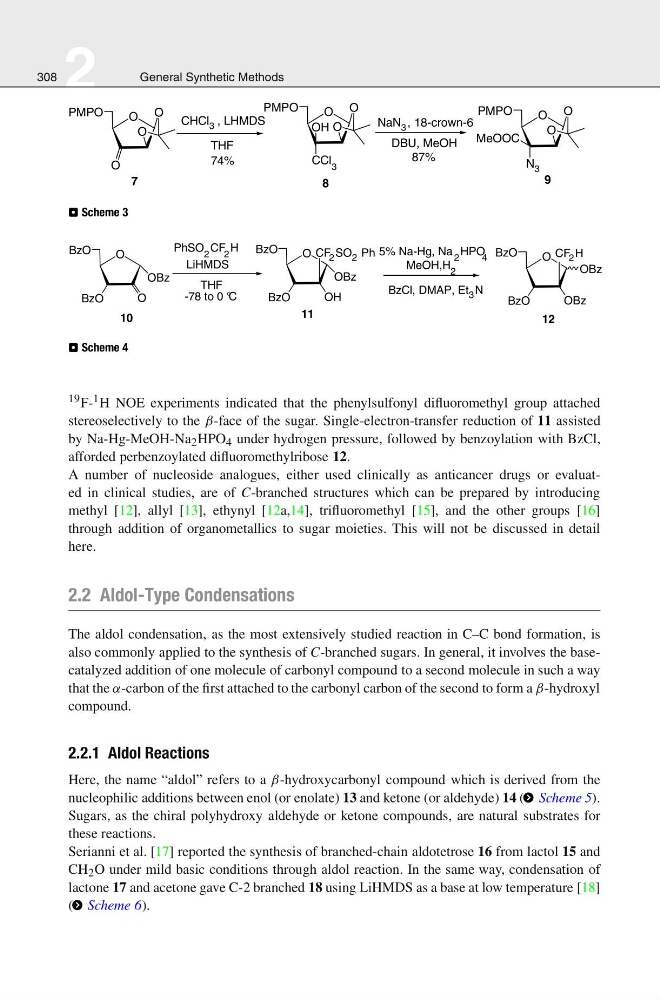
⊡ Scheme 3
⊡ Scheme 4
19 F- 1 H NOE experiments indicated that the phenylsulfonyl difluoromethyl group attached
stereoselectively to the β-face of the sugar. Single-electron-transfer reduction of 11 assisted
by Na-Hg-MeOH-Na 2 HPO 4 under hydrogen pressure, followed by benzoylation with BzCl,
afforded perbenzoylated difluoromethylribose 12.
A number of nucleoside analogues, either used clinically as anticancer drugs or evaluated in clinical studies, are of C-branched structures which can be prepared by introducing
methyl [12], allyl [13], ethynyl [12a,14], trifluoromethyl [15], and the other groups [16]
through addition of organometallics to sugar moieties. This will not be discussed in detail
here.
2.2 Aldol-Type Condensations
The aldol condensation, as the most extensively studied reaction in C–C bond formation, is
also commonly applied to the synthesis of C-branched sugars. In general, it involves the basecatalyzed addition of one molecule of carbonyl compound to a second molecule in such a way
that the α-carbon of the first attached to the carbonyl carbon of the second to form a β-hydroxyl
compound.
2.2.1 Aldol Reactions
Here, the name “aldol” refers to a β-hydroxycarbonyl compound which is derived from the
nucleophilic additions between enol (or enolate) 13 and ketone (or aldehyde) 14 ( > Scheme 5).
Sugars, as the chiral polyhydroxy aldehyde or ketone compounds, are natural substrates for
these reactions.
Serianni et al. [17] reported the synthesis of branched-chain aldotetrose 16 from lactol 15 and
CH 2 O under mild basic conditions through aldol reaction. In the same way, condensation of
lactone 17 and acetone gave C-2 branched 18 using LiHMDS as a base at low temperature [18]
( > Scheme 6).
2
General Synthetic Methods
⊡ Scheme 3
⊡ Scheme 4
19 F- 1 H NOE experiments indicated that the phenylsulfonyl difluoromethyl group attached
stereoselectively to the β-face of the sugar. Single-electron-transfer reduction of 11 assisted
by Na-Hg-MeOH-Na 2 HPO 4 under hydrogen pressure, followed by benzoylation with BzCl,
afforded perbenzoylated difluoromethylribose 12.
A number of nucleoside analogues, either used clinically as anticancer drugs or evaluated in clinical studies, are of C-branched structures which can be prepared by introducing
methyl [12], allyl [13], ethynyl [12a,14], trifluoromethyl [15], and the other groups [16]
through addition of organometallics to sugar moieties. This will not be discussed in detail
here.
2.2 Aldol-Type Condensations
The aldol condensation, as the most extensively studied reaction in C–C bond formation, is
also commonly applied to the synthesis of C-branched sugars. In general, it involves the basecatalyzed addition of one molecule of carbonyl compound to a second molecule in such a way
that the α-carbon of the first attached to the carbonyl carbon of the second to form a β-hydroxyl
compound.
2.2.1 Aldol Reactions
Here, the name “aldol” refers to a β-hydroxycarbonyl compound which is derived from the
nucleophilic additions between enol (or enolate) 13 and ketone (or aldehyde) 14 ( > Scheme 5).
Sugars, as the chiral polyhydroxy aldehyde or ketone compounds, are natural substrates for
these reactions.
Serianni et al. [17] reported the synthesis of branched-chain aldotetrose 16 from lactol 15 and
CH 2 O under mild basic conditions through aldol reaction. In the same way, condensation of
lactone 17 and acetone gave C-2 branched 18 using LiHMDS as a base at low temperature [18]
( > Scheme 6).