

C–C Bond Formation
2.5
309
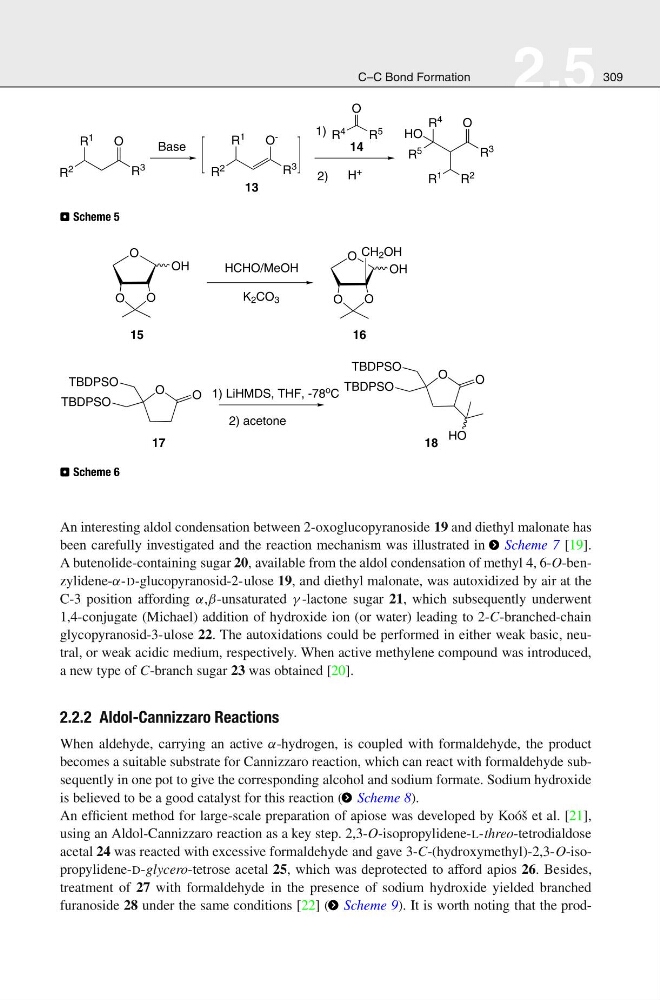
⊡ Scheme 5
⊡ Scheme 6
An interesting aldol condensation between 2-oxoglucopyranoside 19 and diethyl malonate has
been carefully investigated and the reaction mechanism was illustrated in > Scheme 7 [19].
A butenolide-containing sugar 20, available from the aldol condensation of methyl 4, 6-O-benzylidene-α-D-glucopyranosid-2-ulose 19, and diethyl malonate, was autoxidized by air at the
C-3 position affording α,β-unsaturated γ -lactone sugar 21, which subsequently underwent
1,4-conjugate (Michael) addition of hydroxide ion (or water) leading to 2-C-branched-chain
glycopyranosid-3-ulose 22. The autoxidations could be performed in either weak basic, neutral, or weak acidic medium, respectively. When active methylene compound was introduced,
a new type of C-branch sugar 23 was obtained [20].
2.2.2 Aldol-Cannizzaro Reactions
When aldehyde, carrying an active α-hydrogen, is coupled with formaldehyde, the product
becomes a suitable substrate for Cannizzaro reaction, which can react with formaldehyde subsequently in one pot to give the corresponding alcohol and sodium formate. Sodium hydroxide
is believed to be a good catalyst for this reaction ( > Scheme 8).
An efficient method for large-scale preparation of apiose was developed by Koóš et al. [21],
using an Aldol-Cannizzaro reaction as a key step. 2,3-O-isopropylidene-L-threo-tetrodialdose
acetal 24 was reacted with excessive formaldehyde and gave 3-C-(hydroxymethyl)-2,3-O-isopropylidene-D-glycero-tetrose acetal 25, which was deprotected to afford apios 26. Besides,
treatment of 27 with formaldehyde in the presence of sodium hydroxide yielded branched
furanoside 28 under the same conditions [22] ( > Scheme 9). It is worth noting that the prod-
2.5
309
⊡ Scheme 5
⊡ Scheme 6
An interesting aldol condensation between 2-oxoglucopyranoside 19 and diethyl malonate has
been carefully investigated and the reaction mechanism was illustrated in > Scheme 7 [19].
A butenolide-containing sugar 20, available from the aldol condensation of methyl 4, 6-O-benzylidene-α-D-glucopyranosid-2-ulose 19, and diethyl malonate, was autoxidized by air at the
C-3 position affording α,β-unsaturated γ -lactone sugar 21, which subsequently underwent
1,4-conjugate (Michael) addition of hydroxide ion (or water) leading to 2-C-branched-chain
glycopyranosid-3-ulose 22. The autoxidations could be performed in either weak basic, neutral, or weak acidic medium, respectively. When active methylene compound was introduced,
a new type of C-branch sugar 23 was obtained [20].
2.2.2 Aldol-Cannizzaro Reactions
When aldehyde, carrying an active α-hydrogen, is coupled with formaldehyde, the product
becomes a suitable substrate for Cannizzaro reaction, which can react with formaldehyde subsequently in one pot to give the corresponding alcohol and sodium formate. Sodium hydroxide
is believed to be a good catalyst for this reaction ( > Scheme 8).
An efficient method for large-scale preparation of apiose was developed by Koóš et al. [21],
using an Aldol-Cannizzaro reaction as a key step. 2,3-O-isopropylidene-L-threo-tetrodialdose
acetal 24 was reacted with excessive formaldehyde and gave 3-C-(hydroxymethyl)-2,3-O-isopropylidene-D-glycero-tetrose acetal 25, which was deprotected to afford apios 26. Besides,
treatment of 27 with formaldehyde in the presence of sodium hydroxide yielded branched
furanoside 28 under the same conditions [22] ( > Scheme 9). It is worth noting that the prod-