

C–C Bond Formation
2.5
307
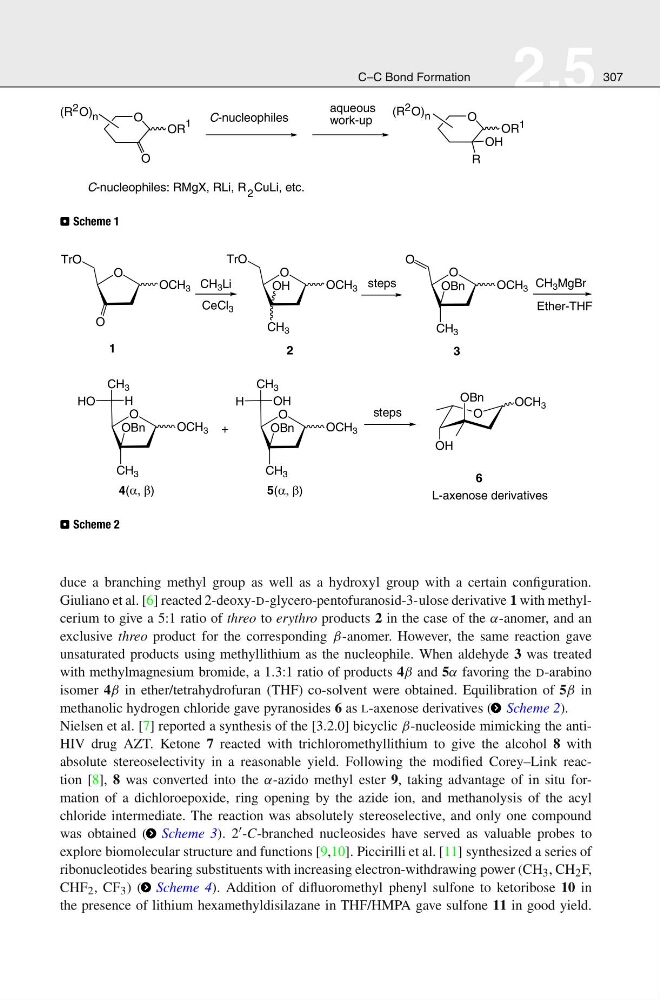
⊡ Scheme 1
⊡ Scheme 2
duce a branching methyl group as well as a hydroxyl group with a certain configuration.
Giuliano et al. [6] reacted 2-deoxy-D-glycero-pentofuranosid-3-ulose derivative 1 with methylcerium to give a 5:1 ratio of threo to erythro products 2 in the case of the α-anomer, and an
exclusive threo product for the corresponding β-anomer. However, the same reaction gave
unsaturated products using methyllithium as the nucleophile. When aldehyde 3 was treated
with methylmagnesium bromide, a 1.3:1 ratio of products 4β and 5α favoring the D-arabino
isomer 4β in ether/tetrahydrofuran (THF) co-solvent were obtained. Equilibration of 5β in
methanolic hydrogen chloride gave pyranosides 6 as L-axenose derivatives ( > Scheme 2).
Nielsen et al. [7] reported a synthesis of the [3.2.0] bicyclic β-nucleoside mimicking the antiHIV drug AZT. Ketone 7 reacted with trichloromethyllithium to give the alcohol 8 with
absolute stereoselectivity in a reasonable yield. Following the modified Corey–Link reaction [8], 8 was converted into the α-azido methyl ester 9, taking advantage of in situ formation of a dichloroepoxide, ring opening by the azide ion, and methanolysis of the acyl
chloride intermediate. The reaction was absolutely stereoselective, and only one compound
was obtained ( > Scheme 3). 2 -C-branched nucleosides have served as valuable probes to
explore biomolecular structure and functions [9,10]. Piccirilli et al. [11] synthesized a series of
ribonucleotides bearing substituents with increasing electron-withdrawing power (CH 3 , CH 2 F,
CHF 2 , CF 3 ) ( > Scheme 4). Addition of difluoromethyl phenyl sulfone to ketoribose 10 in
the presence of lithium hexamethyldisilazane in THF/HMPA gave sulfone 11 in good yield.
2.5
307
⊡ Scheme 1
⊡ Scheme 2
duce a branching methyl group as well as a hydroxyl group with a certain configuration.
Giuliano et al. [6] reacted 2-deoxy-D-glycero-pentofuranosid-3-ulose derivative 1 with methylcerium to give a 5:1 ratio of threo to erythro products 2 in the case of the α-anomer, and an
exclusive threo product for the corresponding β-anomer. However, the same reaction gave
unsaturated products using methyllithium as the nucleophile. When aldehyde 3 was treated
with methylmagnesium bromide, a 1.3:1 ratio of products 4β and 5α favoring the D-arabino
isomer 4β in ether/tetrahydrofuran (THF) co-solvent were obtained. Equilibration of 5β in
methanolic hydrogen chloride gave pyranosides 6 as L-axenose derivatives ( > Scheme 2).
Nielsen et al. [7] reported a synthesis of the [3.2.0] bicyclic β-nucleoside mimicking the antiHIV drug AZT. Ketone 7 reacted with trichloromethyllithium to give the alcohol 8 with
absolute stereoselectivity in a reasonable yield. Following the modified Corey–Link reaction [8], 8 was converted into the α-azido methyl ester 9, taking advantage of in situ formation of a dichloroepoxide, ring opening by the azide ion, and methanolysis of the acyl
chloride intermediate. The reaction was absolutely stereoselective, and only one compound
was obtained ( > Scheme 3). 2 -C-branched nucleosides have served as valuable probes to
explore biomolecular structure and functions [9,10]. Piccirilli et al. [11] synthesized a series of
ribonucleotides bearing substituents with increasing electron-withdrawing power (CH 3 , CH 2 F,
CHF 2 , CF 3 ) ( > Scheme 4). Addition of difluoromethyl phenyl sulfone to ketoribose 10 in
the presence of lithium hexamethyldisilazane in THF/HMPA gave sulfone 11 in good yield.