

Anhydrosugars
2.4
285
⊡ Scheme 16
⊡ Scheme 17
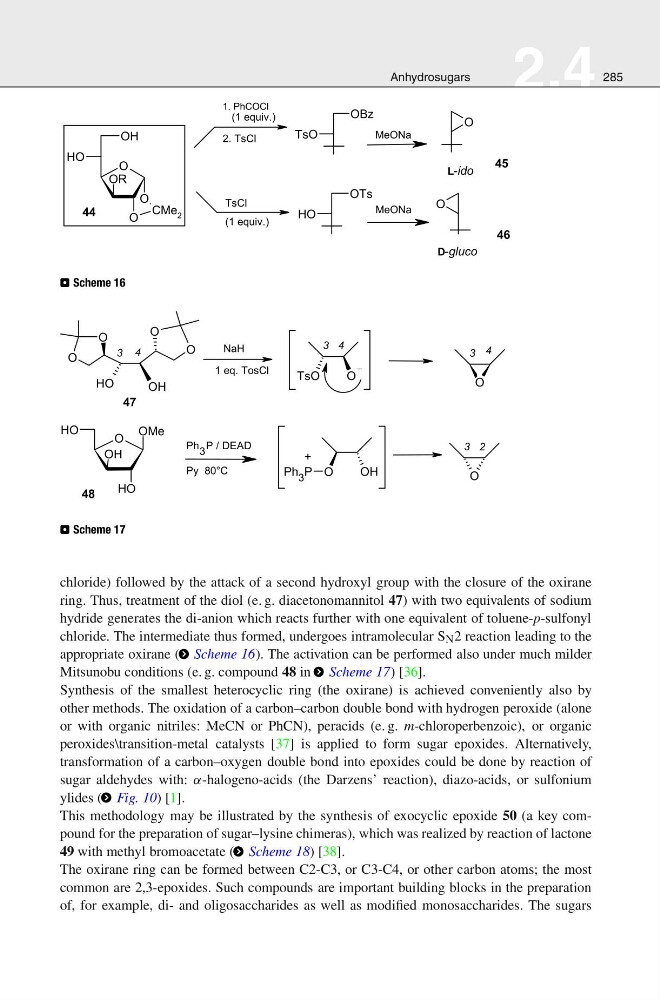
chloride) followed by the attack of a second hydroxyl group with the closure of the oxirane
ring. Thus, treatment of the diol (e. g. diacetonomannitol 47) with two equivalents of sodium
hydride generates the di-anion which reacts further with one equivalent of toluene-p-sulfonyl
chloride. The intermediate thus formed, undergoes intramolecular S N 2 reaction leading to the
appropriate oxirane ( > Scheme 16). The activation can be performed also under much milder
Mitsunobu conditions (e. g. compound 48 in > Scheme 17) [36].
Synthesis of the smallest heterocyclic ring (the oxirane) is achieved conveniently also by
other methods. The oxidation of a carbon–carbon double bond with hydrogen peroxide (alone
or with organic nitriles: MeCN or PhCN), peracids (e. g. m-chloroperbenzoic), or organic
peroxides\transition-metal catalysts [37] is applied to form sugar epoxides. Alternatively,
transformation of a carbon–oxygen double bond into epoxides could be done by reaction of
sugar aldehydes with: α-halogeno-acids (the Darzens’ reaction), diazo-acids, or sulfonium
ylides ( > Fig. 10) [1].
This methodology may be illustrated by the synthesis of exocyclic epoxide 50 (a key compound for the preparation of sugar–lysine chimeras), which was realized by reaction of lactone
49 with methyl bromoacetate ( > Scheme 18) [38].
The oxirane ring can be formed between C2-C3, or C3-C4, or other carbon atoms; the most
common are 2,3-epoxides. Such compounds are important building blocks in the preparation
of, for example, di- and oligosaccharides as well as modified monosaccharides. The sugars
2.4
285
⊡ Scheme 16
⊡ Scheme 17
chloride) followed by the attack of a second hydroxyl group with the closure of the oxirane
ring. Thus, treatment of the diol (e. g. diacetonomannitol 47) with two equivalents of sodium
hydride generates the di-anion which reacts further with one equivalent of toluene-p-sulfonyl
chloride. The intermediate thus formed, undergoes intramolecular S N 2 reaction leading to the
appropriate oxirane ( > Scheme 16). The activation can be performed also under much milder
Mitsunobu conditions (e. g. compound 48 in > Scheme 17) [36].
Synthesis of the smallest heterocyclic ring (the oxirane) is achieved conveniently also by
other methods. The oxidation of a carbon–carbon double bond with hydrogen peroxide (alone
or with organic nitriles: MeCN or PhCN), peracids (e. g. m-chloroperbenzoic), or organic
peroxides\transition-metal catalysts [37] is applied to form sugar epoxides. Alternatively,
transformation of a carbon–oxygen double bond into epoxides could be done by reaction of
sugar aldehydes with: α-halogeno-acids (the Darzens’ reaction), diazo-acids, or sulfonium
ylides ( > Fig. 10) [1].
This methodology may be illustrated by the synthesis of exocyclic epoxide 50 (a key compound for the preparation of sugar–lysine chimeras), which was realized by reaction of lactone
49 with methyl bromoacetate ( > Scheme 18) [38].
The oxirane ring can be formed between C2-C3, or C3-C4, or other carbon atoms; the most
common are 2,3-epoxides. Such compounds are important building blocks in the preparation
of, for example, di- and oligosaccharides as well as modified monosaccharides. The sugars