

286
2
General Synthetic Methods
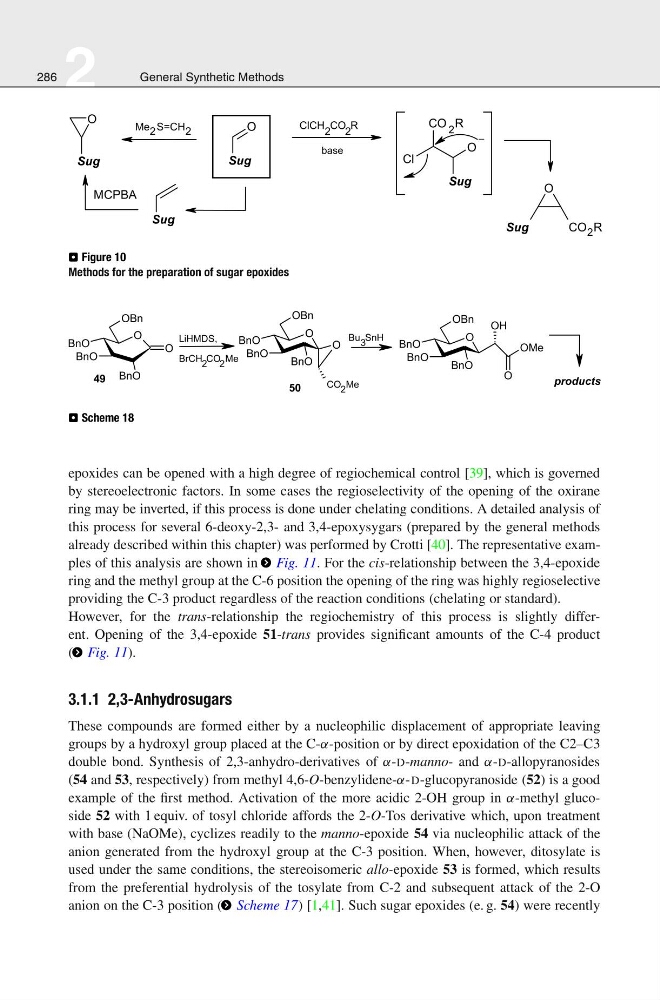
⊡ Figure 10
Methods for the preparation of sugar epoxides
⊡ Scheme 18
epoxides can be opened with a high degree of regiochemical control [39], which is governed
by stereoelectronic factors. In some cases the regioselectivity of the opening of the oxirane
ring may be inverted, if this process is done under chelating conditions. A detailed analysis of
this process for several 6-deoxy-2,3- and 3,4-epoxysygars (prepared by the general methods
already described within this chapter) was performed by Crotti [40]. The representative examples of this analysis are shown in > Fig. 11. For the cis-relationship between the 3,4-epoxide
ring and the methyl group at the C-6 position the opening of the ring was highly regioselective
providing the C-3 product regardless of the reaction conditions (chelating or standard).
However, for the trans-relationship the regiochemistry of this process is slightly different. Opening of the 3,4-epoxide 51-trans provides significant amounts of the C-4 product
( > Fig. 11).
3.1.1 2,3-Anhydrosugars
These compounds are formed either by a nucleophilic displacement of appropriate leaving
groups by a hydroxyl group placed at the C-α-position or by direct epoxidation of the C2–C3
double bond. Synthesis of 2,3-anhydro-derivatives of α-D-manno- and α-D-allopyranosides
(54 and 53, respectively) from methyl 4,6-O-benzylidene-α-D-glucopyranoside (52) is a good
example of the first method. Activation of the more acidic 2-OH group in α-methyl glucoside 52 with 1 equiv. of tosyl chloride affords the 2-O-Tos derivative which, upon treatment
with base (NaOMe), cyclizes readily to the manno-epoxide 54 via nucleophilic attack of the
anion generated from the hydroxyl group at the C-3 position. When, however, ditosylate is
used under the same conditions, the stereoisomeric allo-epoxide 53 is formed, which results
from the preferential hydrolysis of the tosylate from C-2 and subsequent attack of the 2-O
anion on the C-3 position ( > Scheme 17) [1,41]. Such sugar epoxides (e. g. 54) were recently
2
General Synthetic Methods
⊡ Figure 10
Methods for the preparation of sugar epoxides
⊡ Scheme 18
epoxides can be opened with a high degree of regiochemical control [39], which is governed
by stereoelectronic factors. In some cases the regioselectivity of the opening of the oxirane
ring may be inverted, if this process is done under chelating conditions. A detailed analysis of
this process for several 6-deoxy-2,3- and 3,4-epoxysygars (prepared by the general methods
already described within this chapter) was performed by Crotti [40]. The representative examples of this analysis are shown in > Fig. 11. For the cis-relationship between the 3,4-epoxide
ring and the methyl group at the C-6 position the opening of the ring was highly regioselective
providing the C-3 product regardless of the reaction conditions (chelating or standard).
However, for the trans-relationship the regiochemistry of this process is slightly different. Opening of the 3,4-epoxide 51-trans provides significant amounts of the C-4 product
( > Fig. 11).
3.1.1 2,3-Anhydrosugars
These compounds are formed either by a nucleophilic displacement of appropriate leaving
groups by a hydroxyl group placed at the C-α-position or by direct epoxidation of the C2–C3
double bond. Synthesis of 2,3-anhydro-derivatives of α-D-manno- and α-D-allopyranosides
(54 and 53, respectively) from methyl 4,6-O-benzylidene-α-D-glucopyranoside (52) is a good
example of the first method. Activation of the more acidic 2-OH group in α-methyl glucoside 52 with 1 equiv. of tosyl chloride affords the 2-O-Tos derivative which, upon treatment
with base (NaOMe), cyclizes readily to the manno-epoxide 54 via nucleophilic attack of the
anion generated from the hydroxyl group at the C-3 position. When, however, ditosylate is
used under the same conditions, the stereoisomeric allo-epoxide 53 is formed, which results
from the preferential hydrolysis of the tosylate from C-2 and subsequent attack of the 2-O
anion on the C-3 position ( > Scheme 17) [1,41]. Such sugar epoxides (e. g. 54) were recently