

284
2
General Synthetic Methods
sulfonylated partially protected sugars with a base or azide anion (NaN 3 ). Examples of the
preparation of 1,3-anhydropyranose and 1,4-anhydropyranose are shown in > Fig. 8 [3].
Substituted 1,3-anhydroglucopyranoses, in the presence of the acidic catalysts, undergo regioselective ring-opening polymerization providing (1→3)-β-D-glucopyranans. The 1,4-anhydrosugars are stable in basic media, but are readily hydrolyzed with acid. 1,4-Anhydro-galactose is so unstable that it is already decomposed on silica gel.
3 Non-anomeric Anhydrosugars: Synthesis and Reactions
This group of compounds is characterized by the presence of a free (or protected as a intermolecular glycoside) anomeric position. The anhydro function may be created between various (except anomeric) carbon atoms, thus a large number of such derivatives are possible.
The most convenient method of classification of such anhydrosugars is based on the size of
the anhydro ring: sugar oxiranes, oxetanes, THF and THP derivatives are known. The latter
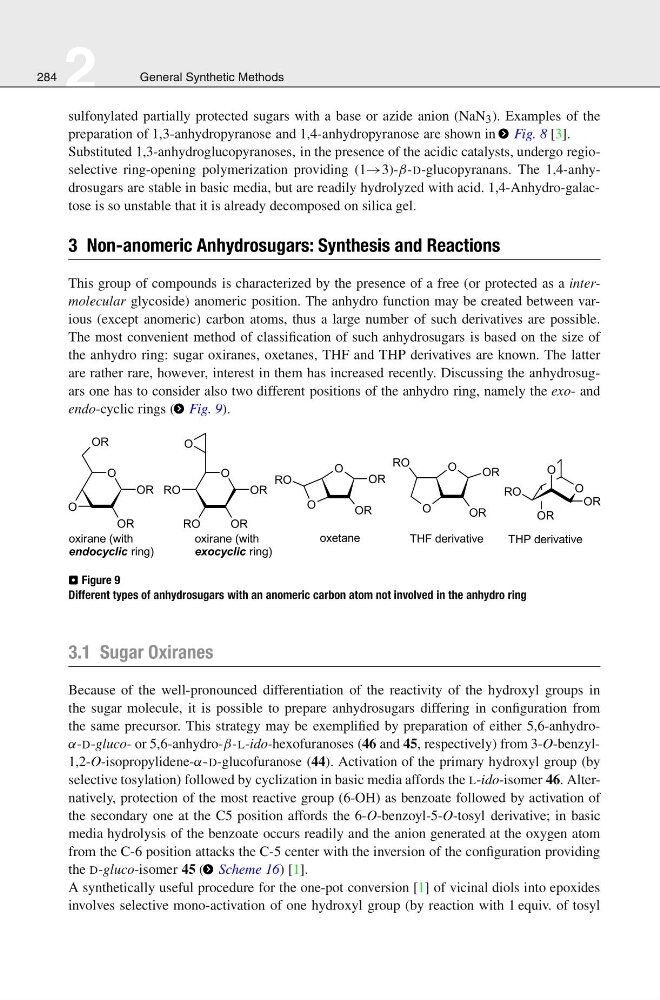
are rather rare, however, interest in them has increased recently. Discussing the anhydrosugars one has to consider also two different positions of the anhydro ring, namely the exo- and
endo-cyclic rings ( > Fig. 9).
⊡ Figure 9
Different types of anhydrosugars with an anomeric carbon atom not involved in the anhydro ring
3.1 Sugar Oxiranes
Because of the well-pronounced differentiation of the reactivity of the hydroxyl groups in
the sugar molecule, it is possible to prepare anhydrosugars differing in configuration from
the same precursor. This strategy may be exemplified by preparation of either 5,6-anhydroα-D-gluco- or 5,6-anhydro-β-L-ido-hexofuranoses (46 and 45, respectively) from 3-O-benzyl1,2-O-isopropylidene-α-D-glucofuranose (44). Activation of the primary hydroxyl group (by
selective tosylation) followed by cyclization in basic media affords the L-ido-isomer 46. Alternatively, protection of the most reactive group (6-OH) as benzoate followed by activation of
the secondary one at the C5 position affords the 6-O-benzoyl-5-O-tosyl derivative; in basic
media hydrolysis of the benzoate occurs readily and the anion generated at the oxygen atom
from the C-6 position attacks the C-5 center with the inversion of the configuration providing
the D-gluco-isomer 45 ( > Scheme 16) [1].
A synthetically useful procedure for the one-pot conversion [1] of vicinal diols into epoxides
involves selective mono-activation of one hydroxyl group (by reaction with 1 equiv. of tosyl
2
General Synthetic Methods
sulfonylated partially protected sugars with a base or azide anion (NaN 3 ). Examples of the
preparation of 1,3-anhydropyranose and 1,4-anhydropyranose are shown in > Fig. 8 [3].
Substituted 1,3-anhydroglucopyranoses, in the presence of the acidic catalysts, undergo regioselective ring-opening polymerization providing (1→3)-β-D-glucopyranans. The 1,4-anhydrosugars are stable in basic media, but are readily hydrolyzed with acid. 1,4-Anhydro-galactose is so unstable that it is already decomposed on silica gel.
3 Non-anomeric Anhydrosugars: Synthesis and Reactions
This group of compounds is characterized by the presence of a free (or protected as a intermolecular glycoside) anomeric position. The anhydro function may be created between various (except anomeric) carbon atoms, thus a large number of such derivatives are possible.
The most convenient method of classification of such anhydrosugars is based on the size of
the anhydro ring: sugar oxiranes, oxetanes, THF and THP derivatives are known. The latter
are rather rare, however, interest in them has increased recently. Discussing the anhydrosugars one has to consider also two different positions of the anhydro ring, namely the exo- and
endo-cyclic rings ( > Fig. 9).
⊡ Figure 9
Different types of anhydrosugars with an anomeric carbon atom not involved in the anhydro ring
3.1 Sugar Oxiranes
Because of the well-pronounced differentiation of the reactivity of the hydroxyl groups in
the sugar molecule, it is possible to prepare anhydrosugars differing in configuration from
the same precursor. This strategy may be exemplified by preparation of either 5,6-anhydroα-D-gluco- or 5,6-anhydro-β-L-ido-hexofuranoses (46 and 45, respectively) from 3-O-benzyl1,2-O-isopropylidene-α-D-glucofuranose (44). Activation of the primary hydroxyl group (by
selective tosylation) followed by cyclization in basic media affords the L-ido-isomer 46. Alternatively, protection of the most reactive group (6-OH) as benzoate followed by activation of
the secondary one at the C5 position affords the 6-O-benzoyl-5-O-tosyl derivative; in basic
media hydrolysis of the benzoate occurs readily and the anion generated at the oxygen atom
from the C-6 position attacks the C-5 center with the inversion of the configuration providing
the D-gluco-isomer 45 ( > Scheme 16) [1].
A synthetically useful procedure for the one-pot conversion [1] of vicinal diols into epoxides
involves selective mono-activation of one hydroxyl group (by reaction with 1 equiv. of tosyl