

250
2
General Synthetic Methods
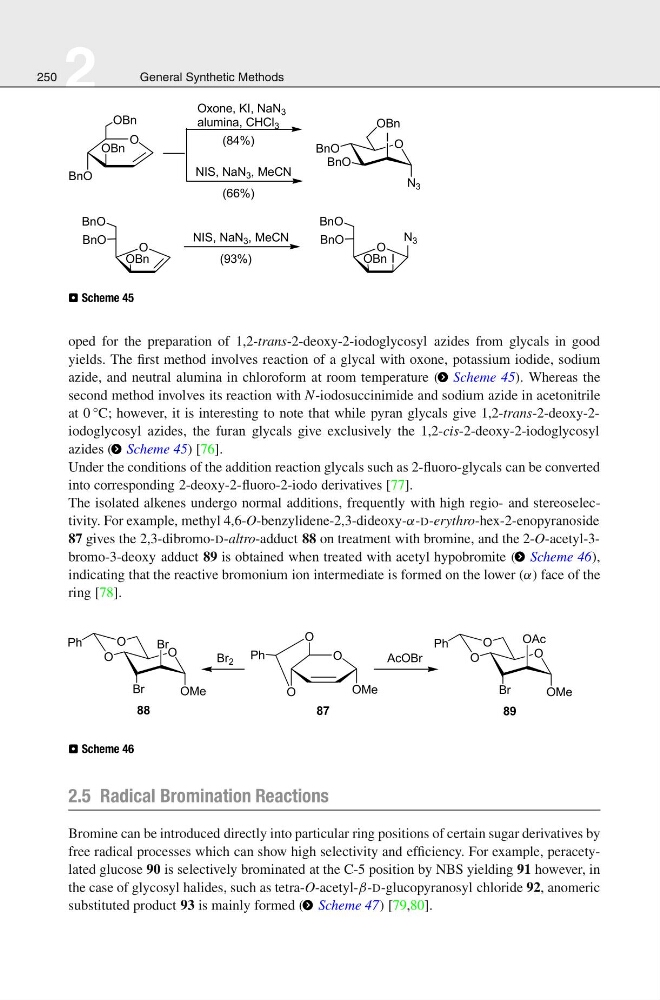
⊡ Scheme 45
oped for the preparation of 1,2-trans-2-deoxy-2-iodoglycosyl azides from glycals in good
yields. The first method involves reaction of a glycal with oxone, potassium iodide, sodium
azide, and neutral alumina in chloroform at room temperature ( > Scheme 45). Whereas the
second method involves its reaction with N-iodosuccinimide and sodium azide in acetonitrile
at 0 °C; however, it is interesting to note that while pyran glycals give 1,2-trans-2-deoxy-2iodoglycosyl azides, the furan glycals give exclusively the 1,2-cis-2-deoxy-2-iodoglycosyl
azides ( > Scheme 45) [76].
Under the conditions of the addition reaction glycals such as 2-fluoro-glycals can be converted
into corresponding 2-deoxy-2-fluoro-2-iodo derivatives [77].
The isolated alkenes undergo normal additions, frequently with high regio- and stereoselectivity. For example, methyl 4,6-O-benzylidene-2,3-dideoxy-α-D-erythro-hex-2-enopyranoside
87 gives the 2,3-dibromo-D-altro-adduct 88 on treatment with bromine, and the 2-O-acetyl-3bromo-3-deoxy adduct 89 is obtained when treated with acetyl hypobromite ( > Scheme 46),
indicating that the reactive bromonium ion intermediate is formed on the lower (α) face of the
ring [78].
⊡ Scheme 46
2.5 Radical Bromination Reactions
Bromine can be introduced directly into particular ring positions of certain sugar derivatives by
free radical processes which can show high selectivity and efficiency. For example, peracetylated glucose 90 is selectively brominated at the C-5 position by NBS yielding 91 however, in
the case of glycosyl halides, such as tetra-O-acetyl-β-D-glucopyranosyl chloride 92, anomeric
substituted product 93 is mainly formed ( > Scheme 47) [79,80].
2
General Synthetic Methods
⊡ Scheme 45
oped for the preparation of 1,2-trans-2-deoxy-2-iodoglycosyl azides from glycals in good
yields. The first method involves reaction of a glycal with oxone, potassium iodide, sodium
azide, and neutral alumina in chloroform at room temperature ( > Scheme 45). Whereas the
second method involves its reaction with N-iodosuccinimide and sodium azide in acetonitrile
at 0 °C; however, it is interesting to note that while pyran glycals give 1,2-trans-2-deoxy-2iodoglycosyl azides, the furan glycals give exclusively the 1,2-cis-2-deoxy-2-iodoglycosyl
azides ( > Scheme 45) [76].
Under the conditions of the addition reaction glycals such as 2-fluoro-glycals can be converted
into corresponding 2-deoxy-2-fluoro-2-iodo derivatives [77].
The isolated alkenes undergo normal additions, frequently with high regio- and stereoselectivity. For example, methyl 4,6-O-benzylidene-2,3-dideoxy-α-D-erythro-hex-2-enopyranoside
87 gives the 2,3-dibromo-D-altro-adduct 88 on treatment with bromine, and the 2-O-acetyl-3bromo-3-deoxy adduct 89 is obtained when treated with acetyl hypobromite ( > Scheme 46),
indicating that the reactive bromonium ion intermediate is formed on the lower (α) face of the
ring [78].
⊡ Scheme 46
2.5 Radical Bromination Reactions
Bromine can be introduced directly into particular ring positions of certain sugar derivatives by
free radical processes which can show high selectivity and efficiency. For example, peracetylated glucose 90 is selectively brominated at the C-5 position by NBS yielding 91 however, in
the case of glycosyl halides, such as tetra-O-acetyl-β-D-glucopyranosyl chloride 92, anomeric
substituted product 93 is mainly formed ( > Scheme 47) [79,80].