

Heteroatom Exchange
2.3
251
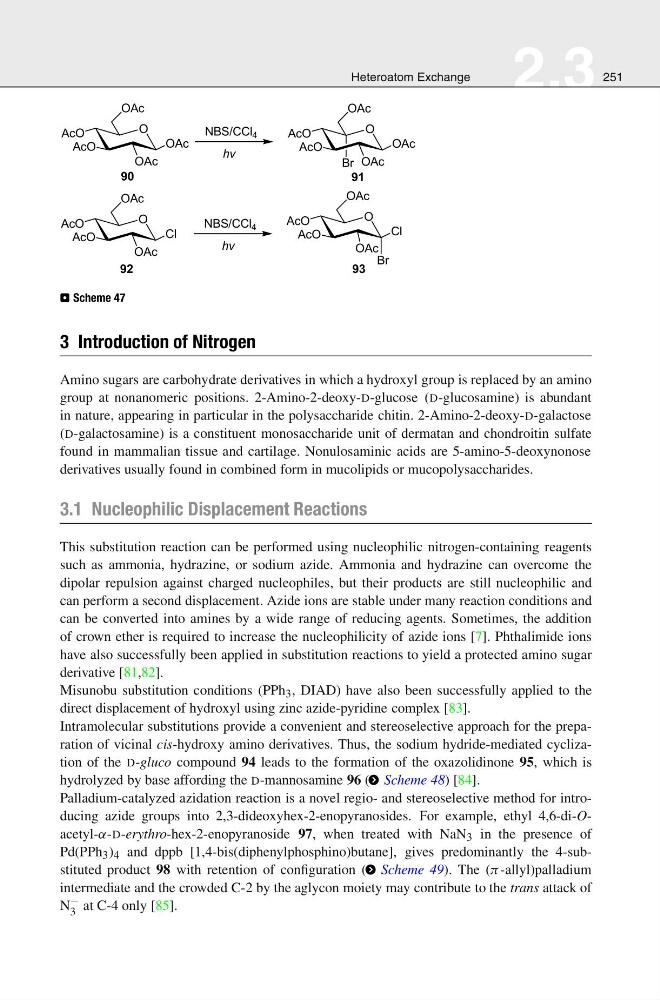
⊡ Scheme 47
3 Introduction of Nitrogen
Amino sugars are carbohydrate derivatives in which a hydroxyl group is replaced by an amino
group at nonanomeric positions. 2-Amino-2-deoxy-D-glucose (D-glucosamine) is abundant
in nature, appearing in particular in the polysaccharide chitin. 2-Amino-2-deoxy-D-galactose
(D-galactosamine) is a constituent monosaccharide unit of dermatan and chondroitin sulfate
found in mammalian tissue and cartilage. Nonulosaminic acids are 5-amino-5-deoxynonose
derivatives usually found in combined form in mucolipids or mucopolysaccharides.
3.1 Nucleophilic Displacement Reactions
This substitution reaction can be performed using nucleophilic nitrogen-containing reagents
such as ammonia, hydrazine, or sodium azide. Ammonia and hydrazine can overcome the
dipolar repulsion against charged nucleophiles, but their products are still nucleophilic and
can perform a second displacement. Azide ions are stable under many reaction conditions and
can be converted into amines by a wide range of reducing agents. Sometimes, the addition
of crown ether is required to increase the nucleophilicity of azide ions [7]. Phthalimide ions
have also successfully been applied in substitution reactions to yield a protected amino sugar
derivative [81,82].
Misunobu substitution conditions (PPh 3 , DIAD) have also been successfully applied to the
direct displacement of hydroxyl using zinc azide-pyridine complex [83].
Intramolecular substitutions provide a convenient and stereoselective approach for the preparation of vicinal cis-hydroxy amino derivatives. Thus, the sodium hydride-mediated cyclization of the D-gluco compound 94 leads to the formation of the oxazolidinone 95, which is
hydrolyzed by base affording the D-mannosamine 96 ( > Scheme 48) [84].
Palladium-catalyzed azidation reaction is a novel regio- and stereoselective method for introducing azide groups into 2,3-dideoxyhex-2-enopyranosides. For example, ethyl 4,6-di-Oacetyl-α-D-erythro-hex-2-enopyranoside 97, when treated with NaN 3 in the presence of
Pd(PPh 3 ) 4 and dppb [1,4-bis(diphenylphosphino)butane], gives predominantly the 4-substituted product 98 with retention of configuration ( > Scheme 49). The (π-allyl)palladium
intermediate and the crowded C-2 by the aglycon moiety may contribute to the trans attack of
N
−
3 at C-4 only [85].
2.3
251
⊡ Scheme 47
3 Introduction of Nitrogen
Amino sugars are carbohydrate derivatives in which a hydroxyl group is replaced by an amino
group at nonanomeric positions. 2-Amino-2-deoxy-D-glucose (D-glucosamine) is abundant
in nature, appearing in particular in the polysaccharide chitin. 2-Amino-2-deoxy-D-galactose
(D-galactosamine) is a constituent monosaccharide unit of dermatan and chondroitin sulfate
found in mammalian tissue and cartilage. Nonulosaminic acids are 5-amino-5-deoxynonose
derivatives usually found in combined form in mucolipids or mucopolysaccharides.
3.1 Nucleophilic Displacement Reactions
This substitution reaction can be performed using nucleophilic nitrogen-containing reagents
such as ammonia, hydrazine, or sodium azide. Ammonia and hydrazine can overcome the
dipolar repulsion against charged nucleophiles, but their products are still nucleophilic and
can perform a second displacement. Azide ions are stable under many reaction conditions and
can be converted into amines by a wide range of reducing agents. Sometimes, the addition
of crown ether is required to increase the nucleophilicity of azide ions [7]. Phthalimide ions
have also successfully been applied in substitution reactions to yield a protected amino sugar
derivative [81,82].
Misunobu substitution conditions (PPh 3 , DIAD) have also been successfully applied to the
direct displacement of hydroxyl using zinc azide-pyridine complex [83].
Intramolecular substitutions provide a convenient and stereoselective approach for the preparation of vicinal cis-hydroxy amino derivatives. Thus, the sodium hydride-mediated cyclization of the D-gluco compound 94 leads to the formation of the oxazolidinone 95, which is
hydrolyzed by base affording the D-mannosamine 96 ( > Scheme 48) [84].
Palladium-catalyzed azidation reaction is a novel regio- and stereoselective method for introducing azide groups into 2,3-dideoxyhex-2-enopyranosides. For example, ethyl 4,6-di-Oacetyl-α-D-erythro-hex-2-enopyranoside 97, when treated with NaN 3 in the presence of
Pd(PPh 3 ) 4 and dppb [1,4-bis(diphenylphosphino)butane], gives predominantly the 4-substituted product 98 with retention of configuration ( > Scheme 49). The (π-allyl)palladium
intermediate and the crowded C-2 by the aglycon moiety may contribute to the trans attack of
N
−
3 at C-4 only [85].