

Heteroatom Exchange
2.3
249
also be applied to 2,3- and 3,4-benzylidene acetals of pyranosides and furanosides, and proceeds regioselectively [23]. When there are no stereochemical constrains to effect regioselectivity, mixtures of isomers are formed. And similar transformations can be performed using
bromotrichloromethane as the bromine source [70].
2.4 Addition to Unsaturated Sugar Derivatives
Addition reactions of electrophilic halogenation reagents to unsaturated sugars constitute
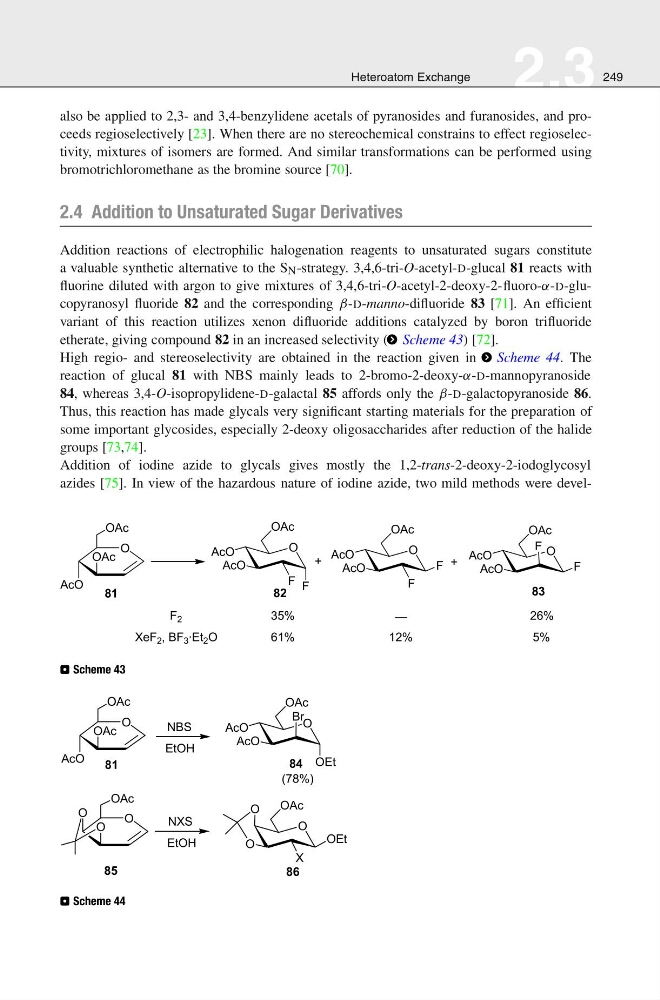
a valuable synthetic alternative to the S N -strategy. 3,4,6-tri-O-acetyl-D-glucal 81 reacts with
fluorine diluted with argon to give mixtures of 3,4,6-tri-O-acetyl-2-deoxy-2-fluoro-α-D-glucopyranosyl fluoride 82 and the corresponding β-D-manno-difluoride 83 [71]. An efficient
variant of this reaction utilizes xenon difluoride additions catalyzed by boron trifluoride
etherate, giving compound 82 in an increased selectivity ( > Scheme 43) [72].
High regio- and stereoselectivity are obtained in the reaction given in > Scheme 44. The
reaction of glucal 81 with NBS mainly leads to 2-bromo-2-deoxy-α-D-mannopyranoside
84, whereas 3,4-O-isopropylidene-D-galactal 85 affords only the β-D-galactopyranoside 86.
Thus, this reaction has made glycals very significant starting materials for the preparation of
some important glycosides, especially 2-deoxy oligosaccharides after reduction of the halide
groups [73,74].
Addition of iodine azide to glycals gives mostly the 1,2-trans-2-deoxy-2-iodoglycosyl
azides [75]. In view of the hazardous nature of iodine azide, two mild methods were devel⊡ Scheme 43
⊡ Scheme 44
2.3
249
also be applied to 2,3- and 3,4-benzylidene acetals of pyranosides and furanosides, and proceeds regioselectively [23]. When there are no stereochemical constrains to effect regioselectivity, mixtures of isomers are formed. And similar transformations can be performed using
bromotrichloromethane as the bromine source [70].
2.4 Addition to Unsaturated Sugar Derivatives
Addition reactions of electrophilic halogenation reagents to unsaturated sugars constitute
a valuable synthetic alternative to the S N -strategy. 3,4,6-tri-O-acetyl-D-glucal 81 reacts with
fluorine diluted with argon to give mixtures of 3,4,6-tri-O-acetyl-2-deoxy-2-fluoro-α-D-glucopyranosyl fluoride 82 and the corresponding β-D-manno-difluoride 83 [71]. An efficient
variant of this reaction utilizes xenon difluoride additions catalyzed by boron trifluoride
etherate, giving compound 82 in an increased selectivity ( > Scheme 43) [72].
High regio- and stereoselectivity are obtained in the reaction given in > Scheme 44. The
reaction of glucal 81 with NBS mainly leads to 2-bromo-2-deoxy-α-D-mannopyranoside
84, whereas 3,4-O-isopropylidene-D-galactal 85 affords only the β-D-galactopyranoside 86.
Thus, this reaction has made glycals very significant starting materials for the preparation of
some important glycosides, especially 2-deoxy oligosaccharides after reduction of the halide
groups [73,74].
Addition of iodine azide to glycals gives mostly the 1,2-trans-2-deoxy-2-iodoglycosyl
azides [75]. In view of the hazardous nature of iodine azide, two mild methods were devel⊡ Scheme 43
⊡ Scheme 44