

248
2
General Synthetic Methods
A special example of epoxide opening reaction is outlined in > Scheme 40. Methyl 2,3anhydro-4,6-O-benzylidene-α-D-allopyranoside 72 gives the 2-chloro-2-deoxy-3-O-formylaltroside 73 on treatment of (chloromethylene)dimethyliminium chloride at room temperature.
Alternatively, when the reaction mixture is heated for a longer time, methyl 3,4-O-benzylidene-2,6-dichloro-2,6-dideoxy-α-D-altroside 74 is obtained by means of a rearrangement of
the benzylidene group [51].
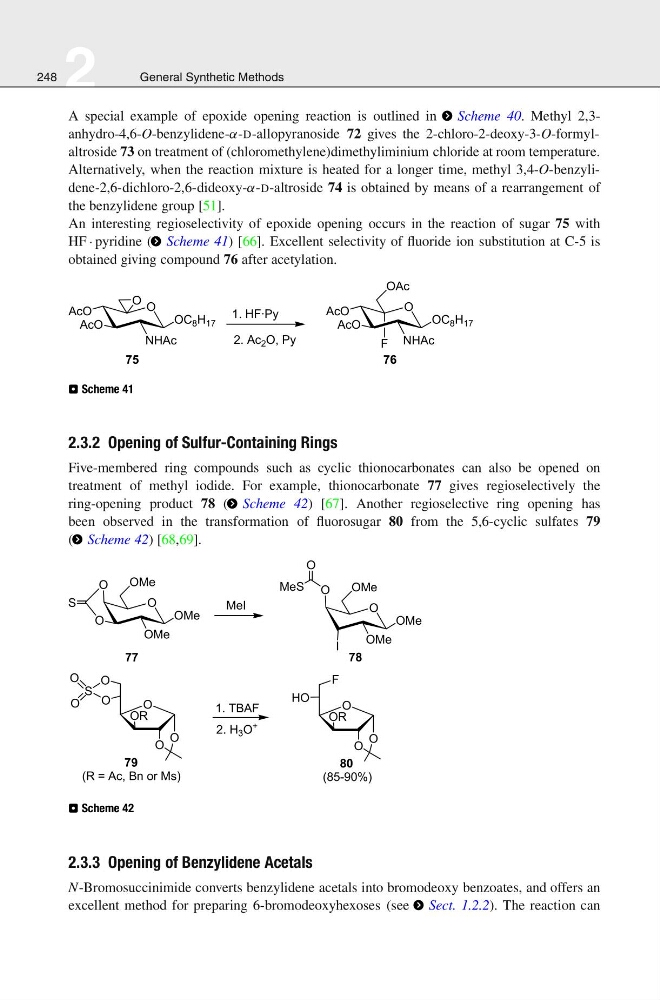
An interesting regioselectivity of epoxide opening occurs in the reaction of sugar 75 with
HF · pyridine ( > Scheme 41) [66]. Excellent selectivity of fluoride ion substitution at C-5 is
obtained giving compound 76 after acetylation.
⊡ Scheme 41
2.3.2 Opening of Sulfur-Containing Rings
Five-membered ring compounds such as cyclic thionocarbonates can also be opened on
treatment of methyl iodide. For example, thionocarbonate 77 gives regioselectively the
ring-opening product 78 ( > Scheme 42) [67]. Another regioselective ring opening has
been observed in the transformation of fluorosugar 80 from the 5,6-cyclic sulfates 79
( > Scheme 42) [68,69].
⊡ Scheme 42
2.3.3 Opening of Benzylidene Acetals
N-Bromosuccinimide converts benzylidene acetals into bromodeoxy benzoates, and offers an
excellent method for preparing 6-bromodeoxyhexoses (see > Sect. 1.2.2). The reaction can
2
General Synthetic Methods
A special example of epoxide opening reaction is outlined in > Scheme 40. Methyl 2,3anhydro-4,6-O-benzylidene-α-D-allopyranoside 72 gives the 2-chloro-2-deoxy-3-O-formylaltroside 73 on treatment of (chloromethylene)dimethyliminium chloride at room temperature.
Alternatively, when the reaction mixture is heated for a longer time, methyl 3,4-O-benzylidene-2,6-dichloro-2,6-dideoxy-α-D-altroside 74 is obtained by means of a rearrangement of
the benzylidene group [51].
An interesting regioselectivity of epoxide opening occurs in the reaction of sugar 75 with
HF · pyridine ( > Scheme 41) [66]. Excellent selectivity of fluoride ion substitution at C-5 is
obtained giving compound 76 after acetylation.
⊡ Scheme 41
2.3.2 Opening of Sulfur-Containing Rings
Five-membered ring compounds such as cyclic thionocarbonates can also be opened on
treatment of methyl iodide. For example, thionocarbonate 77 gives regioselectively the
ring-opening product 78 ( > Scheme 42) [67]. Another regioselective ring opening has
been observed in the transformation of fluorosugar 80 from the 5,6-cyclic sulfates 79
( > Scheme 42) [68,69].
⊡ Scheme 42
2.3.3 Opening of Benzylidene Acetals
N-Bromosuccinimide converts benzylidene acetals into bromodeoxy benzoates, and offers an
excellent method for preparing 6-bromodeoxyhexoses (see > Sect. 1.2.2). The reaction can