

244
2
General Synthetic Methods
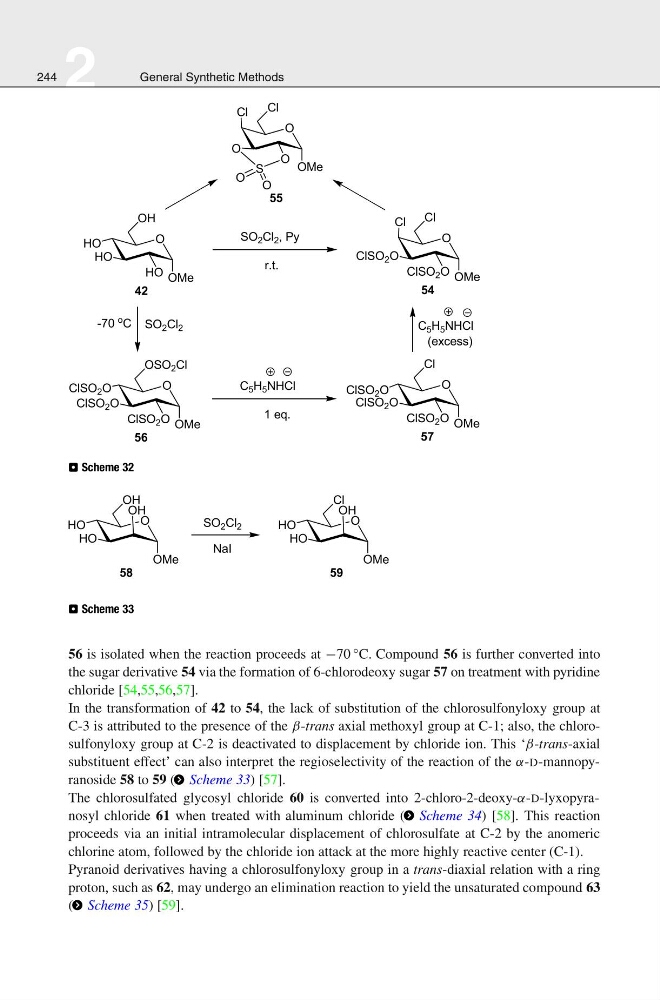
⊡ Scheme 32
⊡ Scheme 33
56 is isolated when the reaction proceeds at −70 °C. Compound 56 is further converted into
the sugar derivative 54 via the formation of 6-chlorodeoxy sugar 57 on treatment with pyridine
chloride [54,55,56,57].
In the transformation of 42 to 54, the lack of substitution of the chlorosulfonyloxy group at
C-3 is attributed to the presence of the β-trans axial methoxyl group at C-1; also, the chlorosulfonyloxy group at C-2 is deactivated to displacement by chloride ion. This ‘β-trans-axial
substituent effect’ can also interpret the regioselectivity of the reaction of the α-D-mannopyranoside 58 to 59 ( > Scheme 33) [57].
The chlorosulfated glycosyl chloride 60 is converted into 2-chloro-2-deoxy-α-D-lyxopyranosyl chloride 61 when treated with aluminum chloride ( > Scheme 34) [58]. This reaction
proceeds via an initial intramolecular displacement of chlorosulfate at C-2 by the anomeric
chlorine atom, followed by the chloride ion attack at the more highly reactive center (C-1).
Pyranoid derivatives having a chlorosulfonyloxy group in a trans-diaxial relation with a ring
proton, such as 62, may undergo an elimination reaction to yield the unsaturated compound 63
( > Scheme 35) [59].
2
General Synthetic Methods
⊡ Scheme 32
⊡ Scheme 33
56 is isolated when the reaction proceeds at −70 °C. Compound 56 is further converted into
the sugar derivative 54 via the formation of 6-chlorodeoxy sugar 57 on treatment with pyridine
chloride [54,55,56,57].
In the transformation of 42 to 54, the lack of substitution of the chlorosulfonyloxy group at
C-3 is attributed to the presence of the β-trans axial methoxyl group at C-1; also, the chlorosulfonyloxy group at C-2 is deactivated to displacement by chloride ion. This ‘β-trans-axial
substituent effect’ can also interpret the regioselectivity of the reaction of the α-D-mannopyranoside 58 to 59 ( > Scheme 33) [57].
The chlorosulfated glycosyl chloride 60 is converted into 2-chloro-2-deoxy-α-D-lyxopyranosyl chloride 61 when treated with aluminum chloride ( > Scheme 34) [58]. This reaction
proceeds via an initial intramolecular displacement of chlorosulfate at C-2 by the anomeric
chlorine atom, followed by the chloride ion attack at the more highly reactive center (C-1).
Pyranoid derivatives having a chlorosulfonyloxy group in a trans-diaxial relation with a ring
proton, such as 62, may undergo an elimination reaction to yield the unsaturated compound 63
( > Scheme 35) [59].