

Heteroatom Exchange
2.3
243
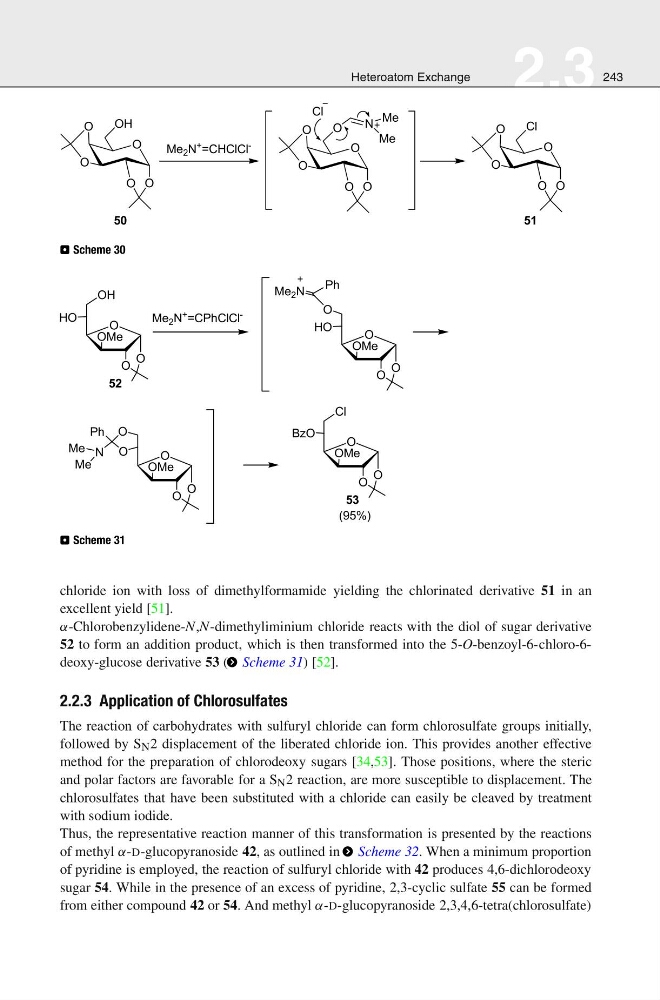
⊡ Scheme 30
⊡ Scheme 31
chloride ion with loss of dimethylformamide yielding the chlorinated derivative 51 in an
excellent yield [51].
α-Chlorobenzylidene-N,N-dimethyliminium chloride reacts with the diol of sugar derivative
52 to form an addition product, which is then transformed into the 5-O-benzoyl-6-chloro-6deoxy-glucose derivative 53 ( > Scheme 31) [52].
2.2.3 Application of Chlorosulfates
The reaction of carbohydrates with sulfuryl chloride can form chlorosulfate groups initially,
followed by S N 2 displacement of the liberated chloride ion. This provides another effective
method for the preparation of chlorodeoxy sugars [34,53]. Those positions, where the steric
and polar factors are favorable for a S N 2 reaction, are more susceptible to displacement. The
chlorosulfates that have been substituted with a chloride can easily be cleaved by treatment
with sodium iodide.
Thus, the representative reaction manner of this transformation is presented by the reactions
of methyl α-D-glucopyranoside 42, as outlined in > Scheme 32. When a minimum proportion
of pyridine is employed, the reaction of sulfuryl chloride with 42 produces 4,6-dichlorodeoxy
sugar 54. While in the presence of an excess of pyridine, 2,3-cyclic sulfate 55 can be formed
from either compound 42 or 54. And methyl α-D-glucopyranoside 2,3,4,6-tetra(chlorosulfate)
2.3
243
⊡ Scheme 30
⊡ Scheme 31
chloride ion with loss of dimethylformamide yielding the chlorinated derivative 51 in an
excellent yield [51].
α-Chlorobenzylidene-N,N-dimethyliminium chloride reacts with the diol of sugar derivative
52 to form an addition product, which is then transformed into the 5-O-benzoyl-6-chloro-6deoxy-glucose derivative 53 ( > Scheme 31) [52].
2.2.3 Application of Chlorosulfates
The reaction of carbohydrates with sulfuryl chloride can form chlorosulfate groups initially,
followed by S N 2 displacement of the liberated chloride ion. This provides another effective
method for the preparation of chlorodeoxy sugars [34,53]. Those positions, where the steric
and polar factors are favorable for a S N 2 reaction, are more susceptible to displacement. The
chlorosulfates that have been substituted with a chloride can easily be cleaved by treatment
with sodium iodide.
Thus, the representative reaction manner of this transformation is presented by the reactions
of methyl α-D-glucopyranoside 42, as outlined in > Scheme 32. When a minimum proportion
of pyridine is employed, the reaction of sulfuryl chloride with 42 produces 4,6-dichlorodeoxy
sugar 54. While in the presence of an excess of pyridine, 2,3-cyclic sulfate 55 can be formed
from either compound 42 or 54. And methyl α-D-glucopyranoside 2,3,4,6-tetra(chlorosulfate)