

242
2
General Synthetic Methods
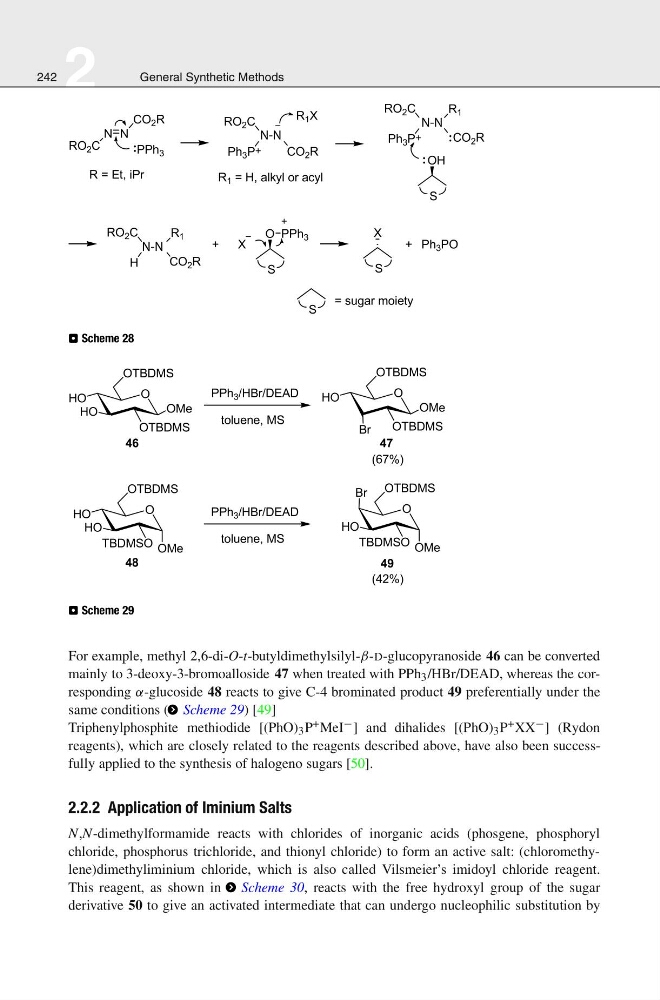
⊡ Scheme 28
⊡ Scheme 29
For example, methyl 2,6-di-O-t-butyldimethylsilyl-β-D-glucopyranoside 46 can be converted
mainly to 3-deoxy-3-bromoalloside 47 when treated with PPh 3 /HBr/DEAD, whereas the corresponding α-glucoside 48 reacts to give C-4 brominated product 49 preferentially under the
same conditions ( > Scheme 29) [49]
Triphenylphosphite methiodide [(PhO) 3 P + MeI − ] and dihalides [(PhO) 3 P + XX − ] (Rydon
reagents), which are closely related to the reagents described above, have also been successfully applied to the synthesis of halogeno sugars [50].
2.2.2 Application of Iminium Salts
N,N-dimethylformamide reacts with chlorides of inorganic acids (phosgene, phosphoryl
chloride, phosphorus trichloride, and thionyl chloride) to form an active salt: (chloromethylene)dimethyliminium chloride, which is also called Vilsmeier’s imidoyl chloride reagent.
This reagent, as shown in > Scheme 30, reacts with the free hydroxyl group of the sugar
derivative 50 to give an activated intermediate that can undergo nucleophilic substitution by
2
General Synthetic Methods
⊡ Scheme 28
⊡ Scheme 29
For example, methyl 2,6-di-O-t-butyldimethylsilyl-β-D-glucopyranoside 46 can be converted
mainly to 3-deoxy-3-bromoalloside 47 when treated with PPh 3 /HBr/DEAD, whereas the corresponding α-glucoside 48 reacts to give C-4 brominated product 49 preferentially under the
same conditions ( > Scheme 29) [49]
Triphenylphosphite methiodide [(PhO) 3 P + MeI − ] and dihalides [(PhO) 3 P + XX − ] (Rydon
reagents), which are closely related to the reagents described above, have also been successfully applied to the synthesis of halogeno sugars [50].
2.2.2 Application of Iminium Salts
N,N-dimethylformamide reacts with chlorides of inorganic acids (phosgene, phosphoryl
chloride, phosphorus trichloride, and thionyl chloride) to form an active salt: (chloromethylene)dimethyliminium chloride, which is also called Vilsmeier’s imidoyl chloride reagent.
This reagent, as shown in > Scheme 30, reacts with the free hydroxyl group of the sugar
derivative 50 to give an activated intermediate that can undergo nucleophilic substitution by