

Heteroatom Exchange
2.3
241
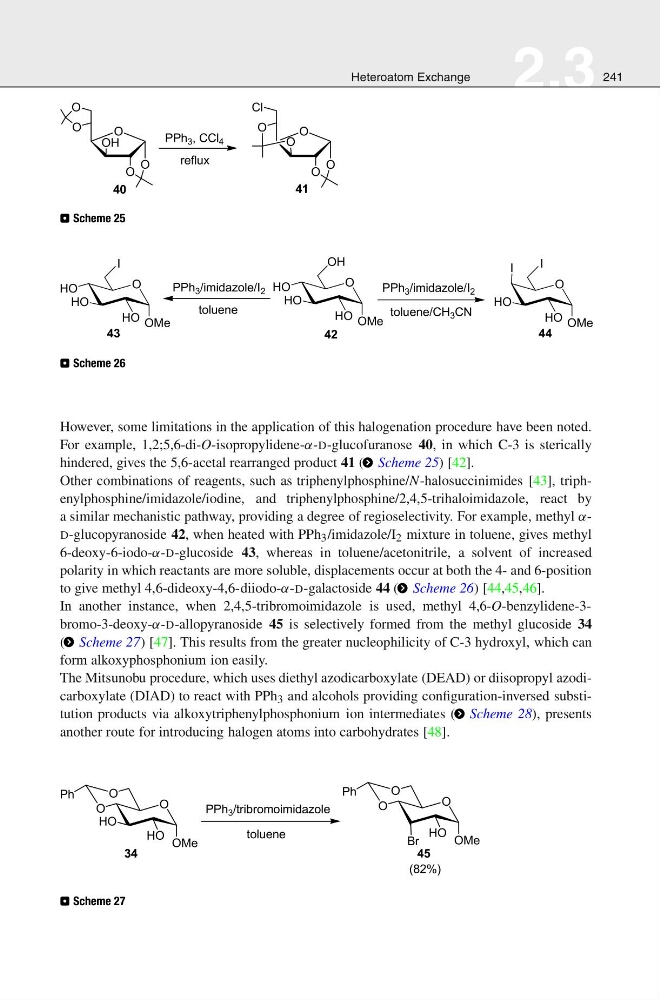
⊡ Scheme 25
⊡ Scheme 26
However, some limitations in the application of this halogenation procedure have been noted.
For example, 1,2;5,6-di-O-isopropylidene-α-D-glucofuranose 40, in which C-3 is sterically
hindered, gives the 5,6-acetal rearranged product 41 ( > Scheme 25) [42].
Other combinations of reagents, such as triphenylphosphine/N-halosuccinimides [43], triphenylphosphine/imidazole/iodine, and triphenylphosphine/2,4,5-trihaloimidazole, react by
a similar mechanistic pathway, providing a degree of regioselectivity. For example, methyl αD-glucopyranoside 42, when heated with PPh 3 /imidazole/I 2 mixture in toluene, gives methyl
6-deoxy-6-iodo-α-D-glucoside 43, whereas in toluene/acetonitrile, a solvent of increased
polarity in which reactants are more soluble, displacements occur at both the 4- and 6-position
to give methyl 4,6-dideoxy-4,6-diiodo-α-D-galactoside 44 ( > Scheme 26) [44,45,46].
In another instance, when 2,4,5-tribromoimidazole is used, methyl 4,6-O-benzylidene-3bromo-3-deoxy-α-D-allopyranoside 45 is selectively formed from the methyl glucoside 34
( > Scheme 27) [47]. This results from the greater nucleophilicity of C-3 hydroxyl, which can
form alkoxyphosphonium ion easily.
The Mitsunobu procedure, which uses diethyl azodicarboxylate (DEAD) or diisopropyl azodicarboxylate (DIAD) to react with PPh 3 and alcohols providing configuration-inversed substitution products via alkoxytriphenylphosphonium ion intermediates ( > Scheme 28), presents
another route for introducing halogen atoms into carbohydrates [48].
⊡ Scheme 27
2.3
241
⊡ Scheme 25
⊡ Scheme 26
However, some limitations in the application of this halogenation procedure have been noted.
For example, 1,2;5,6-di-O-isopropylidene-α-D-glucofuranose 40, in which C-3 is sterically
hindered, gives the 5,6-acetal rearranged product 41 ( > Scheme 25) [42].
Other combinations of reagents, such as triphenylphosphine/N-halosuccinimides [43], triphenylphosphine/imidazole/iodine, and triphenylphosphine/2,4,5-trihaloimidazole, react by
a similar mechanistic pathway, providing a degree of regioselectivity. For example, methyl αD-glucopyranoside 42, when heated with PPh 3 /imidazole/I 2 mixture in toluene, gives methyl
6-deoxy-6-iodo-α-D-glucoside 43, whereas in toluene/acetonitrile, a solvent of increased
polarity in which reactants are more soluble, displacements occur at both the 4- and 6-position
to give methyl 4,6-dideoxy-4,6-diiodo-α-D-galactoside 44 ( > Scheme 26) [44,45,46].
In another instance, when 2,4,5-tribromoimidazole is used, methyl 4,6-O-benzylidene-3bromo-3-deoxy-α-D-allopyranoside 45 is selectively formed from the methyl glucoside 34
( > Scheme 27) [47]. This results from the greater nucleophilicity of C-3 hydroxyl, which can
form alkoxyphosphonium ion easily.
The Mitsunobu procedure, which uses diethyl azodicarboxylate (DEAD) or diisopropyl azodicarboxylate (DIAD) to react with PPh 3 and alcohols providing configuration-inversed substitution products via alkoxytriphenylphosphonium ion intermediates ( > Scheme 28), presents
another route for introducing halogen atoms into carbohydrates [48].
⊡ Scheme 27