

Heteroatom Exchange
2.3
245
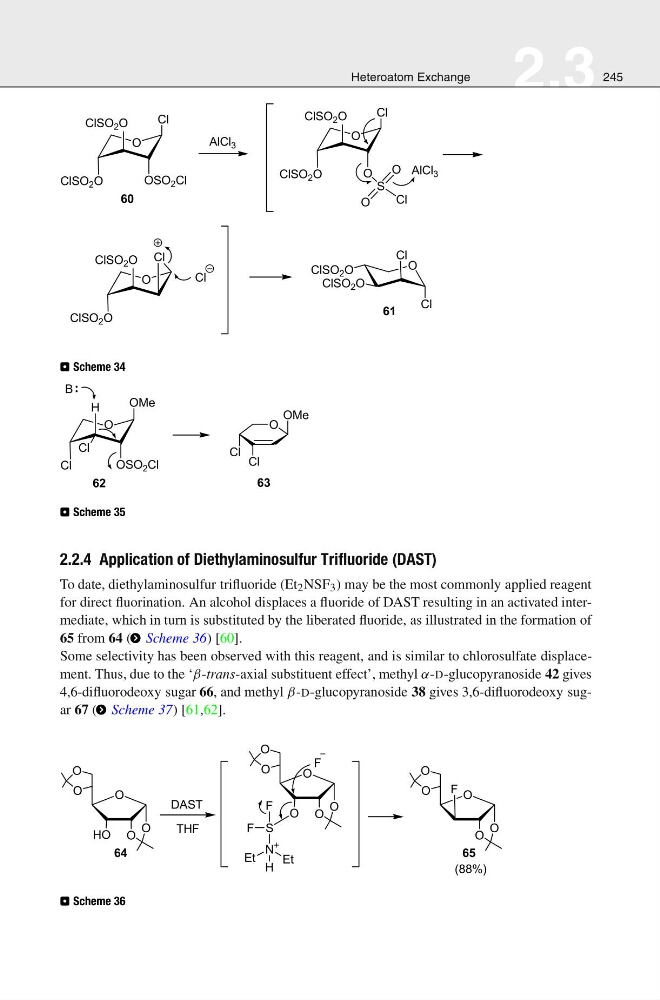
⊡ Scheme 34
⊡ Scheme 35
2.2.4 Application of Diethylaminosulfur Trifluoride (DAST)
To date, diethylaminosulfur trifluoride (Et 2 NSF 3 ) may be the most commonly applied reagent
for direct fluorination. An alcohol displaces a fluoride of DAST resulting in an activated intermediate, which in turn is substituted by the liberated fluoride, as illustrated in the formation of
65 from 64 ( > Scheme 36) [60].
Some selectivity has been observed with this reagent, and is similar to chlorosulfate displacement. Thus, due to the ‘β-trans-axial substituent effect’, methyl α-D-glucopyranoside 42 gives
4,6-difluorodeoxy sugar 66, and methyl β-D-glucopyranoside 38 gives 3,6-difluorodeoxy sugar 67 ( > Scheme 37) [61,62].
⊡ Scheme 36
2.3
245
⊡ Scheme 34
⊡ Scheme 35
2.2.4 Application of Diethylaminosulfur Trifluoride (DAST)
To date, diethylaminosulfur trifluoride (Et 2 NSF 3 ) may be the most commonly applied reagent
for direct fluorination. An alcohol displaces a fluoride of DAST resulting in an activated intermediate, which in turn is substituted by the liberated fluoride, as illustrated in the formation of
65 from 64 ( > Scheme 36) [60].
Some selectivity has been observed with this reagent, and is similar to chlorosulfate displacement. Thus, due to the ‘β-trans-axial substituent effect’, methyl α-D-glucopyranoside 42 gives
4,6-difluorodeoxy sugar 66, and methyl β-D-glucopyranoside 38 gives 3,6-difluorodeoxy sugar 67 ( > Scheme 37) [61,62].
⊡ Scheme 36