

238
2
General Synthetic Methods
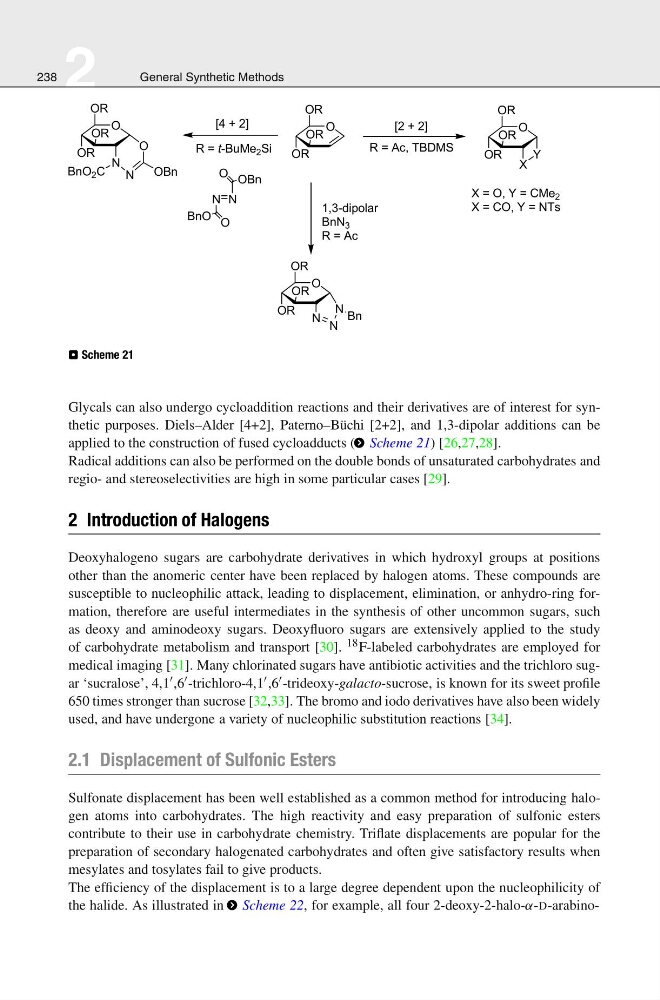
⊡ Scheme 21
Glycals can also undergo cycloaddition reactions and their derivatives are of interest for synthetic purposes. Diels–Alder [4+2], Paterno–Büchi [2+2], and 1,3-dipolar additions can be
applied to the construction of fused cycloadducts ( > Scheme 21) [26,27,28].
Radical additions can also be performed on the double bonds of unsaturated carbohydrates and
regio- and stereoselectivities are high in some particular cases [29].
2 Introduction of Halogens
Deoxyhalogeno sugars are carbohydrate derivatives in which hydroxyl groups at positions
other than the anomeric center have been replaced by halogen atoms. These compounds are
susceptible to nucleophilic attack, leading to displacement, elimination, or anhydro-ring formation, therefore are useful intermediates in the synthesis of other uncommon sugars, such
as deoxy and aminodeoxy sugars. Deoxyfluoro sugars are extensively applied to the study
of carbohydrate metabolism and transport [30]. 18 F-labeled carbohydrates are employed for
medical imaging [31]. Many chlorinated sugars have antibiotic activities and the trichloro sugar ‘sucralose’, 4,1 ,6 -trichloro-4,1 ,6 -trideoxy-galacto-sucrose, is known for its sweet profile
650 times stronger than sucrose [32,33]. The bromo and iodo derivatives have also been widely
used, and have undergone a variety of nucleophilic substitution reactions [34].
2.1 Displacement of Sulfonic Esters
Sulfonate displacement has been well established as a common method for introducing halogen atoms into carbohydrates. The high reactivity and easy preparation of sulfonic esters
contribute to their use in carbohydrate chemistry. Triflate displacements are popular for the
preparation of secondary halogenated carbohydrates and often give satisfactory results when
mesylates and tosylates fail to give products.
The efficiency of the displacement is to a large degree dependent upon the nucleophilicity of
the halide. As illustrated in > Scheme 22, for example, all four 2-deoxy-2-halo-α-D-arabino-
2
General Synthetic Methods
⊡ Scheme 21
Glycals can also undergo cycloaddition reactions and their derivatives are of interest for synthetic purposes. Diels–Alder [4+2], Paterno–Büchi [2+2], and 1,3-dipolar additions can be
applied to the construction of fused cycloadducts ( > Scheme 21) [26,27,28].
Radical additions can also be performed on the double bonds of unsaturated carbohydrates and
regio- and stereoselectivities are high in some particular cases [29].
2 Introduction of Halogens
Deoxyhalogeno sugars are carbohydrate derivatives in which hydroxyl groups at positions
other than the anomeric center have been replaced by halogen atoms. These compounds are
susceptible to nucleophilic attack, leading to displacement, elimination, or anhydro-ring formation, therefore are useful intermediates in the synthesis of other uncommon sugars, such
as deoxy and aminodeoxy sugars. Deoxyfluoro sugars are extensively applied to the study
of carbohydrate metabolism and transport [30]. 18 F-labeled carbohydrates are employed for
medical imaging [31]. Many chlorinated sugars have antibiotic activities and the trichloro sugar ‘sucralose’, 4,1 ,6 -trichloro-4,1 ,6 -trideoxy-galacto-sucrose, is known for its sweet profile
650 times stronger than sucrose [32,33]. The bromo and iodo derivatives have also been widely
used, and have undergone a variety of nucleophilic substitution reactions [34].
2.1 Displacement of Sulfonic Esters
Sulfonate displacement has been well established as a common method for introducing halogen atoms into carbohydrates. The high reactivity and easy preparation of sulfonic esters
contribute to their use in carbohydrate chemistry. Triflate displacements are popular for the
preparation of secondary halogenated carbohydrates and often give satisfactory results when
mesylates and tosylates fail to give products.
The efficiency of the displacement is to a large degree dependent upon the nucleophilicity of
the halide. As illustrated in > Scheme 22, for example, all four 2-deoxy-2-halo-α-D-arabino-