

Heteroatom Exchange
2.3
239
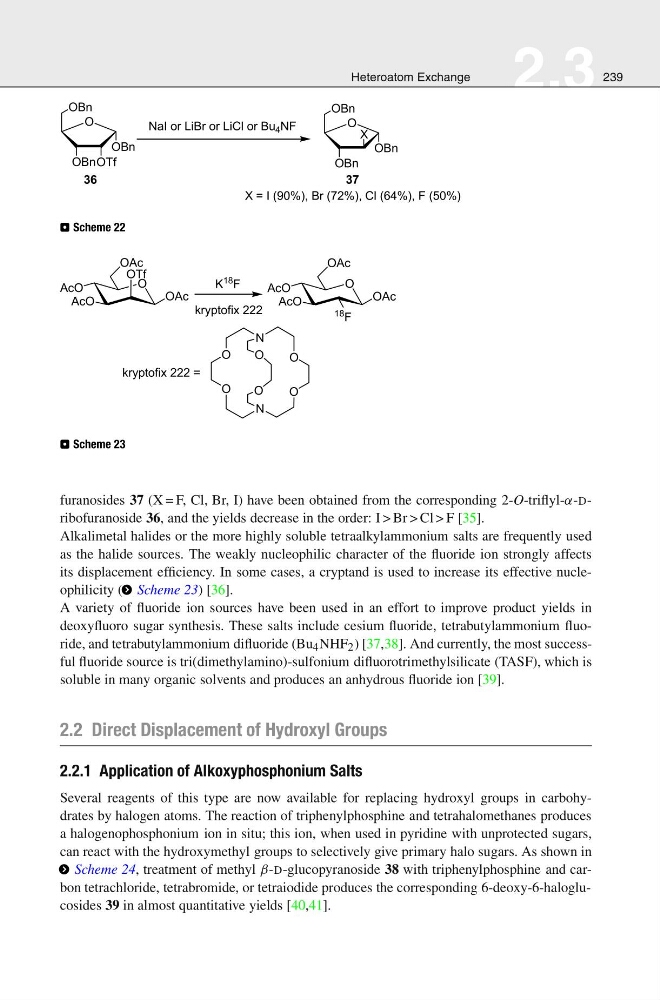
⊡ Scheme 22
⊡ Scheme 23
furanosides 37 (X = F, Cl, Br, I) have been obtained from the corresponding 2-O-triflyl-α-Dribofuranoside 36, and the yields decrease in the order: I > Br > Cl > F [35].
Alkalimetal halides or the more highly soluble tetraalkylammonium salts are frequently used
as the halide sources. The weakly nucleophilic character of the fluoride ion strongly affects
its displacement efficiency. In some cases, a cryptand is used to increase its effective nucleophilicity ( > Scheme 23) [36].
A variety of fluoride ion sources have been used in an effort to improve product yields in
deoxyfluoro sugar synthesis. These salts include cesium fluoride, tetrabutylammonium fluoride, and tetrabutylammonium difluoride (Bu 4 NHF 2 ) [37,38]. And currently, the most successful fluoride source is tri(dimethylamino)-sulfonium difluorotrimethylsilicate (TASF), which is
soluble in many organic solvents and produces an anhydrous fluoride ion [39].
2.2 Direct Displacement of Hydroxyl Groups
2.2.1 Application of Alkoxyphosphonium Salts
Several reagents of this type are now available for replacing hydroxyl groups in carbohydrates by halogen atoms. The reaction of triphenylphosphine and tetrahalomethanes produces
a halogenophosphonium ion in situ; this ion, when used in pyridine with unprotected sugars,
can react with the hydroxymethyl groups to selectively give primary halo sugars. As shown in
> Scheme 24, treatment of methyl β-D-glucopyranoside 38 with triphenylphosphine and carbon tetrachloride, tetrabromide, or tetraiodide produces the corresponding 6-deoxy-6-haloglucosides 39 in almost quantitative yields [40,41].
2.3
239
⊡ Scheme 22
⊡ Scheme 23
furanosides 37 (X = F, Cl, Br, I) have been obtained from the corresponding 2-O-triflyl-α-Dribofuranoside 36, and the yields decrease in the order: I > Br > Cl > F [35].
Alkalimetal halides or the more highly soluble tetraalkylammonium salts are frequently used
as the halide sources. The weakly nucleophilic character of the fluoride ion strongly affects
its displacement efficiency. In some cases, a cryptand is used to increase its effective nucleophilicity ( > Scheme 23) [36].
A variety of fluoride ion sources have been used in an effort to improve product yields in
deoxyfluoro sugar synthesis. These salts include cesium fluoride, tetrabutylammonium fluoride, and tetrabutylammonium difluoride (Bu 4 NHF 2 ) [37,38]. And currently, the most successful fluoride source is tri(dimethylamino)-sulfonium difluorotrimethylsilicate (TASF), which is
soluble in many organic solvents and produces an anhydrous fluoride ion [39].
2.2 Direct Displacement of Hydroxyl Groups
2.2.1 Application of Alkoxyphosphonium Salts
Several reagents of this type are now available for replacing hydroxyl groups in carbohydrates by halogen atoms. The reaction of triphenylphosphine and tetrahalomethanes produces
a halogenophosphonium ion in situ; this ion, when used in pyridine with unprotected sugars,
can react with the hydroxymethyl groups to selectively give primary halo sugars. As shown in
> Scheme 24, treatment of methyl β-D-glucopyranoside 38 with triphenylphosphine and carbon tetrachloride, tetrabromide, or tetraiodide produces the corresponding 6-deoxy-6-haloglucosides 39 in almost quantitative yields [40,41].