

Heteroatom Exchange
2.3
237
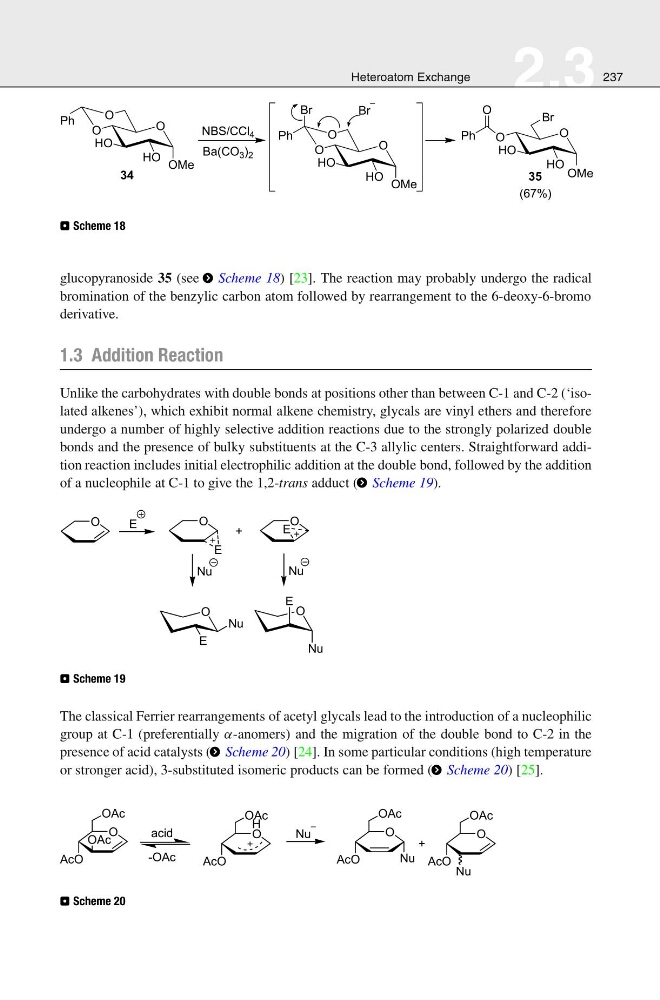
⊡ Scheme 18
glucopyranoside 35 (see > Scheme 18) [23]. The reaction may probably undergo the radical
bromination of the benzylic carbon atom followed by rearrangement to the 6-deoxy-6-bromo
derivative.
1.3 Addition Reaction
Unlike the carbohydrates with double bonds at positions other than between C-1 and C-2 (‘isolated alkenes’), which exhibit normal alkene chemistry, glycals are vinyl ethers and therefore
undergo a number of highly selective addition reactions due to the strongly polarized double
bonds and the presence of bulky substituents at the C-3 allylic centers. Straightforward addition reaction includes initial electrophilic addition at the double bond, followed by the addition
of a nucleophile at C-1 to give the 1,2-trans adduct ( > Scheme 19).
⊡ Scheme 19
The classical Ferrier rearrangements of acetyl glycals lead to the introduction of a nucleophilic
group at C-1 (preferentially α-anomers) and the migration of the double bond to C-2 in the
presence of acid catalysts ( > Scheme 20) [24]. In some particular conditions (high temperature
or stronger acid), 3-substituted isomeric products can be formed ( > Scheme 20) [25].
⊡ Scheme 20
2.3
237
⊡ Scheme 18
glucopyranoside 35 (see > Scheme 18) [23]. The reaction may probably undergo the radical
bromination of the benzylic carbon atom followed by rearrangement to the 6-deoxy-6-bromo
derivative.
1.3 Addition Reaction
Unlike the carbohydrates with double bonds at positions other than between C-1 and C-2 (‘isolated alkenes’), which exhibit normal alkene chemistry, glycals are vinyl ethers and therefore
undergo a number of highly selective addition reactions due to the strongly polarized double
bonds and the presence of bulky substituents at the C-3 allylic centers. Straightforward addition reaction includes initial electrophilic addition at the double bond, followed by the addition
of a nucleophile at C-1 to give the 1,2-trans adduct ( > Scheme 19).
⊡ Scheme 19
The classical Ferrier rearrangements of acetyl glycals lead to the introduction of a nucleophilic
group at C-1 (preferentially α-anomers) and the migration of the double bond to C-2 in the
presence of acid catalysts ( > Scheme 20) [24]. In some particular conditions (high temperature
or stronger acid), 3-substituted isomeric products can be formed ( > Scheme 20) [25].
⊡ Scheme 20