

236
2
General Synthetic Methods
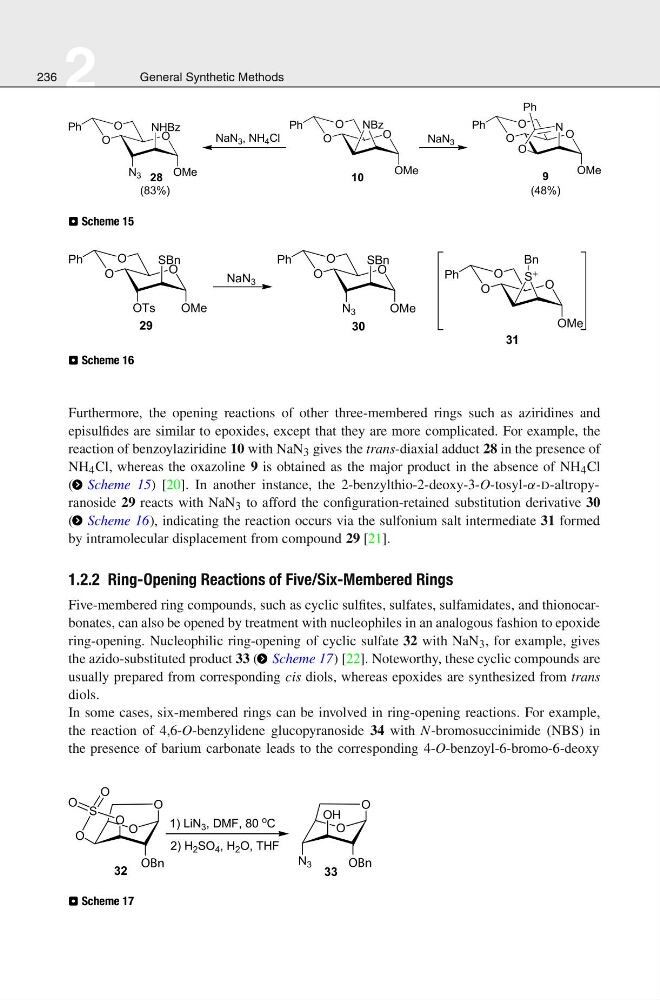
⊡ Scheme 15
⊡ Scheme 16
Furthermore, the opening reactions of other three-membered rings such as aziridines and
episulfides are similar to epoxides, except that they are more complicated. For example, the
reaction of benzoylaziridine 10 with NaN 3 gives the trans-diaxial adduct 28 in the presence of
NH 4 Cl, whereas the oxazoline 9 is obtained as the major product in the absence of NH 4 Cl
( > Scheme 15) [20]. In another instance, the 2-benzylthio-2-deoxy-3-O-tosyl-α-D-altropyranoside 29 reacts with NaN 3 to afford the configuration-retained substitution derivative 30
( > Scheme 16), indicating the reaction occurs via the sulfonium salt intermediate 31 formed
by intramolecular displacement from compound 29 [21].
1.2.2 Ring-Opening Reactions of Five/Six-Membered Rings
Five-membered ring compounds, such as cyclic sulfites, sulfates, sulfamidates, and thionocarbonates, can also be opened by treatment with nucleophiles in an analogous fashion to epoxide
ring-opening. Nucleophilic ring-opening of cyclic sulfate 32 with NaN 3 , for example, gives
the azido-substituted product 33 ( > Scheme 17) [22]. Noteworthy, these cyclic compounds are
usually prepared from corresponding cis diols, whereas epoxides are synthesized from trans
diols.
In some cases, six-membered rings can be involved in ring-opening reactions. For example,
the reaction of 4,6-O-benzylidene glucopyranoside 34 with N-bromosuccinimide (NBS) in
the presence of barium carbonate leads to the corresponding 4-O-benzoyl-6-bromo-6-deoxy
⊡ Scheme 17
2
General Synthetic Methods
⊡ Scheme 15
⊡ Scheme 16
Furthermore, the opening reactions of other three-membered rings such as aziridines and
episulfides are similar to epoxides, except that they are more complicated. For example, the
reaction of benzoylaziridine 10 with NaN 3 gives the trans-diaxial adduct 28 in the presence of
NH 4 Cl, whereas the oxazoline 9 is obtained as the major product in the absence of NH 4 Cl
( > Scheme 15) [20]. In another instance, the 2-benzylthio-2-deoxy-3-O-tosyl-α-D-altropyranoside 29 reacts with NaN 3 to afford the configuration-retained substitution derivative 30
( > Scheme 16), indicating the reaction occurs via the sulfonium salt intermediate 31 formed
by intramolecular displacement from compound 29 [21].
1.2.2 Ring-Opening Reactions of Five/Six-Membered Rings
Five-membered ring compounds, such as cyclic sulfites, sulfates, sulfamidates, and thionocarbonates, can also be opened by treatment with nucleophiles in an analogous fashion to epoxide
ring-opening. Nucleophilic ring-opening of cyclic sulfate 32 with NaN 3 , for example, gives
the azido-substituted product 33 ( > Scheme 17) [22]. Noteworthy, these cyclic compounds are
usually prepared from corresponding cis diols, whereas epoxides are synthesized from trans
diols.
In some cases, six-membered rings can be involved in ring-opening reactions. For example,
the reaction of 4,6-O-benzylidene glucopyranoside 34 with N-bromosuccinimide (NBS) in
the presence of barium carbonate leads to the corresponding 4-O-benzoyl-6-bromo-6-deoxy
⊡ Scheme 17