

Heteroatom Exchange
2.3
235
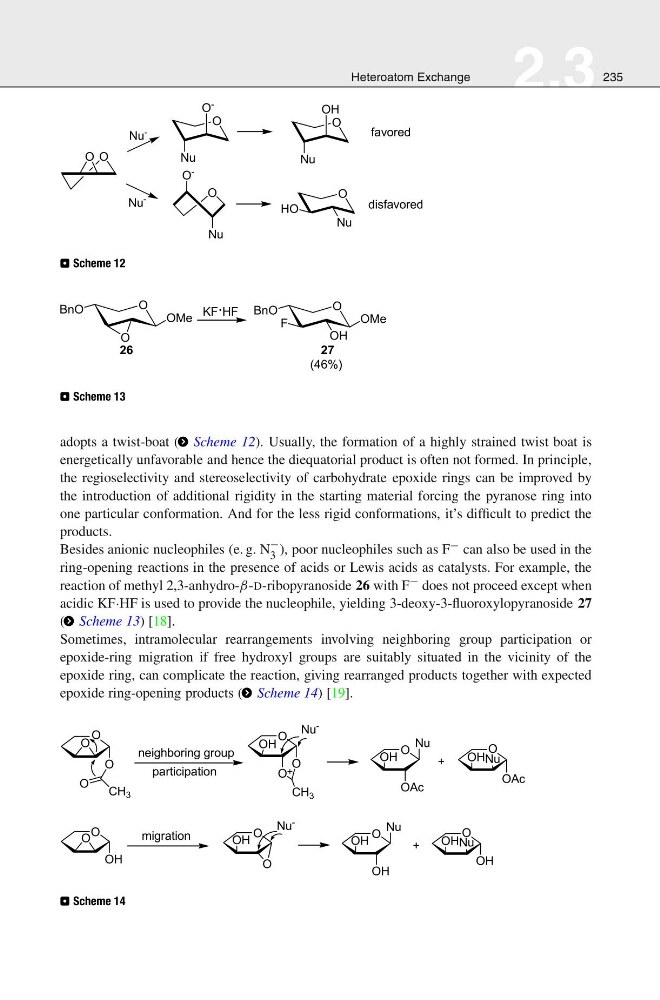
⊡ Scheme 12
⊡ Scheme 13
adopts a twist-boat ( > Scheme 12). Usually, the formation of a highly strained twist boat is
energetically unfavorable and hence the diequatorial product is often not formed. In principle,
the regioselectivity and stereoselectivity of carbohydrate epoxide rings can be improved by
the introduction of additional rigidity in the starting material forcing the pyranose ring into
one particular conformation. And for the less rigid conformations, it’s difficult to predict the
products.
Besides anionic nucleophiles (e. g. N
−
3 ), poor nucleophiles such as F − can also be used in the
ring-opening reactions in the presence of acids or Lewis acids as catalysts. For example, the
reaction of methyl 2,3-anhydro-β-D-ribopyranoside 26 with F − does not proceed except when
acidic KF·HF is used to provide the nucleophile, yielding 3-deoxy-3-fluoroxylopyranoside 27
( > Scheme 13) [18].
Sometimes, intramolecular rearrangements involving neighboring group participation or
epoxide-ring migration if free hydroxyl groups are suitably situated in the vicinity of the
epoxide ring, can complicate the reaction, giving rearranged products together with expected
epoxide ring-opening products ( > Scheme 14) [19].
⊡ Scheme 14
2.3
235
⊡ Scheme 12
⊡ Scheme 13
adopts a twist-boat ( > Scheme 12). Usually, the formation of a highly strained twist boat is
energetically unfavorable and hence the diequatorial product is often not formed. In principle,
the regioselectivity and stereoselectivity of carbohydrate epoxide rings can be improved by
the introduction of additional rigidity in the starting material forcing the pyranose ring into
one particular conformation. And for the less rigid conformations, it’s difficult to predict the
products.
Besides anionic nucleophiles (e. g. N
−
3 ), poor nucleophiles such as F − can also be used in the
ring-opening reactions in the presence of acids or Lewis acids as catalysts. For example, the
reaction of methyl 2,3-anhydro-β-D-ribopyranoside 26 with F − does not proceed except when
acidic KF·HF is used to provide the nucleophile, yielding 3-deoxy-3-fluoroxylopyranoside 27
( > Scheme 13) [18].
Sometimes, intramolecular rearrangements involving neighboring group participation or
epoxide-ring migration if free hydroxyl groups are suitably situated in the vicinity of the
epoxide ring, can complicate the reaction, giving rearranged products together with expected
epoxide ring-opening products ( > Scheme 14) [19].
⊡ Scheme 14