

234
2
General Synthetic Methods
galactopyranoside 19 with an azide ion led to the formation of the corresponding 2,5-anhydro
sugar 20 ( > Scheme 9) [16]. The predominance of a ring-contraction reaction over a substitution can be explained by a steric interaction between the incoming nucleophile and the axial
C-4 substituent, and by the favored antiparallel disposition of the C-1-O-5 bond and the equatorial leaving groups at C-2.
1.2 Ring-Opening Reaction
1.2.1 Nucleophilic Ring Opening of Epoxides
Nucleophilic ring opening of epoxides with heteroatom nucleophiles is another valuable
method for the synthesis of many heteroatom-modified carbohydrate derivatives. The cyclic
nature of epoxides renders the competing elimination process stereoelectronically unfavorable.
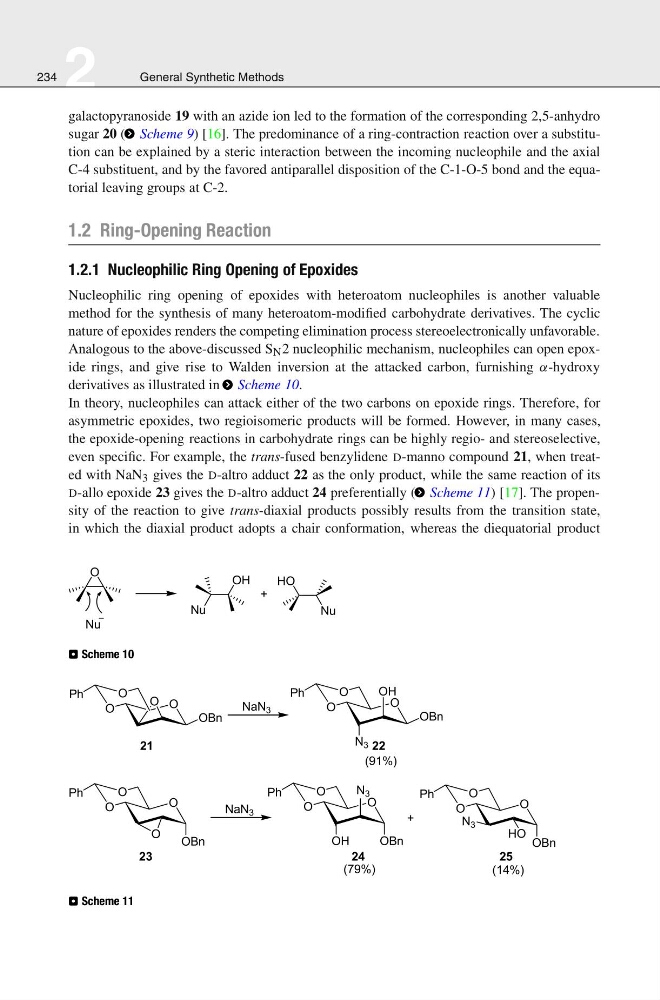
Analogous to the above-discussed S N 2 nucleophilic mechanism, nucleophiles can open epoxide rings, and give rise to Walden inversion at the attacked carbon, furnishing α-hydroxy
derivatives as illustrated in > Scheme 10.
In theory, nucleophiles can attack either of the two carbons on epoxide rings. Therefore, for
asymmetric epoxides, two regioisomeric products will be formed. However, in many cases,
the epoxide-opening reactions in carbohydrate rings can be highly regio- and stereoselective,
even specific. For example, the trans-fused benzylidene D-manno compound 21, when treated with NaN 3 gives the D-altro adduct 22 as the only product, while the same reaction of its
D-allo epoxide 23 gives the D-altro adduct 24 preferentially ( > Scheme 11) [17]. The propensity of the reaction to give trans-diaxial products possibly results from the transition state,
in which the diaxial product adopts a chair conformation, whereas the diequatorial product
⊡ Scheme 10
⊡ Scheme 11
2
General Synthetic Methods
galactopyranoside 19 with an azide ion led to the formation of the corresponding 2,5-anhydro
sugar 20 ( > Scheme 9) [16]. The predominance of a ring-contraction reaction over a substitution can be explained by a steric interaction between the incoming nucleophile and the axial
C-4 substituent, and by the favored antiparallel disposition of the C-1-O-5 bond and the equatorial leaving groups at C-2.
1.2 Ring-Opening Reaction
1.2.1 Nucleophilic Ring Opening of Epoxides
Nucleophilic ring opening of epoxides with heteroatom nucleophiles is another valuable
method for the synthesis of many heteroatom-modified carbohydrate derivatives. The cyclic
nature of epoxides renders the competing elimination process stereoelectronically unfavorable.
Analogous to the above-discussed S N 2 nucleophilic mechanism, nucleophiles can open epoxide rings, and give rise to Walden inversion at the attacked carbon, furnishing α-hydroxy
derivatives as illustrated in > Scheme 10.
In theory, nucleophiles can attack either of the two carbons on epoxide rings. Therefore, for
asymmetric epoxides, two regioisomeric products will be formed. However, in many cases,
the epoxide-opening reactions in carbohydrate rings can be highly regio- and stereoselective,
even specific. For example, the trans-fused benzylidene D-manno compound 21, when treated with NaN 3 gives the D-altro adduct 22 as the only product, while the same reaction of its
D-allo epoxide 23 gives the D-altro adduct 24 preferentially ( > Scheme 11) [17]. The propensity of the reaction to give trans-diaxial products possibly results from the transition state,
in which the diaxial product adopts a chair conformation, whereas the diequatorial product
⊡ Scheme 10
⊡ Scheme 11