

Heteroatom Exchange
2.3
233
group and the acylamino group, which is the ideal position for neighboring group participation. On the other hand, when the substituents in methyl 4,6-O-benzylidene-2-deoxy-2benzoylamino-3-O-mesyl-α-D-glucopyranoside 11 are in a 1,2-trans-diequatorial orientation,
the nucleophile competes with the acylamino group to form substituted products 12, 14, and
oxazoline 13 ( > Scheme 6) [13]. The participation of acyloxy groups is not very often encountered in pyranoid rings, even when the substituents are in suitable orientations. It seems that
acyloxy group participation is more facile in furanoid rings.
It has to be realized that an elimination reaction is the most frequent competing side reaction of
nucleophilic substitution. Strong bases and weak nucleophiles favor this reaction. And elimination reactions are more likely when the leaving group is in a trans-diaxial relationship with
a α-hydrogen atom at a sterically hindered position. Among halide ions, the fluoride ion is the
strongest base and the weakest nucleophile and, as a result, substitution by this anion is often
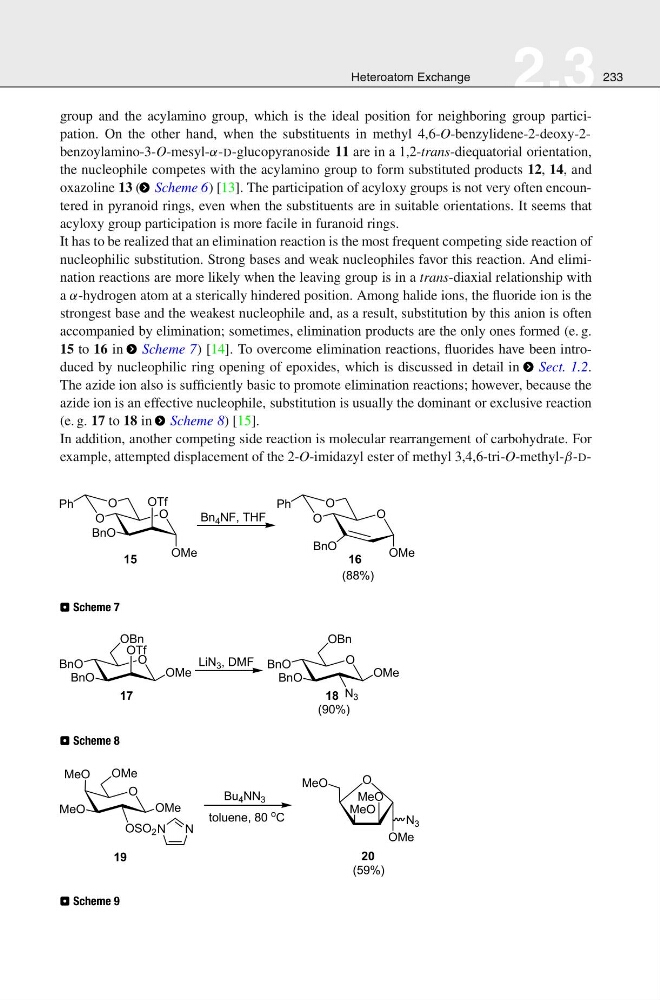
accompanied by elimination; sometimes, elimination products are the only ones formed (e. g.
15 to 16 in > Scheme 7) [14]. To overcome elimination reactions, fluorides have been introduced by nucleophilic ring opening of epoxides, which is discussed in detail in > Sect. 1.2.
The azide ion also is sufficiently basic to promote elimination reactions; however, because the
azide ion is an effective nucleophile, substitution is usually the dominant or exclusive reaction
(e. g. 17 to 18 in > Scheme 8) [15].
In addition, another competing side reaction is molecular rearrangement of carbohydrate. For
example, attempted displacement of the 2-O-imidazyl ester of methyl 3,4,6-tri-O-methyl-β-D⊡ Scheme 7
⊡ Scheme 8
⊡ Scheme 9
2.3
233
group and the acylamino group, which is the ideal position for neighboring group participation. On the other hand, when the substituents in methyl 4,6-O-benzylidene-2-deoxy-2benzoylamino-3-O-mesyl-α-D-glucopyranoside 11 are in a 1,2-trans-diequatorial orientation,
the nucleophile competes with the acylamino group to form substituted products 12, 14, and
oxazoline 13 ( > Scheme 6) [13]. The participation of acyloxy groups is not very often encountered in pyranoid rings, even when the substituents are in suitable orientations. It seems that
acyloxy group participation is more facile in furanoid rings.
It has to be realized that an elimination reaction is the most frequent competing side reaction of
nucleophilic substitution. Strong bases and weak nucleophiles favor this reaction. And elimination reactions are more likely when the leaving group is in a trans-diaxial relationship with
a α-hydrogen atom at a sterically hindered position. Among halide ions, the fluoride ion is the
strongest base and the weakest nucleophile and, as a result, substitution by this anion is often
accompanied by elimination; sometimes, elimination products are the only ones formed (e. g.
15 to 16 in > Scheme 7) [14]. To overcome elimination reactions, fluorides have been introduced by nucleophilic ring opening of epoxides, which is discussed in detail in > Sect. 1.2.
The azide ion also is sufficiently basic to promote elimination reactions; however, because the
azide ion is an effective nucleophile, substitution is usually the dominant or exclusive reaction
(e. g. 17 to 18 in > Scheme 8) [15].
In addition, another competing side reaction is molecular rearrangement of carbohydrate. For
example, attempted displacement of the 2-O-imidazyl ester of methyl 3,4,6-tri-O-methyl-β-D⊡ Scheme 7
⊡ Scheme 8
⊡ Scheme 9