

230
2
General Synthetic Methods
⊡ Scheme 2
In addition to the phosphorus-containing reagents, other reagents, such as the Vilsmeier–
Haack reagent [(Me 2 N + =CHX)X − ] [3], sulfuryl chloride [4] and diethylaminosulfur trifluoride (DAST) [5] have also been employed for direct replacement of hydroxyl groups in carbohydrates.
Classical substitution reactions usually involve the introduction of leaving groups, among
which sulfonic esters provide a versatile and simple method for activating hydroxyl groups of
the carbohydrate for a bimolecular displacement reaction. The most common sulfonate leaving
groups consist of mesylates and tosylates. The use of p-bromobenzenesulfonates (brosylates),
which are ten times more reactive than tosylates, has been occasionally reported [6]. Triflates
and imidazole-1-sulfonates (imidazylates) [7] are used in the substitutions at positions where
other sulfonates are known to be ineffective. Halogens can also be used as leaving groups.
The efficiency of a displacement critically depends on the position of the leaving group and
the chemical environment of the sugar ring (the steric- or stereoelectronic dispositions of
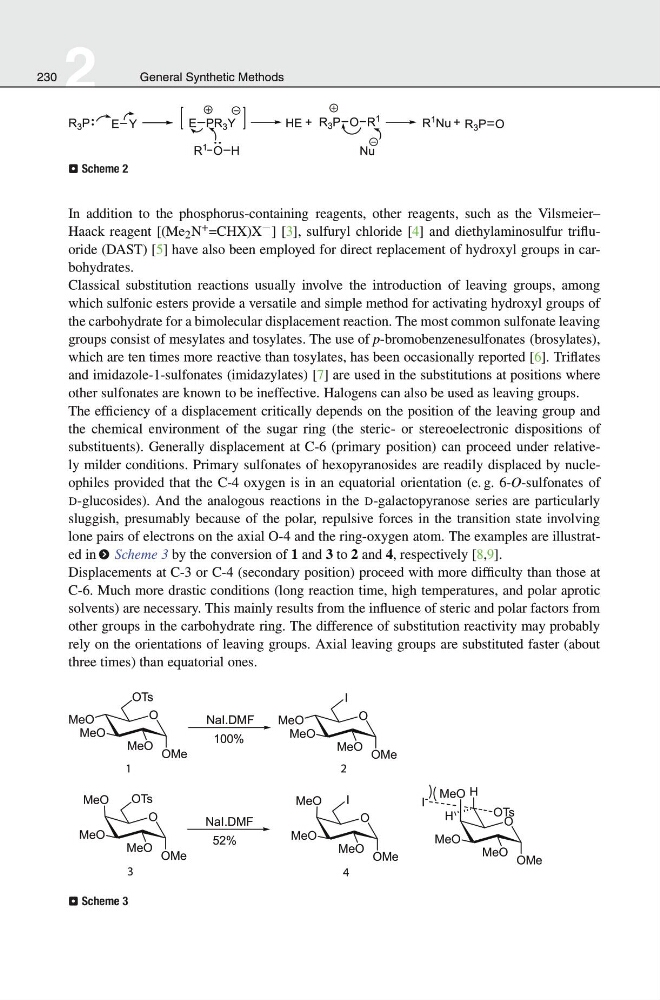
substituents). Generally displacement at C-6 (primary position) can proceed under relatively milder conditions. Primary sulfonates of hexopyranosides are readily displaced by nucleophiles provided that the C-4 oxygen is in an equatorial orientation (e. g. 6-O-sulfonates of
D-glucosides). And the analogous reactions in the D-galactopyranose series are particularly
sluggish, presumably because of the polar, repulsive forces in the transition state involving
lone pairs of electrons on the axial O-4 and the ring-oxygen atom. The examples are illustrated in > Scheme 3 by the conversion of 1 and 3 to 2 and 4, respectively [8,9].
Displacements at C-3 or C-4 (secondary position) proceed with more difficulty than those at
C-6. Much more drastic conditions (long reaction time, high temperatures, and polar aprotic
solvents) are necessary. This mainly results from the influence of steric and polar factors from
other groups in the carbohydrate ring. The difference of substitution reactivity may probably
rely on the orientations of leaving groups. Axial leaving groups are substituted faster (about
three times) than equatorial ones.
⊡ Scheme 3
2
General Synthetic Methods
⊡ Scheme 2
In addition to the phosphorus-containing reagents, other reagents, such as the Vilsmeier–
Haack reagent [(Me 2 N + =CHX)X − ] [3], sulfuryl chloride [4] and diethylaminosulfur trifluoride (DAST) [5] have also been employed for direct replacement of hydroxyl groups in carbohydrates.
Classical substitution reactions usually involve the introduction of leaving groups, among
which sulfonic esters provide a versatile and simple method for activating hydroxyl groups of
the carbohydrate for a bimolecular displacement reaction. The most common sulfonate leaving
groups consist of mesylates and tosylates. The use of p-bromobenzenesulfonates (brosylates),
which are ten times more reactive than tosylates, has been occasionally reported [6]. Triflates
and imidazole-1-sulfonates (imidazylates) [7] are used in the substitutions at positions where
other sulfonates are known to be ineffective. Halogens can also be used as leaving groups.
The efficiency of a displacement critically depends on the position of the leaving group and
the chemical environment of the sugar ring (the steric- or stereoelectronic dispositions of
substituents). Generally displacement at C-6 (primary position) can proceed under relatively milder conditions. Primary sulfonates of hexopyranosides are readily displaced by nucleophiles provided that the C-4 oxygen is in an equatorial orientation (e. g. 6-O-sulfonates of
D-glucosides). And the analogous reactions in the D-galactopyranose series are particularly
sluggish, presumably because of the polar, repulsive forces in the transition state involving
lone pairs of electrons on the axial O-4 and the ring-oxygen atom. The examples are illustrated in > Scheme 3 by the conversion of 1 and 3 to 2 and 4, respectively [8,9].
Displacements at C-3 or C-4 (secondary position) proceed with more difficulty than those at
C-6. Much more drastic conditions (long reaction time, high temperatures, and polar aprotic
solvents) are necessary. This mainly results from the influence of steric and polar factors from
other groups in the carbohydrate ring. The difference of substitution reactivity may probably
rely on the orientations of leaving groups. Axial leaving groups are substituted faster (about
three times) than equatorial ones.
⊡ Scheme 3