

Heteroatom Exchange
2.3
229
hydrates. Among these reactions replacements of nonanomeric oxygen atoms by heteroatoms
(e. g. halogen, nitrogen, sulfur, phosphorus, etc.) afford valuable compounds having biological activities as well as synthetic usefulness. Halogeno sugars can serve as tools for studying
carbohydrate-protein interaction, and useful intermediates in the synthesis of other important
sugar derivatives. Amino sugars are widely distributed in living organisms and are essential
units of various antibiotics such as amino glycosides. Thiosugars exhibit biologically important properties as the substrates for many carbohydrate-related enzymes. Phosphorus derivatives have been widely used as chiral ligands for asymmetric synthesis and also as biological
intermediates. Here synthetic methodologies for the preparation of these specific classes of
carbohydrates will be reviewed and discussed in this chapter, as the revised version of the corresponding chapter written by Boullanger and Descotes in the previous edition of this book.
1.1 Nucleophilic Substitution
The manipulation of appropriately activated hydroxyl groups by nucleophilic displacement
reactions is an indispensable tool for the introduction of functionalities directly attached to the
sugar framework.
Carbohydrates are excellent substrates to test nucleophilic displacement reactions with a variety of heteroatom-based nucleophiles. These reactions can be tried on primary and secondary
hydroxyl groups at different sites of the sugar ring, and with different steric or stereoelectronic
dispositions [1].
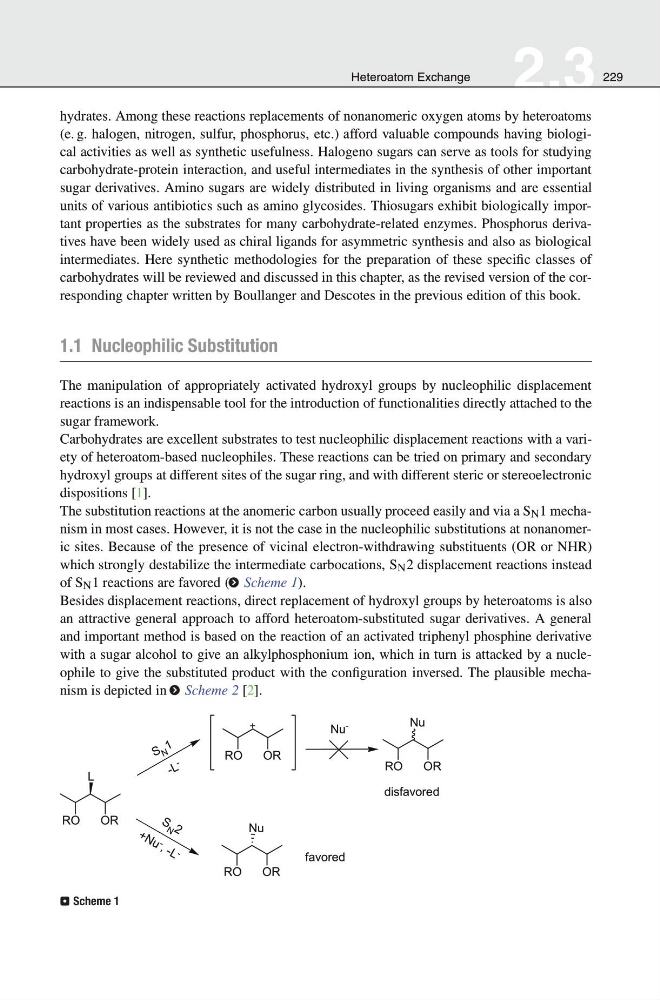
The substitution reactions at the anomeric carbon usually proceed easily and via a S N 1 mechanism in most cases. However, it is not the case in the nucleophilic substitutions at nonanomeric sites. Because of the presence of vicinal electron-withdrawing substituents (OR or NHR)
which strongly destabilize the intermediate carbocations, S N 2 displacement reactions instead
of S N 1 reactions are favored ( > Scheme 1).
Besides displacement reactions, direct replacement of hydroxyl groups by heteroatoms is also
an attractive general approach to afford heteroatom-substituted sugar derivatives. A general
and important method is based on the reaction of an activated triphenyl phosphine derivative
with a sugar alcohol to give an alkylphosphonium ion, which in turn is attacked by a nucleophile to give the substituted product with the configuration inversed. The plausible mechanism is depicted in > Scheme 2 [2].
⊡ Scheme 1
2.3
229
hydrates. Among these reactions replacements of nonanomeric oxygen atoms by heteroatoms
(e. g. halogen, nitrogen, sulfur, phosphorus, etc.) afford valuable compounds having biological activities as well as synthetic usefulness. Halogeno sugars can serve as tools for studying
carbohydrate-protein interaction, and useful intermediates in the synthesis of other important
sugar derivatives. Amino sugars are widely distributed in living organisms and are essential
units of various antibiotics such as amino glycosides. Thiosugars exhibit biologically important properties as the substrates for many carbohydrate-related enzymes. Phosphorus derivatives have been widely used as chiral ligands for asymmetric synthesis and also as biological
intermediates. Here synthetic methodologies for the preparation of these specific classes of
carbohydrates will be reviewed and discussed in this chapter, as the revised version of the corresponding chapter written by Boullanger and Descotes in the previous edition of this book.
1.1 Nucleophilic Substitution
The manipulation of appropriately activated hydroxyl groups by nucleophilic displacement
reactions is an indispensable tool for the introduction of functionalities directly attached to the
sugar framework.
Carbohydrates are excellent substrates to test nucleophilic displacement reactions with a variety of heteroatom-based nucleophiles. These reactions can be tried on primary and secondary
hydroxyl groups at different sites of the sugar ring, and with different steric or stereoelectronic
dispositions [1].
The substitution reactions at the anomeric carbon usually proceed easily and via a S N 1 mechanism in most cases. However, it is not the case in the nucleophilic substitutions at nonanomeric sites. Because of the presence of vicinal electron-withdrawing substituents (OR or NHR)
which strongly destabilize the intermediate carbocations, S N 2 displacement reactions instead
of S N 1 reactions are favored ( > Scheme 1).
Besides displacement reactions, direct replacement of hydroxyl groups by heteroatoms is also
an attractive general approach to afford heteroatom-substituted sugar derivatives. A general
and important method is based on the reaction of an activated triphenyl phosphine derivative
with a sugar alcohol to give an alkylphosphonium ion, which in turn is attacked by a nucleophile to give the substituted product with the configuration inversed. The plausible mechanism is depicted in > Scheme 2 [2].
⊡ Scheme 1