

Heteroatom Exchange
2.3
231
The displacements at C-2 are very difficult owing to the vicinal C-1 bearing two electron-withdrawing oxygens, which retard the departing of the leaving group. This substitution depends
strongly on the orientations of the anomeric substituents. When C-3 also bears an electronwithdrawing group, the displacement at C-2 of α-glycosides can hardly proceed, while the
corresponding reaction at C-2 of β-glycosides is much more facile.
Furthermore, S N 2 displacements in furanoid rings are easier in comparison with pyranoid
rings, since the more flexible five-membered rings have a smaller increasing strain, favoring
the formation of the transition state. In unsaturated rings, substituents at the allylic positions
are particularly susceptible to nucleophilic displacement due to the presence of double bonds.
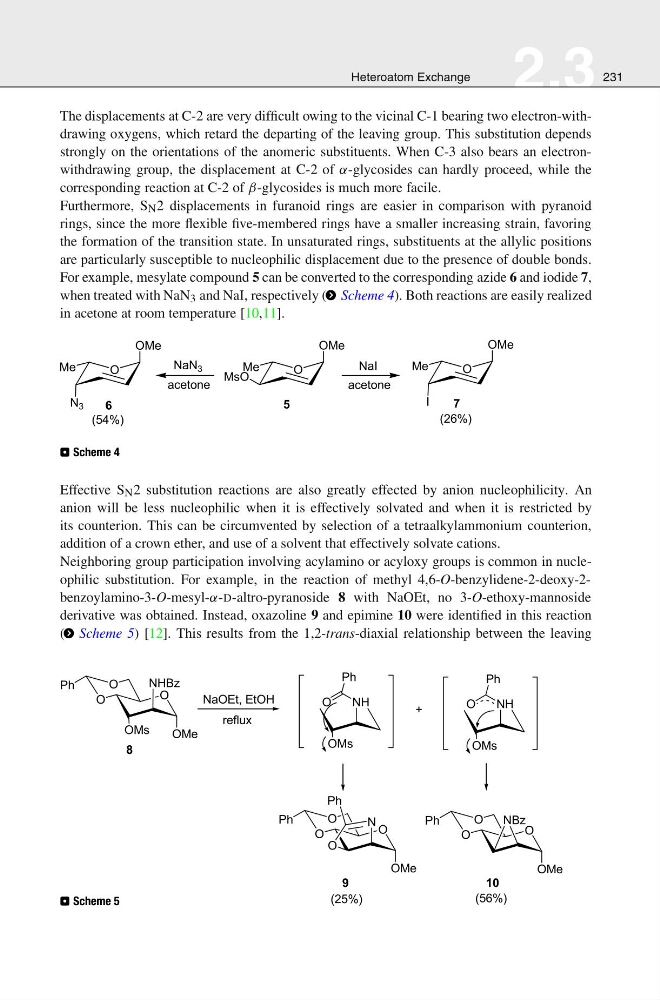
For example, mesylate compound 5 can be converted to the corresponding azide 6 and iodide 7,
when treated with NaN 3 and NaI, respectively ( > Scheme 4). Both reactions are easily realized
in acetone at room temperature [10,11].
⊡ Scheme 4
Effective S N 2 substitution reactions are also greatly effected by anion nucleophilicity. An
anion will be less nucleophilic when it is effectively solvated and when it is restricted by
its counterion. This can be circumvented by selection of a tetraalkylammonium counterion,
addition of a crown ether, and use of a solvent that effectively solvate cations.
Neighboring group participation involving acylamino or acyloxy groups is common in nucleophilic substitution. For example, in the reaction of methyl 4,6-O-benzylidene-2-deoxy-2benzoylamino-3-O-mesyl-α-D-altro-pyranoside 8 with NaOEt, no 3-O-ethoxy-mannoside
derivative was obtained. Instead, oxazoline 9 and epimine 10 were identified in this reaction
( > Scheme 5) [12]. This results from the 1,2-trans-diaxial relationship between the leaving
⊡ Scheme 5
2.3
231
The displacements at C-2 are very difficult owing to the vicinal C-1 bearing two electron-withdrawing oxygens, which retard the departing of the leaving group. This substitution depends
strongly on the orientations of the anomeric substituents. When C-3 also bears an electronwithdrawing group, the displacement at C-2 of α-glycosides can hardly proceed, while the
corresponding reaction at C-2 of β-glycosides is much more facile.
Furthermore, S N 2 displacements in furanoid rings are easier in comparison with pyranoid
rings, since the more flexible five-membered rings have a smaller increasing strain, favoring
the formation of the transition state. In unsaturated rings, substituents at the allylic positions
are particularly susceptible to nucleophilic displacement due to the presence of double bonds.
For example, mesylate compound 5 can be converted to the corresponding azide 6 and iodide 7,
when treated with NaN 3 and NaI, respectively ( > Scheme 4). Both reactions are easily realized
in acetone at room temperature [10,11].
⊡ Scheme 4
Effective S N 2 substitution reactions are also greatly effected by anion nucleophilicity. An
anion will be less nucleophilic when it is effectively solvated and when it is restricted by
its counterion. This can be circumvented by selection of a tetraalkylammonium counterion,
addition of a crown ether, and use of a solvent that effectively solvate cations.
Neighboring group participation involving acylamino or acyloxy groups is common in nucleophilic substitution. For example, in the reaction of methyl 4,6-O-benzylidene-2-deoxy-2benzoylamino-3-O-mesyl-α-D-altro-pyranoside 8 with NaOEt, no 3-O-ethoxy-mannoside
derivative was obtained. Instead, oxazoline 9 and epimine 10 were identified in this reaction
( > Scheme 5) [12]. This results from the 1,2-trans-diaxial relationship between the leaving
⊡ Scheme 5