

216
2
General Synthetic Methods
applied to a partially protected substrate ( > Scheme 29) [237]. A similar radical deoxygenation
at C6 can be achieved by using the more complex 4,6-O-[1-cyano-2-(2-iodophenyl)ethylidene]
acetal [238]. In this case, the redox rearrangement is mediated by tributyltin hydride and AIBN.
Again, the trans-fused acetals in glucose and mannose undergo a very regioselective fragmentation to yield the 6-deoxy compounds while the regioselectivity with the cis-fused acetal in
galactose is poor [238].
4.3 Deoxygenation of Secondary Alcohols
The reduction of secondary sulfonates with lithium aluminum hydride or sodium borohydride
is usually a poor reaction for deoxygenating secondary alcohols [220,222]. In most cases,
the hydride attack will occur at sulfur and result in cleavage of the S–O bond to afford the
starting secondary alcohol as the main product. An exception from this rule is observed when
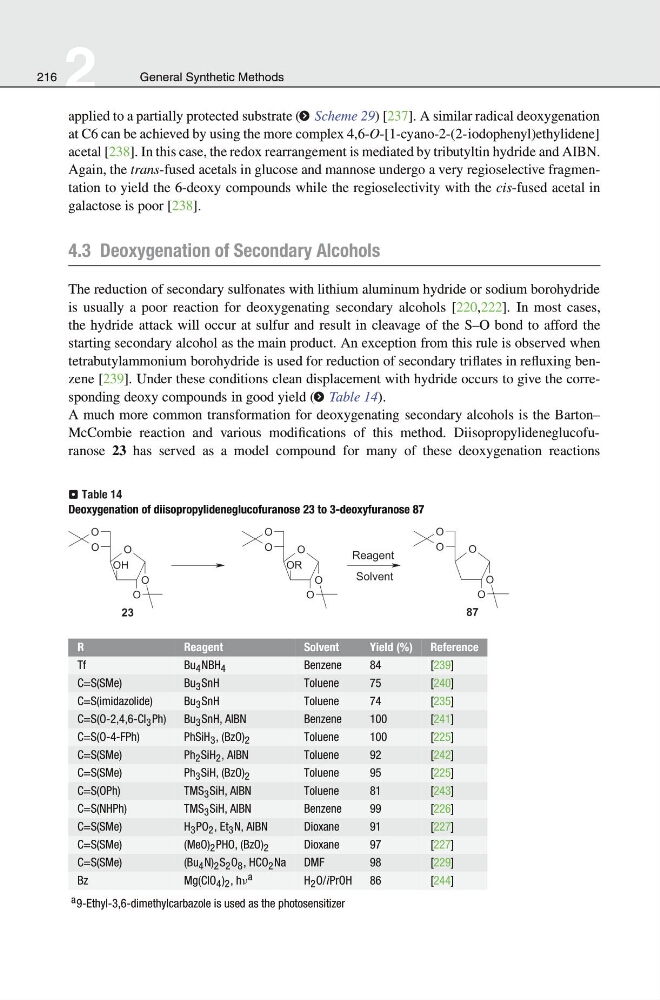
tetrabutylammonium borohydride is used for reduction of secondary triflates in refluxing benzene [239]. Under these conditions clean displacement with hydride occurs to give the corresponding deoxy compounds in good yield ( > Table 14).
A much more common transformation for deoxygenating secondary alcohols is the Barton–
McCombie reaction and various modifications of this method. Diisopropylideneglucofuranose 23 has served as a model compound for many of these deoxygenation reactions
⊡ Table 14
Deoxygenation of diisopropylideneglucofuranose 23 to 3-deoxyfuranose 87
R
Reagent
Solvent
Yield (%) Reference
Tf
Bu 4 NBH 4
Benzene
84
[239]
C=S(SMe)
Bu 3 SnH
Toluene
75
[240]
C=S(imidazolide)
Bu 3 SnH
Toluene
74
[235]
C=S(O-2,4,6-Cl 3 Ph) Bu 3 SnH, AIBN
Benzene
100
[241]
C=S(O-4-FPh)
PhSiH 3 , (BzO) 2
Toluene
100
[225]
C=S(SMe)
Ph 2 SiH 2 , AIBN
Toluene
92
[242]
C=S(SMe)
Ph 3 SiH, (BzO) 2
Toluene
95
[225]
C=S(OPh)
TMS 3 SiH, AIBN
Toluene
81
[243]
C=S(NHPh)
TMS 3 SiH, AIBN
Benzene
99
[226]
C=S(SMe)
H 3 PO 2 , Et 3 N, AIBN
Dioxane
91
[227]
C=S(SMe)
(MeO) 2 PHO, (BzO) 2
Dioxane
97
[227]
C=S(SMe)
(Bu 4 N) 2 S 2 O 8 , HCO 2 Na DMF
98
[229]
Bz
Mg(ClO 4 ) 2 , hν a
H 2 O/iPrOH 86
[244]
a 9-Ethyl-3,6-dimethylcarbazole is used as the photosensitizer
2
General Synthetic Methods
applied to a partially protected substrate ( > Scheme 29) [237]. A similar radical deoxygenation
at C6 can be achieved by using the more complex 4,6-O-[1-cyano-2-(2-iodophenyl)ethylidene]
acetal [238]. In this case, the redox rearrangement is mediated by tributyltin hydride and AIBN.
Again, the trans-fused acetals in glucose and mannose undergo a very regioselective fragmentation to yield the 6-deoxy compounds while the regioselectivity with the cis-fused acetal in
galactose is poor [238].
4.3 Deoxygenation of Secondary Alcohols
The reduction of secondary sulfonates with lithium aluminum hydride or sodium borohydride
is usually a poor reaction for deoxygenating secondary alcohols [220,222]. In most cases,
the hydride attack will occur at sulfur and result in cleavage of the S–O bond to afford the
starting secondary alcohol as the main product. An exception from this rule is observed when
tetrabutylammonium borohydride is used for reduction of secondary triflates in refluxing benzene [239]. Under these conditions clean displacement with hydride occurs to give the corresponding deoxy compounds in good yield ( > Table 14).
A much more common transformation for deoxygenating secondary alcohols is the Barton–
McCombie reaction and various modifications of this method. Diisopropylideneglucofuranose 23 has served as a model compound for many of these deoxygenation reactions
⊡ Table 14
Deoxygenation of diisopropylideneglucofuranose 23 to 3-deoxyfuranose 87
R
Reagent
Solvent
Yield (%) Reference
Tf
Bu 4 NBH 4
Benzene
84
[239]
C=S(SMe)
Bu 3 SnH
Toluene
75
[240]
C=S(imidazolide)
Bu 3 SnH
Toluene
74
[235]
C=S(O-2,4,6-Cl 3 Ph) Bu 3 SnH, AIBN
Benzene
100
[241]
C=S(O-4-FPh)
PhSiH 3 , (BzO) 2
Toluene
100
[225]
C=S(SMe)
Ph 2 SiH 2 , AIBN
Toluene
92
[242]
C=S(SMe)
Ph 3 SiH, (BzO) 2
Toluene
95
[225]
C=S(OPh)
TMS 3 SiH, AIBN
Toluene
81
[243]
C=S(NHPh)
TMS 3 SiH, AIBN
Benzene
99
[226]
C=S(SMe)
H 3 PO 2 , Et 3 N, AIBN
Dioxane
91
[227]
C=S(SMe)
(MeO) 2 PHO, (BzO) 2
Dioxane
97
[227]
C=S(SMe)
(Bu 4 N) 2 S 2 O 8 , HCO 2 Na DMF
98
[229]
Bz
Mg(ClO 4 ) 2 , hν a
H 2 O/iPrOH 86
[244]
a 9-Ethyl-3,6-dimethylcarbazole is used as the photosensitizer