

Oxidation, Reduction, and Deoxygenation
2.2
217
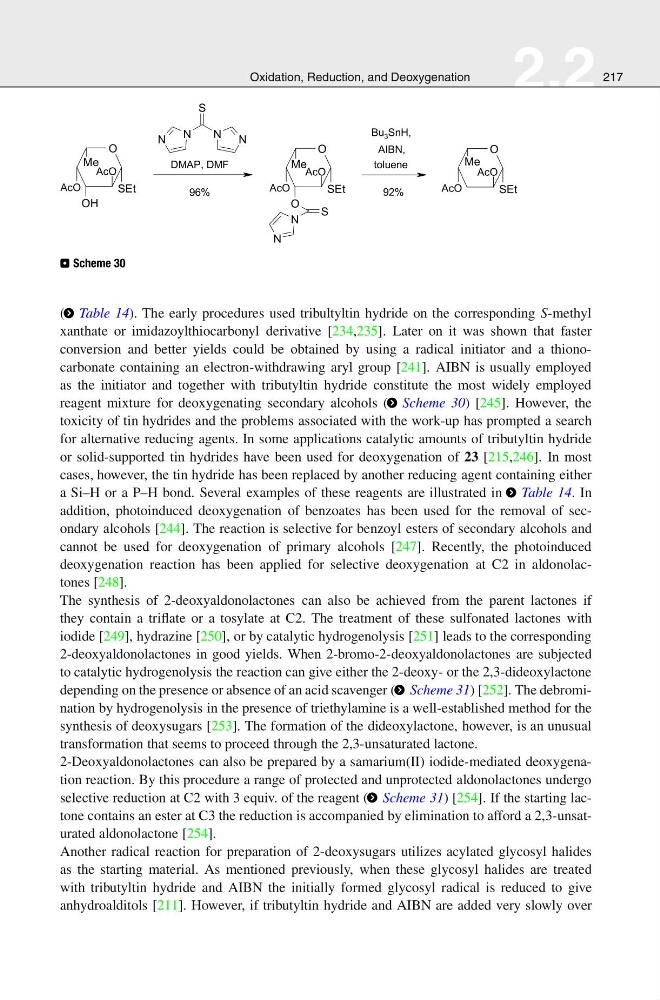
⊡ Scheme 30
( > Table 14). The early procedures used tribultyltin hydride on the corresponding S-methyl
xanthate or imidazoylthiocarbonyl derivative [234,235]. Later on it was shown that faster
conversion and better yields could be obtained by using a radical initiator and a thionocarbonate containing an electron-withdrawing aryl group [241]. AIBN is usually employed
as the initiator and together with tributyltin hydride constitute the most widely employed
reagent mixture for deoxygenating secondary alcohols ( > Scheme 30) [245]. However, the
toxicity of tin hydrides and the problems associated with the work-up has prompted a search
for alternative reducing agents. In some applications catalytic amounts of tributyltin hydride
or solid-supported tin hydrides have been used for deoxygenation of 23 [215,246]. In most
cases, however, the tin hydride has been replaced by another reducing agent containing either
a Si–H or a P–H bond. Several examples of these reagents are illustrated in > Table 14. In
addition, photoinduced deoxygenation of benzoates has been used for the removal of secondary alcohols [244]. The reaction is selective for benzoyl esters of secondary alcohols and
cannot be used for deoxygenation of primary alcohols [247]. Recently, the photoinduced
deoxygenation reaction has been applied for selective deoxygenation at C2 in aldonolactones [248].
The synthesis of 2-deoxyaldonolactones can also be achieved from the parent lactones if
they contain a triflate or a tosylate at C2. The treatment of these sulfonated lactones with
iodide [249], hydrazine [250], or by catalytic hydrogenolysis [251] leads to the corresponding
2-deoxyaldonolactones in good yields. When 2-bromo-2-deoxyaldonolactones are subjected
to catalytic hydrogenolysis the reaction can give either the 2-deoxy- or the 2,3-dideoxylactone
depending on the presence or absence of an acid scavenger ( > Scheme 31) [252]. The debromination by hydrogenolysis in the presence of triethylamine is a well-established method for the
synthesis of deoxysugars [253]. The formation of the dideoxylactone, however, is an unusual
transformation that seems to proceed through the 2,3-unsaturated lactone.
2-Deoxyaldonolactones can also be prepared by a samarium(II) iodide-mediated deoxygenation reaction. By this procedure a range of protected and unprotected aldonolactones undergo
selective reduction at C2 with 3 equiv. of the reagent ( > Scheme 31) [254]. If the starting lactone contains an ester at C3 the reduction is accompanied by elimination to afford a 2,3-unsaturated aldonolactone [254].
Another radical reaction for preparation of 2-deoxysugars utilizes acylated glycosyl halides
as the starting material. As mentioned previously, when these glycosyl halides are treated
with tributyltin hydride and AIBN the initially formed glycosyl radical is reduced to give
anhydroalditols [211]. However, if tributyltin hydride and AIBN are added very slowly over
2.2
217
⊡ Scheme 30
( > Table 14). The early procedures used tribultyltin hydride on the corresponding S-methyl
xanthate or imidazoylthiocarbonyl derivative [234,235]. Later on it was shown that faster
conversion and better yields could be obtained by using a radical initiator and a thionocarbonate containing an electron-withdrawing aryl group [241]. AIBN is usually employed
as the initiator and together with tributyltin hydride constitute the most widely employed
reagent mixture for deoxygenating secondary alcohols ( > Scheme 30) [245]. However, the
toxicity of tin hydrides and the problems associated with the work-up has prompted a search
for alternative reducing agents. In some applications catalytic amounts of tributyltin hydride
or solid-supported tin hydrides have been used for deoxygenation of 23 [215,246]. In most
cases, however, the tin hydride has been replaced by another reducing agent containing either
a Si–H or a P–H bond. Several examples of these reagents are illustrated in > Table 14. In
addition, photoinduced deoxygenation of benzoates has been used for the removal of secondary alcohols [244]. The reaction is selective for benzoyl esters of secondary alcohols and
cannot be used for deoxygenation of primary alcohols [247]. Recently, the photoinduced
deoxygenation reaction has been applied for selective deoxygenation at C2 in aldonolactones [248].
The synthesis of 2-deoxyaldonolactones can also be achieved from the parent lactones if
they contain a triflate or a tosylate at C2. The treatment of these sulfonated lactones with
iodide [249], hydrazine [250], or by catalytic hydrogenolysis [251] leads to the corresponding
2-deoxyaldonolactones in good yields. When 2-bromo-2-deoxyaldonolactones are subjected
to catalytic hydrogenolysis the reaction can give either the 2-deoxy- or the 2,3-dideoxylactone
depending on the presence or absence of an acid scavenger ( > Scheme 31) [252]. The debromination by hydrogenolysis in the presence of triethylamine is a well-established method for the
synthesis of deoxysugars [253]. The formation of the dideoxylactone, however, is an unusual
transformation that seems to proceed through the 2,3-unsaturated lactone.
2-Deoxyaldonolactones can also be prepared by a samarium(II) iodide-mediated deoxygenation reaction. By this procedure a range of protected and unprotected aldonolactones undergo
selective reduction at C2 with 3 equiv. of the reagent ( > Scheme 31) [254]. If the starting lactone contains an ester at C3 the reduction is accompanied by elimination to afford a 2,3-unsaturated aldonolactone [254].
Another radical reaction for preparation of 2-deoxysugars utilizes acylated glycosyl halides
as the starting material. As mentioned previously, when these glycosyl halides are treated
with tributyltin hydride and AIBN the initially formed glycosyl radical is reduced to give
anhydroalditols [211]. However, if tributyltin hydride and AIBN are added very slowly over