

Oxidation, Reduction, and Deoxygenation
2.2
215
⊡ Table 13
Deoxygenation of diisopropylidenegalactopyranose 7 to diisopropylidenefucopyranose 86
R
Reagent
Solvent
Yield (%) Reference
Ts
LiAlH 4
Et 2 O
59
[220]
Ts
NaBH 4
DMSO
88
[221]
Tf
NaBH 4
MeCN
92
[222]
Ac
hν
H 2 O/HMPA
85
[223]
C=S(O-2,4,6-Cl 3 Ph) Bu 3 SnH, AIBN
Toluene
91
[224]
C=S(O-4-FPh)
PhSiH 3 , (BzO) 2
Toluene
88
[224]
C=S(O-4-FPh)
Ph 3 SiH, (BzO) 2
Toluene
88
[225]
C=S(NHPh)
TMS 3 SiH, AIBN
Benzene
85
[226]
C=S(O-4-FPh)
H 3 PO 2 , Et 3 N, AIBN
Dioxane
91
[227]
C=S(O-4-FPh)
(MeO) 2 PHO, (BzO) 2
Dioxane
90
[228]
C=S(SMe)
(Bu 4 N) 2 S 2 O 8 , HCO 2 Na DMF
86
[229]
substitute has been tris(trimethylsilyl)silane, but unfortunately this reagent is also quite expensive. Arylsilanes, hypophosphorous acid, and dialkyl phosphites are significantly less reactive
than tributyltin hydride and require longer reaction times and larger amounts of the radical
initiator. However, work-up and product purification with these alternative hydrogen donors is
easy and particularly the P–H reagents are much cheaper than tributyltin hydride. More recently an interesting new procedure based on tetrabutylammonium peroxodisulfate and sodium
formate has been published where a range of alcohols are deoxygenated in excellent yield in
less than 1 h [229].
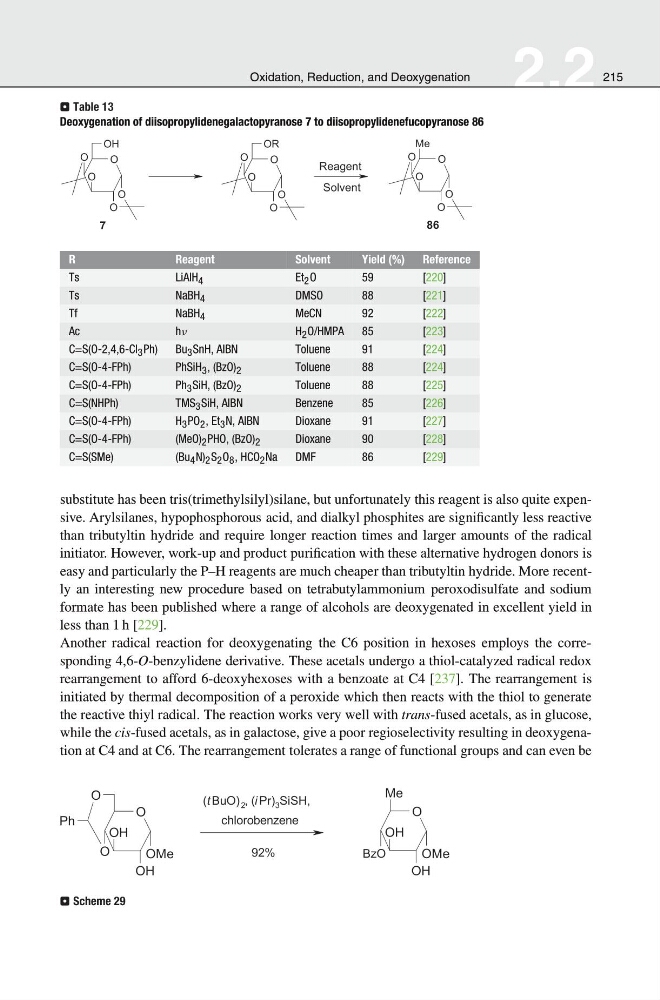
Another radical reaction for deoxygenating the C6 position in hexoses employs the corresponding 4,6-O-benzylidene derivative. These acetals undergo a thiol-catalyzed radical redox
rearrangement to afford 6-deoxyhexoses with a benzoate at C4 [237]. The rearrangement is
initiated by thermal decomposition of a peroxide which then reacts with the thiol to generate
the reactive thiyl radical. The reaction works very well with trans-fused acetals, as in glucose,
while the cis-fused acetals, as in galactose, give a poor regioselectivity resulting in deoxygenation at C4 and at C6. The rearrangement tolerates a range of functional groups and can even be
⊡ Scheme 29
2.2
215
⊡ Table 13
Deoxygenation of diisopropylidenegalactopyranose 7 to diisopropylidenefucopyranose 86
R
Reagent
Solvent
Yield (%) Reference
Ts
LiAlH 4
Et 2 O
59
[220]
Ts
NaBH 4
DMSO
88
[221]
Tf
NaBH 4
MeCN
92
[222]
Ac
hν
H 2 O/HMPA
85
[223]
C=S(O-2,4,6-Cl 3 Ph) Bu 3 SnH, AIBN
Toluene
91
[224]
C=S(O-4-FPh)
PhSiH 3 , (BzO) 2
Toluene
88
[224]
C=S(O-4-FPh)
Ph 3 SiH, (BzO) 2
Toluene
88
[225]
C=S(NHPh)
TMS 3 SiH, AIBN
Benzene
85
[226]
C=S(O-4-FPh)
H 3 PO 2 , Et 3 N, AIBN
Dioxane
91
[227]
C=S(O-4-FPh)
(MeO) 2 PHO, (BzO) 2
Dioxane
90
[228]
C=S(SMe)
(Bu 4 N) 2 S 2 O 8 , HCO 2 Na DMF
86
[229]
substitute has been tris(trimethylsilyl)silane, but unfortunately this reagent is also quite expensive. Arylsilanes, hypophosphorous acid, and dialkyl phosphites are significantly less reactive
than tributyltin hydride and require longer reaction times and larger amounts of the radical
initiator. However, work-up and product purification with these alternative hydrogen donors is
easy and particularly the P–H reagents are much cheaper than tributyltin hydride. More recently an interesting new procedure based on tetrabutylammonium peroxodisulfate and sodium
formate has been published where a range of alcohols are deoxygenated in excellent yield in
less than 1 h [229].
Another radical reaction for deoxygenating the C6 position in hexoses employs the corresponding 4,6-O-benzylidene derivative. These acetals undergo a thiol-catalyzed radical redox
rearrangement to afford 6-deoxyhexoses with a benzoate at C4 [237]. The rearrangement is
initiated by thermal decomposition of a peroxide which then reacts with the thiol to generate
the reactive thiyl radical. The reaction works very well with trans-fused acetals, as in glucose,
while the cis-fused acetals, as in galactose, give a poor regioselectivity resulting in deoxygenation at C4 and at C6. The rearrangement tolerates a range of functional groups and can even be
⊡ Scheme 29