

210
2
General Synthetic Methods
be used to remove traces of sulfur impurities prior to the hydrogenation. Raney nickel can also
be used on its own as a hydrogenation catalyst although it is less reactive than the noble metals
and more catalyst is required [191].
Hydrogenation over noble metals is usually performed at room temperature and at 1–3 atmospheres of hydrogen. The progress of the reaction can be monitored by measuring the hydrogen uptake. Methanol, ethanol, or ethyl acetate are normally the solvents of choice. Catalytic
hydrogenation is sensitive to the steric environment around the olefin, but less sensitive to
electronic factors. The hydrogenation generally occurs from the sterically less demanding face
of the olefin [154].
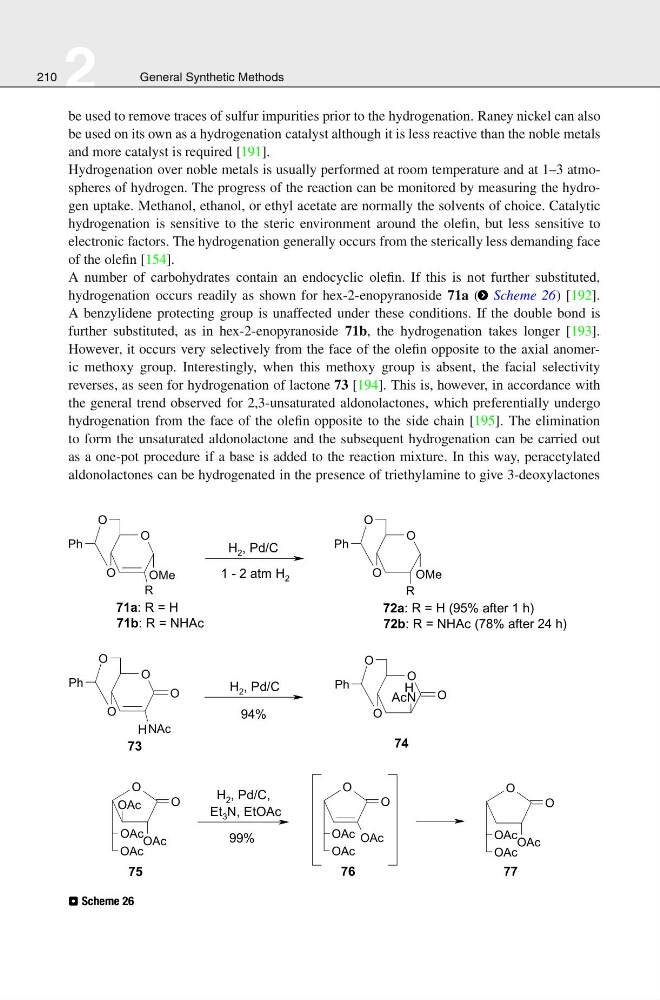
A number of carbohydrates contain an endocyclic olefin. If this is not further substituted,
hydrogenation occurs readily as shown for hex-2-enopyranoside 71a ( > Scheme 26) [192].
A benzylidene protecting group is unaffected under these conditions. If the double bond is
further substituted, as in hex-2-enopyranoside 71b, the hydrogenation takes longer [193].
However, it occurs very selectively from the face of the olefin opposite to the axial anomeric methoxy group. Interestingly, when this methoxy group is absent, the facial selectivity
reverses, as seen for hydrogenation of lactone 73 [194]. This is, however, in accordance with
the general trend observed for 2,3-unsaturated aldonolactones, which preferentially undergo
hydrogenation from the face of the olefin opposite to the side chain [195]. The elimination
to form the unsaturated aldonolactone and the subsequent hydrogenation can be carried out
as a one-pot procedure if a base is added to the reaction mixture. In this way, peracetylated
aldonolactones can be hydrogenated in the presence of triethylamine to give 3-deoxylactones
⊡ Scheme 26
2
General Synthetic Methods
be used to remove traces of sulfur impurities prior to the hydrogenation. Raney nickel can also
be used on its own as a hydrogenation catalyst although it is less reactive than the noble metals
and more catalyst is required [191].
Hydrogenation over noble metals is usually performed at room temperature and at 1–3 atmospheres of hydrogen. The progress of the reaction can be monitored by measuring the hydrogen uptake. Methanol, ethanol, or ethyl acetate are normally the solvents of choice. Catalytic
hydrogenation is sensitive to the steric environment around the olefin, but less sensitive to
electronic factors. The hydrogenation generally occurs from the sterically less demanding face
of the olefin [154].
A number of carbohydrates contain an endocyclic olefin. If this is not further substituted,
hydrogenation occurs readily as shown for hex-2-enopyranoside 71a ( > Scheme 26) [192].
A benzylidene protecting group is unaffected under these conditions. If the double bond is
further substituted, as in hex-2-enopyranoside 71b, the hydrogenation takes longer [193].
However, it occurs very selectively from the face of the olefin opposite to the axial anomeric methoxy group. Interestingly, when this methoxy group is absent, the facial selectivity
reverses, as seen for hydrogenation of lactone 73 [194]. This is, however, in accordance with
the general trend observed for 2,3-unsaturated aldonolactones, which preferentially undergo
hydrogenation from the face of the olefin opposite to the side chain [195]. The elimination
to form the unsaturated aldonolactone and the subsequent hydrogenation can be carried out
as a one-pot procedure if a base is added to the reaction mixture. In this way, peracetylated
aldonolactones can be hydrogenated in the presence of triethylamine to give 3-deoxylactones
⊡ Scheme 26