

Oxidation, Reduction, and Deoxygenation
2.2
211
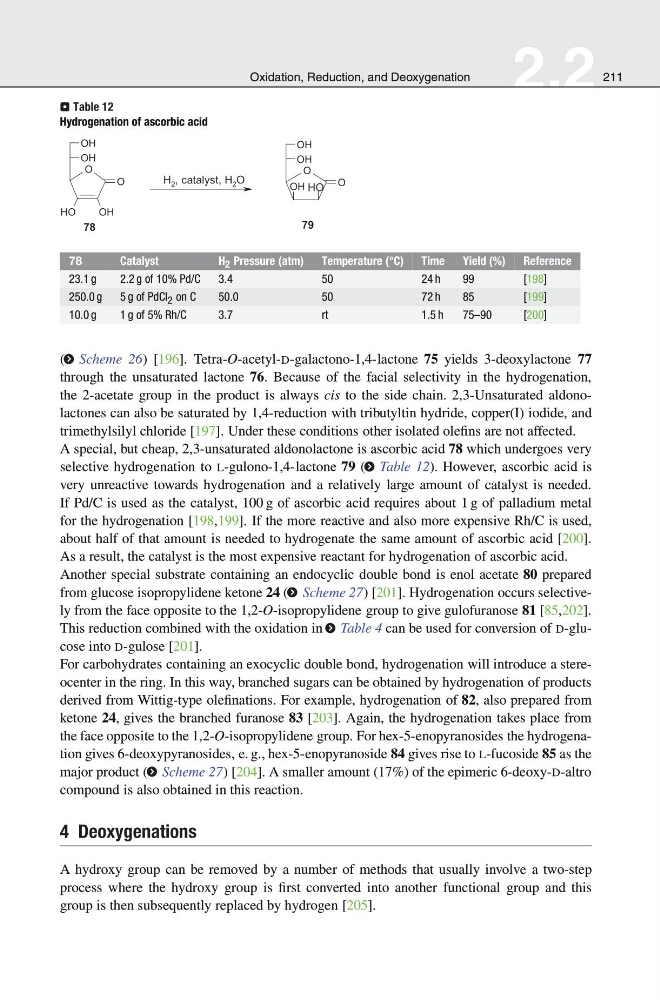
⊡ Table 12
Hydrogenation of ascorbic acid
78
Catalyst
H 2 Pressure (atm) Temperature (°C) Time
Yield (%) Reference
23.1 g
2.2 g of 10% Pd/C 3.4
50
24 h
99
[198]
250.0 g 5 g of PdCl 2 on C
50.0
50
72 h
85
[199]
10.0 g
1 g of 5% Rh/C
3.7
rt
1.5 h
75–90
[200]
( > Scheme 26) [196]. Tetra-O-acetyl-D-galactono-1,4-lactone 75 yields 3-deoxylactone 77
through the unsaturated lactone 76. Because of the facial selectivity in the hydrogenation,
the 2-acetate group in the product is always cis to the side chain. 2,3-Unsaturated aldonolactones can also be saturated by 1,4-reduction with tributyltin hydride, copper(I) iodide, and
trimethylsilyl chloride [197]. Under these conditions other isolated olefins are not affected.
A special, but cheap, 2,3-unsaturated aldonolactone is ascorbic acid 78 which undergoes very
selective hydrogenation to L-gulono-1,4-lactone 79 ( > Table 12). However, ascorbic acid is
very unreactive towards hydrogenation and a relatively large amount of catalyst is needed.
If Pd/C is used as the catalyst, 100 g of ascorbic acid requires about 1 g of palladium metal
for the hydrogenation [198,199]. If the more reactive and also more expensive Rh/C is used,
about half of that amount is needed to hydrogenate the same amount of ascorbic acid [200].
As a result, the catalyst is the most expensive reactant for hydrogenation of ascorbic acid.
Another special substrate containing an endocyclic double bond is enol acetate 80 prepared
from glucose isopropylidene ketone 24 ( > Scheme 27) [201]. Hydrogenation occurs selectively from the face opposite to the 1,2-O-isopropylidene group to give gulofuranose 81 [85,202].
This reduction combined with the oxidation in > Table 4 can be used for conversion of D-glucose into D-gulose [201].
For carbohydrates containing an exocyclic double bond, hydrogenation will introduce a stereocenter in the ring. In this way, branched sugars can be obtained by hydrogenation of products
derived from Wittig-type olefinations. For example, hydrogenation of 82, also prepared from
ketone 24, gives the branched furanose 83 [203]. Again, the hydrogenation takes place from
the face opposite to the 1,2-O-isopropylidene group. For hex-5-enopyranosides the hydrogenation gives 6-deoxypyranosides, e. g., hex-5-enopyranoside 84 gives rise to L-fucoside 85 as the
major product ( > Scheme 27) [204]. A smaller amount (17%) of the epimeric 6-deoxy-D-altro
compound is also obtained in this reaction.
4 Deoxygenations
A hydroxy group can be removed by a number of methods that usually involve a two-step
process where the hydroxy group is first converted into another functional group and this
group is then subsequently replaced by hydrogen [205].
2.2
211
⊡ Table 12
Hydrogenation of ascorbic acid
78
Catalyst
H 2 Pressure (atm) Temperature (°C) Time
Yield (%) Reference
23.1 g
2.2 g of 10% Pd/C 3.4
50
24 h
99
[198]
250.0 g 5 g of PdCl 2 on C
50.0
50
72 h
85
[199]
10.0 g
1 g of 5% Rh/C
3.7
rt
1.5 h
75–90
[200]
( > Scheme 26) [196]. Tetra-O-acetyl-D-galactono-1,4-lactone 75 yields 3-deoxylactone 77
through the unsaturated lactone 76. Because of the facial selectivity in the hydrogenation,
the 2-acetate group in the product is always cis to the side chain. 2,3-Unsaturated aldonolactones can also be saturated by 1,4-reduction with tributyltin hydride, copper(I) iodide, and
trimethylsilyl chloride [197]. Under these conditions other isolated olefins are not affected.
A special, but cheap, 2,3-unsaturated aldonolactone is ascorbic acid 78 which undergoes very
selective hydrogenation to L-gulono-1,4-lactone 79 ( > Table 12). However, ascorbic acid is
very unreactive towards hydrogenation and a relatively large amount of catalyst is needed.
If Pd/C is used as the catalyst, 100 g of ascorbic acid requires about 1 g of palladium metal
for the hydrogenation [198,199]. If the more reactive and also more expensive Rh/C is used,
about half of that amount is needed to hydrogenate the same amount of ascorbic acid [200].
As a result, the catalyst is the most expensive reactant for hydrogenation of ascorbic acid.
Another special substrate containing an endocyclic double bond is enol acetate 80 prepared
from glucose isopropylidene ketone 24 ( > Scheme 27) [201]. Hydrogenation occurs selectively from the face opposite to the 1,2-O-isopropylidene group to give gulofuranose 81 [85,202].
This reduction combined with the oxidation in > Table 4 can be used for conversion of D-glucose into D-gulose [201].
For carbohydrates containing an exocyclic double bond, hydrogenation will introduce a stereocenter in the ring. In this way, branched sugars can be obtained by hydrogenation of products
derived from Wittig-type olefinations. For example, hydrogenation of 82, also prepared from
ketone 24, gives the branched furanose 83 [203]. Again, the hydrogenation takes place from
the face opposite to the 1,2-O-isopropylidene group. For hex-5-enopyranosides the hydrogenation gives 6-deoxypyranosides, e. g., hex-5-enopyranoside 84 gives rise to L-fucoside 85 as the
major product ( > Scheme 27) [204]. A smaller amount (17%) of the epimeric 6-deoxy-D-altro
compound is also obtained in this reaction.
4 Deoxygenations
A hydroxy group can be removed by a number of methods that usually involve a two-step
process where the hydroxy group is first converted into another functional group and this
group is then subsequently replaced by hydrogen [205].