

Oxidation, Reduction, and Deoxygenation
2.2
209
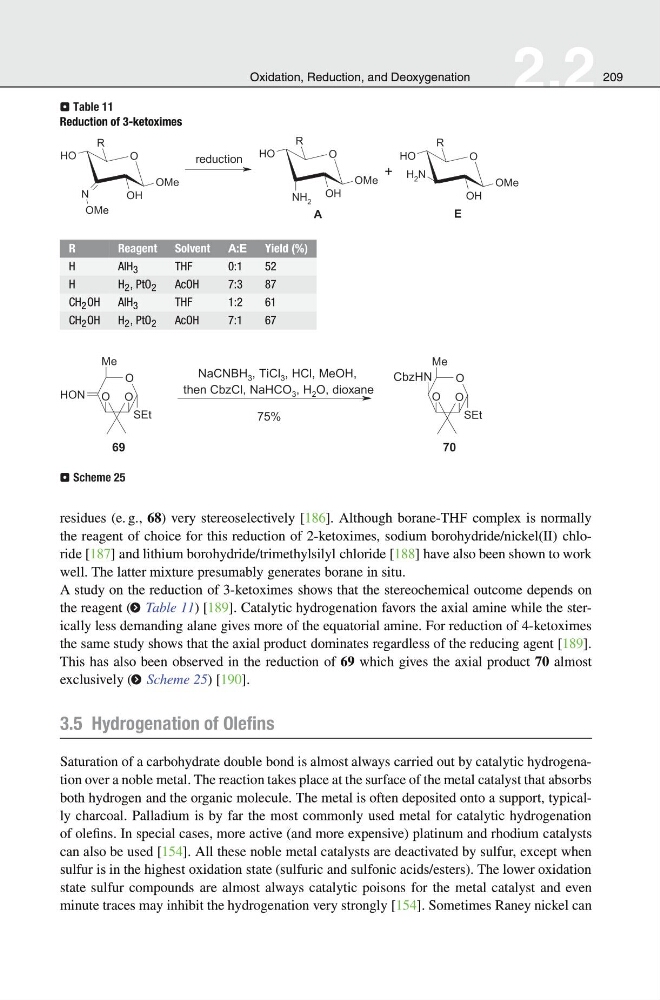
⊡ Table 11
Reduction of 3-ketoximes
R
Reagent Solvent
A:E
Yield (%)
H
AlH 3
THF
0:1
52
H
H 2 , PtO 2
AcOH
7:3
87
CH 2 OH AlH 3
THF
1:2
61
CH 2 OH H 2 , PtO 2
AcOH
7:1
67
⊡ Scheme 25
residues (e. g., 68) very stereoselectively [186]. Although borane-THF complex is normally
the reagent of choice for this reduction of 2-ketoximes, sodium borohydride/nickel(II) chloride [187] and lithium borohydride/trimethylsilyl chloride [188] have also been shown to work
well. The latter mixture presumably generates borane in situ.
A study on the reduction of 3-ketoximes shows that the stereochemical outcome depends on
the reagent ( > Table 11) [189]. Catalytic hydrogenation favors the axial amine while the sterically less demanding alane gives more of the equatorial amine. For reduction of 4-ketoximes
the same study shows that the axial product dominates regardless of the reducing agent [189].
This has also been observed in the reduction of 69 which gives the axial product 70 almost
exclusively ( > Scheme 25) [190].
3.5 Hydrogenation of Olefins
Saturation of a carbohydrate double bond is almost always carried out by catalytic hydrogenation over a noble metal. The reaction takes place at the surface of the metal catalyst that absorbs
both hydrogen and the organic molecule. The metal is often deposited onto a support, typically charcoal. Palladium is by far the most commonly used metal for catalytic hydrogenation
of olefins. In special cases, more active (and more expensive) platinum and rhodium catalysts
can also be used [154]. All these noble metal catalysts are deactivated by sulfur, except when
sulfur is in the highest oxidation state (sulfuric and sulfonic acids/esters). The lower oxidation
state sulfur compounds are almost always catalytic poisons for the metal catalyst and even
minute traces may inhibit the hydrogenation very strongly [154]. Sometimes Raney nickel can
2.2
209
⊡ Table 11
Reduction of 3-ketoximes
R
Reagent Solvent
A:E
Yield (%)
H
AlH 3
THF
0:1
52
H
H 2 , PtO 2
AcOH
7:3
87
CH 2 OH AlH 3
THF
1:2
61
CH 2 OH H 2 , PtO 2
AcOH
7:1
67
⊡ Scheme 25
residues (e. g., 68) very stereoselectively [186]. Although borane-THF complex is normally
the reagent of choice for this reduction of 2-ketoximes, sodium borohydride/nickel(II) chloride [187] and lithium borohydride/trimethylsilyl chloride [188] have also been shown to work
well. The latter mixture presumably generates borane in situ.
A study on the reduction of 3-ketoximes shows that the stereochemical outcome depends on
the reagent ( > Table 11) [189]. Catalytic hydrogenation favors the axial amine while the sterically less demanding alane gives more of the equatorial amine. For reduction of 4-ketoximes
the same study shows that the axial product dominates regardless of the reducing agent [189].
This has also been observed in the reduction of 69 which gives the axial product 70 almost
exclusively ( > Scheme 25) [190].
3.5 Hydrogenation of Olefins
Saturation of a carbohydrate double bond is almost always carried out by catalytic hydrogenation over a noble metal. The reaction takes place at the surface of the metal catalyst that absorbs
both hydrogen and the organic molecule. The metal is often deposited onto a support, typically charcoal. Palladium is by far the most commonly used metal for catalytic hydrogenation
of olefins. In special cases, more active (and more expensive) platinum and rhodium catalysts
can also be used [154]. All these noble metal catalysts are deactivated by sulfur, except when
sulfur is in the highest oxidation state (sulfuric and sulfonic acids/esters). The lower oxidation
state sulfur compounds are almost always catalytic poisons for the metal catalyst and even
minute traces may inhibit the hydrogenation very strongly [154]. Sometimes Raney nickel can