

206
2
General Synthetic Methods
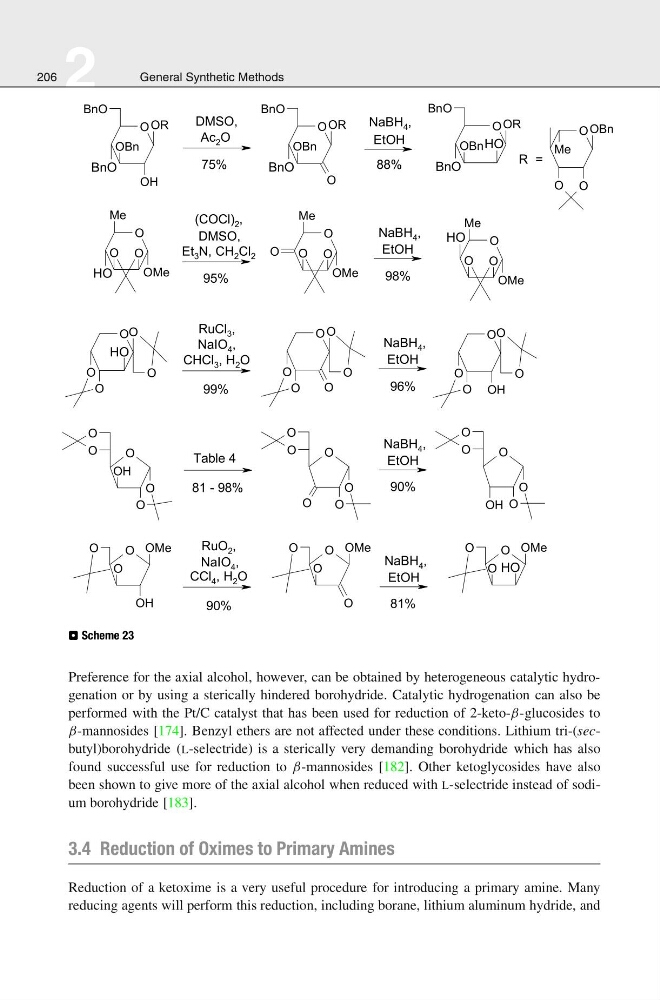
⊡ Scheme 23
Preference for the axial alcohol, however, can be obtained by heterogeneous catalytic hydrogenation or by using a sterically hindered borohydride. Catalytic hydrogenation can also be
performed with the Pt/C catalyst that has been used for reduction of 2-keto-β-glucosides to
β-mannosides [174]. Benzyl ethers are not affected under these conditions. Lithium tri-(secbutyl)borohydride (L-selectride) is a sterically very demanding borohydride which has also
found successful use for reduction to β-mannosides [182]. Other ketoglycosides have also
been shown to give more of the axial alcohol when reduced with L-selectride instead of sodium borohydride [183].
3.4 Reduction of Oximes to Primary Amines
Reduction of a ketoxime is a very useful procedure for introducing a primary amine. Many
reducing agents will perform this reduction, including borane, lithium aluminum hydride, and
2
General Synthetic Methods
⊡ Scheme 23
Preference for the axial alcohol, however, can be obtained by heterogeneous catalytic hydrogenation or by using a sterically hindered borohydride. Catalytic hydrogenation can also be
performed with the Pt/C catalyst that has been used for reduction of 2-keto-β-glucosides to
β-mannosides [174]. Benzyl ethers are not affected under these conditions. Lithium tri-(secbutyl)borohydride (L-selectride) is a sterically very demanding borohydride which has also
found successful use for reduction to β-mannosides [182]. Other ketoglycosides have also
been shown to give more of the axial alcohol when reduced with L-selectride instead of sodium borohydride [183].
3.4 Reduction of Oximes to Primary Amines
Reduction of a ketoxime is a very useful procedure for introducing a primary amine. Many
reducing agents will perform this reduction, including borane, lithium aluminum hydride, and